The best workout apps in 2026 aren't one app. They're twelve different tools built for twelve different jobs, and the one that's "best" depends entirely on what you're trying to do. We put real workouts through all twelve, compared how each one actually feels to use mid-set, and checked every price against the app's own pricing page this week, not a two year old review that's since gone stale.
If you just want the short version: Hevy is the best free logger, Fitbod is the best at building your program for you, Caliber is the best if you want a real human coach, and Kontest (that's us, full disclosure) is the best if you want your training to feel like a competition instead of a chore. None of them is the single best workout app for everyone. A powerlifter running a 12 week peaking block, a beginner who just wants to stop guessing what to do at the gym, and someone training for a friend's wedding in six months all need different things from the app on their phone.
Here's the full breakdown, category by category, with what each app is missing so you're not surprised later.
How We Ranked These Apps
We used a simple bar for this best workout apps list: does it make you stronger, does it respect your time, and is the price worth what you actually get for it. We prioritized apps built for lifting first, since that's who this list is for, then filled in the cardio and nutrition tools that lifters end up using alongside their training anyway.
A few things we specifically checked for: how fast you can log a set without fighting the interface, whether the free tier is real training or a seven day trial dressed up as free, whether pricing is transparent on the page or buried behind a "contact us" form, and whether the app is honest about what it doesn't do. Apps lost points for vague marketing and gained points for a free tier you could train on indefinitely. We also noted platform support, since an app that's excellent on iOS but clunky on Android, or missing an Apple Watch app entirely, isn't equally "best" for everyone reading this.
Every price below is what the app charges as of this week; subscription pricing moves often, and most of these apps run regional pricing and periodic sales on top of their list price, so treat these numbers as a strong starting point and confirm on the app's own page before you buy.
Quick Comparison: Price, Platform, Best For
| App | Price | Platform | Best For |
|---|---|---|---|
| Hevy | Free / Pro $2.99/mo, $23.99/yr, or $74.99 lifetime | iOS, Android, Web | Free workout logging |
| Strong | Free / Pro $4.99/mo, $29.99/yr, or $99.99 lifetime | iOS, Android, Apple Watch | Apple Watch lifters |
| Fitbod | Free trial / $15.99/mo or $95.99/yr | iOS, Android | Auto-generated programming |
| Boostcamp | Free / Pro $14.99/mo or $59.99/yr | iOS, Android | Program library |
| Jefit | Free / Elite $12.99/mo or $69.99/yr | iOS, Android, Web | Exercise library and community |
| StrongLifts 5x5 | Free trial / Pro $11.99/mo or $59.99/yr | iOS, Android | Beginners running one program |
| Caliber | Free (self-guided) / Pro ~$19/mo, Premium from $200/mo | iOS, Android | Human coaching |
| Kontest | Free, Pro coming soon | iOS, Android | Training with friends |
| Strava | Free / ~$6.67/mo billed annually | iOS, Android, Web | Running and cycling |
| Peloton App | Free trial / App One ~$15.99/mo, App+ ~$28.99/mo | iOS, Android | Guided class variety |
| MyFitnessPal | Free / Premium $19.99/mo or $79.99/yr | iOS, Android, Web | Nutrition tracking |
| Nike Training Club | Free | iOS, Android | Free bodyweight workouts |
The 12 Best Workout Apps, Ranked
Here's each app broken down: what it's genuinely best at, what it's missing, and what it costs. A few of these (Strava, MyFitnessPal) are really the best fitness app for their category rather than a lifting tool, but they made the cut because lifters use them constantly alongside their training. None of these are ranked to make Kontest look bigger than it is. We tell you exactly where it fits and where it doesn't.
1. Hevy: Best Free Workout Tracker App
Hevy is the cleanest way to log a lift and get out of the app. Pick an exercise, enter your sets, and it auto-fills your last weight so you're not retyping the same numbers every session. It tracks routines, personal records, and muscle group volume, and the free tier is genuinely usable long term, not a trial dressed up as free: four routines, seven custom exercises, and three months of history, which is enough for most lifters to decide if they want more. It's also built more like a social app than most competitors, with a feed where you can see and react to friends' workouts if you choose to. What it lacks: no real programming intelligence. It logs what you tell it to do, it doesn't decide what you should do next. Pro removes the routine and history caps and adds a warm up calculator, at $2.99/month, $23.99/year (about $2 a month), or $74.99 as a one-time lifetime purchase.
2. Strong: Best for Apple Watch Lifters
Strong does one thing and does it well: fast set logging, especially from your wrist. If you lift with your phone in a locker and your watch on your arm, this is the smoothest way to log a set without breaking your rest timer. The free version already supports unlimited workout logging and Apple Watch access; Pro ($4.99/mo, $29.99/yr, or $99.99 once for life) mainly unlocks unlimited custom routines beyond the free tier's three. What it lacks: minimal social features and no auto-programming, so you're building your own plan or importing one, not having Strong build it for you.
3. Fitbod: Best AI Auto-Programming
Fitbod builds your workout for you based on your available equipment, your recent training, and which muscles you haven't hit in a while. For someone who doesn't want to think about programming, or who trains at a hotel gym one week and a full rack the next, that adaptability is real value, and it adjusts the next session based on what you actually logged, not just what it originally planned. What it lacks: it can suggest odd exercise substitutions when your gym is missing a specific machine, and at $15.99/month (or $95.99/year, about $8/month) it's one of the pricier apps on this list for what's still fundamentally a logging-plus-suggestions tool, not a coach.
4. Boostcamp: Best Program Library
Boostcamp's pitch is simple: over 11,000 real, structured programs (5/3/1 variants, PPL splits, powerlifting blocks, bodybuilding splits) built into a free tracker with RPE logging, personal records, and a year end recap. If you already know the program you want to run but don't want to build the spreadsheet yourself, this is the fastest way to start. What it lacks: the free tier's custom program builder is capped, and Pro ($14.99/mo or $59.99/yr) is really aimed at intermediate lifters who want per-muscle volume heatmaps and a Strength Score, not beginners just looking for a program to follow.
5. Jefit: Best Exercise Library and Community
Jefit's exercise library is enormous, over 1,400 exercises with video demos for nearly all of them, and its community features (sharing routines, following other lifters, comparing progress) go further than most trackers bother with. It's a good pick if you like browsing for new movements and want some social proof you're doing them correctly, and it's been around long enough that its exercise database rarely has gaps. What it lacks: the interface feels busier than Hevy or Strong, and the video demos plus an ad-free experience sit behind Elite ($12.99/mo or $69.99/yr, with the free Basic tier still covering the full exercise library and logging).
6. StrongLifts 5x5: Best Single Beginner Program
StrongLifts 5x5 isn't a general tracker, it's one specific novice barbell program (squat, bench, row, overhead press, deadlift) turned into an app: add weight every session until you can't, then deload and build back up. If you're brand new to barbell training and want zero decisions to make, this removes all of them, right down to telling you exactly what weight to load next. What it lacks: everything outside 5x5. Once you outgrow linear progression, which most lifters do within a few months, you'll need a different app for whatever comes next. It runs $11.99/mo or $59.99/yr, with a lifetime option around $199.99.
7. Caliber: Best Human Coaching
Caliber connects you to a certified coach who builds your program, reviews your lifts on video, and adjusts your plan based on how training actually goes week to week, not just what an algorithm predicts. You get asynchronous video check-ins, daily messaging with your coach, and either weekly or monthly strategy calls depending on your tier, plus access to certified nutrition coaches on top of the strength side. For lifters who've plateaued on self-guided apps, that human feedback loop is worth the price. What it lacks: it's genuinely expensive. Group coaching runs around $19/month, but one-on-one coaching starts around $200/month, which prices out a lot of casual lifters. There's also a free self-guided tier if you want the app without a coach attached.
8. Kontest: Best for Training With Friends
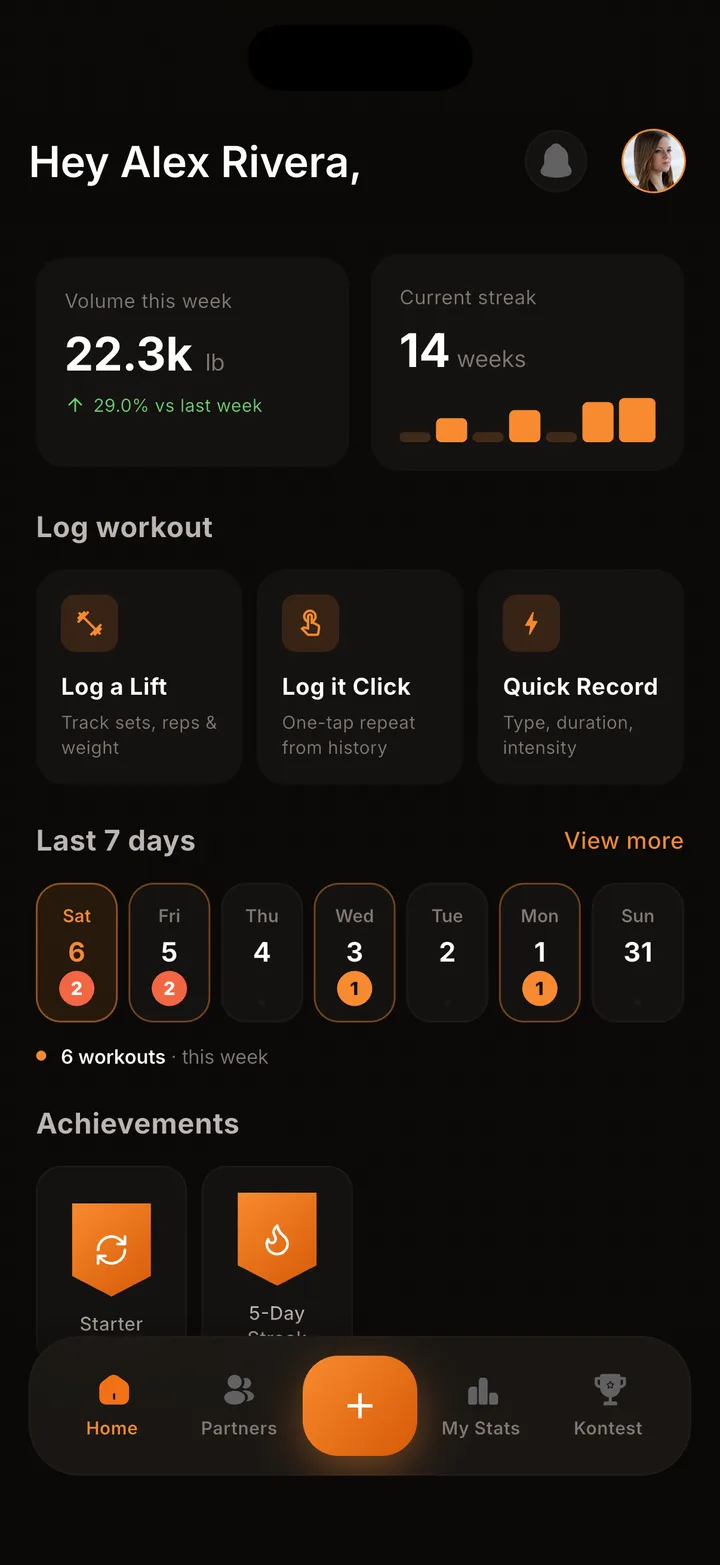
Kontest (this is our app, so take that into account) is built around a different question: what if training was more fun with stakes attached? You create or join a kontest, a head-to-head or group challenge with friends across reps, weight, distance, or streaks, and everyone's progress updates on a live leaderboard as you log sets. That competitive layer is the whole point: most of the apps on this list treat other people as an afterthought, a feed you can scroll, not something built into how you train.
You still get real training tools underneath it: workout logging, personal records, streaks, XP that climbs with every set, and USDA-backed food logging, so it's not competition bolted onto a weak tracker. What it lacks: it's built for training with people you know, so it's less useful if you lift alone and have no interest in a leaderboard, and if your whole friend group refuses to download a second fitness app, the competition side loses some of its pull. Free to start, no credit card required, with Pro plans on the way; see current plans on our pricing page.
9. Strava: Best for Runners and Cyclists
Strava is the default social network for cardio, and if any of your training involves running or riding, its segment leaderboards and route tools are unmatched. Free covers activity recording, the community feed, and basic route browsing. Subscribing (about $6.67/month billed annually) unlocks offline route saving, custom route drawing, deeper training analysis, and segment competition. It also offers a discounted family plan and a student rate if you're paying for it yourself. What it lacks: it's not built for lifting at all, so you'd pair it with a strength app for that side of training, not replace one with it.
10. Peloton App: Best Class Variety
You don't need Peloton hardware to use the Peloton App. It's a large library of instructor-led classes across strength, running, cycling, yoga, and more, no equipment required, which makes it a good fit if you want to be told what to do and how to move, not just what weight to lift. If you already own a Peloton Bike, Tread, or Row, class access is included in your equipment membership instead of the app tiers below. What it lacks: it's not a serious lift-tracking tool, and the standard App+ tier runs around $28.99/month, noticeably more than most dedicated strength apps on this list (App One, a lighter tier, runs closer to $15.99/month).
11. MyFitnessPal: Best Nutrition Tracking
No workout app on this list handles food the way MyFitnessPal does. Barcode scanning, a massive food database, meal photo logging, and macro tracking make it the standard nutrition companion to whatever you're using to track lifts. What it lacks: workout tracking is an afterthought here, it's a nutrition app first, and lift logging isn't a reason to choose it. Premium runs $19.99/month or $79.99/year and mainly unlocks ad-free logging and deeper reports; a higher Premium+ tier adds meal planning for $99.99/year. The free tier already covers core food logging.
12. Nike Training Club: Best Free Workouts
Nike Training Club is fully free, permanently (Nike made that call back in 2020 and never reversed it), and gives you guided bodyweight and light equipment workouts across strength, mobility, and conditioning. It's a solid option if you're traveling, don't have gym access, or want structured workouts with zero cost and zero setup. What it lacks: no barbell programming and no serious progressive overload tracking, so lifters chasing specific strength numbers will outgrow it fast.
Best Workout App by Goal
Build muscle: Fitbod if you want the app to program for you week to week, Boostcamp or Jefit if you'd rather follow a real structured program yourself.
Lose weight: Pair any strength app on this list with MyFitnessPal for food tracking. Training alone rarely outpaces a bad diet, and none of these apps will tell you that as directly as we just did.
Compete with friends: Kontest. This is the one category built specifically for it, everything else on this list treats your training as a solo activity with a social feed bolted on.
Run or ride: Strava, no contest. Segment leaderboards and route tools are the whole reason it exists.
Get told exactly what to do: Fitbod for auto-generated strength sessions, Peloton App if you'd rather follow a live instructor through the whole workout, not just the exercise list.
Train while traveling or without a gym: Nike Training Club. It's free, it's bodyweight and light equipment friendly, and it doesn't assume you have a barbell in a hotel room.
What No Workout App Fixes
Every app on this list can track your training. None of them can make you open it. The best workout apps in 2026 are genuinely good at logging, programming, and analyzing, but the actual hard part of training was never the spreadsheet, it's showing up on a Tuesday when you don't feel like it. That's the one problem software alone doesn't solve.
It's also why the apps built around accountability tend to outperform the ones that just sit there waiting for you to open them. A coach checking in on Caliber, a friend watching your streak on a Kontest leaderboard, a training partner who'll notice if you skip a week: that kind of pressure works better than a push notification, because a notification is easy to swipe away and a person isn't.
None of this means the app doesn't matter. A clunky logging flow is one more reason to skip a session, and a program that doesn't fit your schedule is one you'll quietly stop following. The app should make training easier, not add friction to a day that already has enough of it. It just shouldn't be the only thing keeping you consistent.
FAQ
What is the best free workout app? Hevy has the strongest free tier for serious lifters: unlimited logging with real routine and history limits that most people won't hit for months. Nike Training Club is the best free option if you want guided workouts instead of a blank logging screen, and Kontest and Boostcamp both offer real free tiers if you want either competition or a structured program without paying.
What is the best workout app for beginners? StrongLifts 5x5 removes every decision for someone brand new to barbell training: five lifts, one clear progression rule. If you'd rather have more flexibility from day one and aren't ready to commit to a single program, Hevy or Strong are simple enough to learn in one session and grow with you.
Do I need to pay for a workout app to see results? No. Several apps on this list, including Hevy's free tier, Boostcamp's free tier, Nike Training Club, and Kontest, cover real training without a subscription. Paid tiers mostly unlock analytics, program libraries, and convenience features, not the ability to get stronger, and no subscription can substitute for showing up. If you do decide to pay, most of the dedicated strength apps here land between $5 and $16 a month; coaching apps like Caliber cost more because you're paying for a person's time, not just software.
What is the best workout tracker app if I train with a partner? Kontest is built specifically for this: you and a training partner, or a whole group, compete inside a shared kontest with a live leaderboard, instead of just comparing screenshots of your logs after the fact.
Is Hevy or Strong better? They're closer than people expect. Hevy has a more generous free tier and a more modern interface; Strong has a slightly faster Apple Watch logging experience since that's been its focus for years. Either is a solid choice for straightforward lifting logs, and the honest answer is to try both free tiers for a week and see which one you actually open.
If you train with friends, start a kontest. First one is free.