A beginner workout plan only has one job: get you back in the gym next week. This one is three days a week, twelve weeks long, and built around exercises you can actually recover from, with full tables so you never have to guess what to do when you walk in.
If you've started and quit a program before, that's not a willpower problem. It's usually a plan problem: too many days, too much soreness, too little payoff in the first month. Fix the plan and the consistency mostly takes care of itself.
What a beginner workout plan actually needs (adherence over optimization)
Most beginner programs are written by people optimizing for the wrong thing. They chase the theoretically best split, the ideal rep range, the ".jpg-worthy" periodization scheme, when the actual limiting factor for almost every new lifter is showing up.
Adherence beats optimization for one simple reason: a mediocre program you run for 12 weeks straight beats a perfect program you quit in week three. Nobody has ever gotten strong from a workout they didn't do. The research on habit and behavior change points the same direction over and over: the programs that work long term are the ones that ask the least of you in the beginning, not the ones that ask the most.
That's the whole design philosophy behind this plan. Three days a week instead of five or six, because three is a schedule most people can actually protect. Simple, proven exercises instead of a rotating menu of variations, because repetition is what makes you competent at them. Clear numbers to hit each session, because ambiguity is what makes people skip a workout when they're tired.
This is not the most advanced program you'll ever run. It's the one you'll actually finish.
Why full body beats a split for your first 12 weeks
A lot of beginners default to a body-part split because that's what they see experienced lifters doing at the gym. It's the wrong move early on. A body part hit once a week gives you one shot every seven days to practice that movement and get feedback on your form. A full body session run three times a week gives you three shots at the same squat pattern, three shots at the same row, three chances to get a little more efficient before the week is even over.
That repetition is what turns an awkward, shaky first attempt at a goblet squat into something that looks and feels automatic by week four. Splits earn their place later, once you need more total weekly volume per muscle group than three full body sessions can reasonably deliver. That's a problem for month four or five, not week one.
The 12-week plan: phase 1 (weeks 1-4), phase 2 (5-8), phase 3 (9-12)
The plan runs three days a week on a Workout A / Workout B rotation, alternating so each workout lands roughly every four to five days: A, B, A one week, then B, A, B the next. Monday, Wednesday, Friday is the easiest schedule to protect, but any three non-consecutive days work.
Rest 2-3 minutes between the main lift and the second exercise on each day, and 60-90 seconds on everything after that. A session should run about 45-60 minutes once you're not fumbling with unfamiliar machines.
Phase 1: weeks 1-4 (learn the movements)
The only goal in phase 1 is competence. Weight is secondary. Every exercise here is chosen because it's forgiving to learn and low-risk to load up later.
Workout A
| Exercise | Sets | Reps | RPE |
|---|---|---|---|
| Goblet squat | 3 | 10-12 | 6-7 |
| Push-up (knees or incline if needed) | 3 | 8-12 | 6-7 |
| Dumbbell row | 3 | 10-12 | 6-7 |
| Plank | 3 | 20-30 sec | 6-7 |
Workout B
| Exercise | Sets | Reps | RPE |
|---|---|---|---|
| Dumbbell Romanian deadlift | 3 | 10-12 | 6-7 |
| Dumbbell shoulder press | 3 | 10-12 | 6-7 |
| Lat pulldown | 3 | 10-12 | 6-7 |
| Dead bug | 3 | 8/side | 6-7 |
RPE 6-7 means you're leaving 3-4 reps in the tank on every set. You should finish phase 1 feeling like you could've done more, not wrecked. That's on purpose. The goal is walking out the door still wanting to come back Wednesday.
Phase 2: weeks 5-8 (add load)
Once the movement patterns feel automatic, phase 2 swaps in barbell versions of the same patterns and asks for a little more effort per set.
Workout A
| Exercise | Sets | Reps | RPE |
|---|---|---|---|
| Barbell back squat | 4 | 8-10 | 7-8 |
| Barbell bench press | 3 | 8-10 | 7-8 |
| Seated cable row | 3 | 10-12 | 7-8 |
| Hanging knee raise | 3 | 10-12 | 7 |
Workout B
| Exercise | Sets | Reps | RPE |
|---|---|---|---|
| Barbell Romanian deadlift | 3 | 8-10 | 7-8 |
| Overhead press | 3 | 8-10 | 7-8 |
| Lat pulldown | 3 | 10-12 | 7-8 |
| Weighted plank | 3 | 30-40 sec | 7 |
RPE 7-8 means 2-3 reps left in the tank. If a lift feels like it's fighting you every session, drop the weight and rebuild, this phase is still about earning the load, not chasing a number.
Phase 3: weeks 9-12 (build real strength)
By phase 3 the movements should feel like yours. This is where the plan starts training strength directly: lower reps and higher intensity on the same core lifts you've been building since week one.
Workout A
| Exercise | Sets | Reps | RPE |
|---|---|---|---|
| Barbell back squat | 4 | 5-6 | 8 |
| Barbell bench press | 4 | 5-6 | 8 |
| Barbell row | 3 | 8-10 | 7-8 |
| Cable crunch | 3 | 10-12 | 7-8 |
Workout B
| Exercise | Sets | Reps | RPE |
|---|---|---|---|
| Barbell deadlift | 3 | 5 | 8 |
| Overhead press | 3 | 6-8 | 8 |
| Lat pulldown or assisted pull-up | 3 | 8-10 | 7-8 |
| Side plank | 3 | 20-30 sec/side | 7 |
RPE 8 means about 2 reps left. That's the intensity you'll live at for most of your lifting life once you're past the beginner phase, so week 9 is a reasonable place to start getting used to it.
If three days a week starts to feel easy well before week 12, our 3-day workout split breakdown covers how to structure a longer-term version of this same schedule once you've graduated out of pure beginner territory.
What to do when you miss a day
You will miss a day. A late meeting, a sick kid, a night you just don't have it in you, plan on it happening at least once in 12 weeks. When it does, don't try to make it up by doubling a workout or squeezing an extra session into the same week. Just pick the plan back up on the next scheduled day.
The A/B rotation is built to absorb this. Missing one Wednesday just means Friday's session shifts to whichever workout was next in the rotation, nothing gets skipped forever, it just moves. The only real mistake is treating one missed session as proof the plan isn't working and quitting the whole thing over it.
Exercise form basics with cues
You don't need perfect form on day one. You need form that's safe to add weight to. A few cues that cover most of what goes wrong for beginners:
Squat (goblet or barbell). Feet shoulder-width, toes slightly out. Push your knees out in the direction of your toes as you descend, don't let them cave in. Sit down and back like you're reaching for a chair, keep your chest up, and go as low as you can while keeping your heels flat on the floor.
Hinge (Romanian deadlift, deadlift). This is a hip movement, not a squat. Push your hips back first, keep a soft bend in the knees, and keep the bar or dumbbells close to your legs the whole way down. You should feel your hamstrings stretch, not your lower back.
Push (bench press, push-up, overhead press). Keep your shoulder blades pulled back and down, don't let them roll forward as the weight comes down. On bench press, tuck your elbows to about a 45-degree angle from your torso instead of flaring them straight out to the sides.
Pull (row, lat pulldown, pull-up). Lead with your elbow, not your hand. Think about pulling your elbow toward your back pocket, and pause briefly at the top of the movement so you're not just using momentum to swing the weight up.
Core (plank, dead bug, hanging knee raise). Brace like someone's about to poke you in the stomach. A plank isn't about how long you can hold a sagging hip position, it's about holding a straight line from shoulders to ankles for a shorter, cleaner set.
If any cue doesn't click from text alone, that's normal. Film yourself on your phone for a set and compare it to a form video for that exercise. It's the fastest way to catch what you can't feel yourself doing wrong.
How much weight to start with
Start lighter than your ego wants. On any new exercise, pick a weight where you're confident you could do 2-3 more reps than the set calls for. If you can't, it's too heavy. If the last rep of your first set feels easy, add weight next set.
For barbell lifts in phase 2, most beginners start the squat and deadlift pattern with just the empty bar (45 lb, or the smaller bar if your gym has one) and add 5-10 lb per session on the bar exercises once every set is completed with the reps prescribed. Bench press and overhead press usually need smaller jumps, 2.5-5 lb, since upper body pressing strength builds slower than leg and hip strength.
Don't chase a number you saw someone else lift. The right starting weight is whatever weight lets you complete every set with the form cues above intact. Everyone's starting point is different, and it says nothing about how strong you'll be in 12 weeks.
What to eat (the 80/20 version)
You don't need a meal plan to make this program work. You need three things, most of the time.
Enough protein. Most coaches land somewhere around 0.7-1 gram per pound of bodyweight as a practical target for anyone lifting regularly, it supports recovery without requiring you to obsess over exact numbers.
Mostly whole foods. Meals built around a protein source, a carb source, and vegetables or fruit cover the bases for most people, most of the time. That's the 80. The other 20 is whatever you actually enjoy eating, and it doesn't need to be justified.
Enough calories to fuel three sessions a week. Beginners chronically under-eating are one of the most common (and most fixable) reasons a plan on paper doesn't turn into progress in the gym. If you're new to lifting and trying to lose fat at the same time, a small deficit still works, just don't stack it with a brand new training program and expect every session to feel good.
If you want to actually track what you're eating instead of estimating, Kontest logs meals with USDA-backed nutrition data, so you can see protein and calories next to the workouts you're logging in the same place.
Sleep and water do more heavy lifting than most beginner nutrition advice admits. Under-slept and under-hydrated, the exact same training plan feels harder, the exact same weights feel heavier, and the exact same workouts leave you sorer for longer. Fix those two things before you touch a supplement aisle.
How to know it is working (strength PRs, not the scale)
The scale is a lagging, noisy indicator for a beginner. Water, sodium, and how much you ate the night before will move it more than 12 weeks of consistent training will, especially in the first month.
Your working weights are the real signal. If you started phase 1 doing goblet squats with a 20 lb dumbbell and you're finishing phase 3 back squatting the bar plus 60 lb for the same number of reps, that's not a maybe, that's proof the plan worked. Every session where you complete all your prescribed sets and reps at the top of the range is a small PR, and those compound fast over 12 weeks even if the scale barely moves.
Log every session. Not from memory two days later, in the moment, weight and reps for every set. Without that log you're guessing whether last week was actually easier than this week, and guessing is how people quietly stall out without noticing for months.
The single biggest predictor of sticking with it
Programming matters. Form matters. But the single biggest predictor of whether a beginner is still training in month four isn't the program, it's whether someone else is expecting them to show up.
Training with another person, even just one, changes the calculus on a bad-mood Tuesday. Skipping a solo workout costs you nothing but progress. Skipping on a friend costs you a conversation. That small bit of social friction is often the entire difference between a program that gets finished and one that quietly dies in week three.
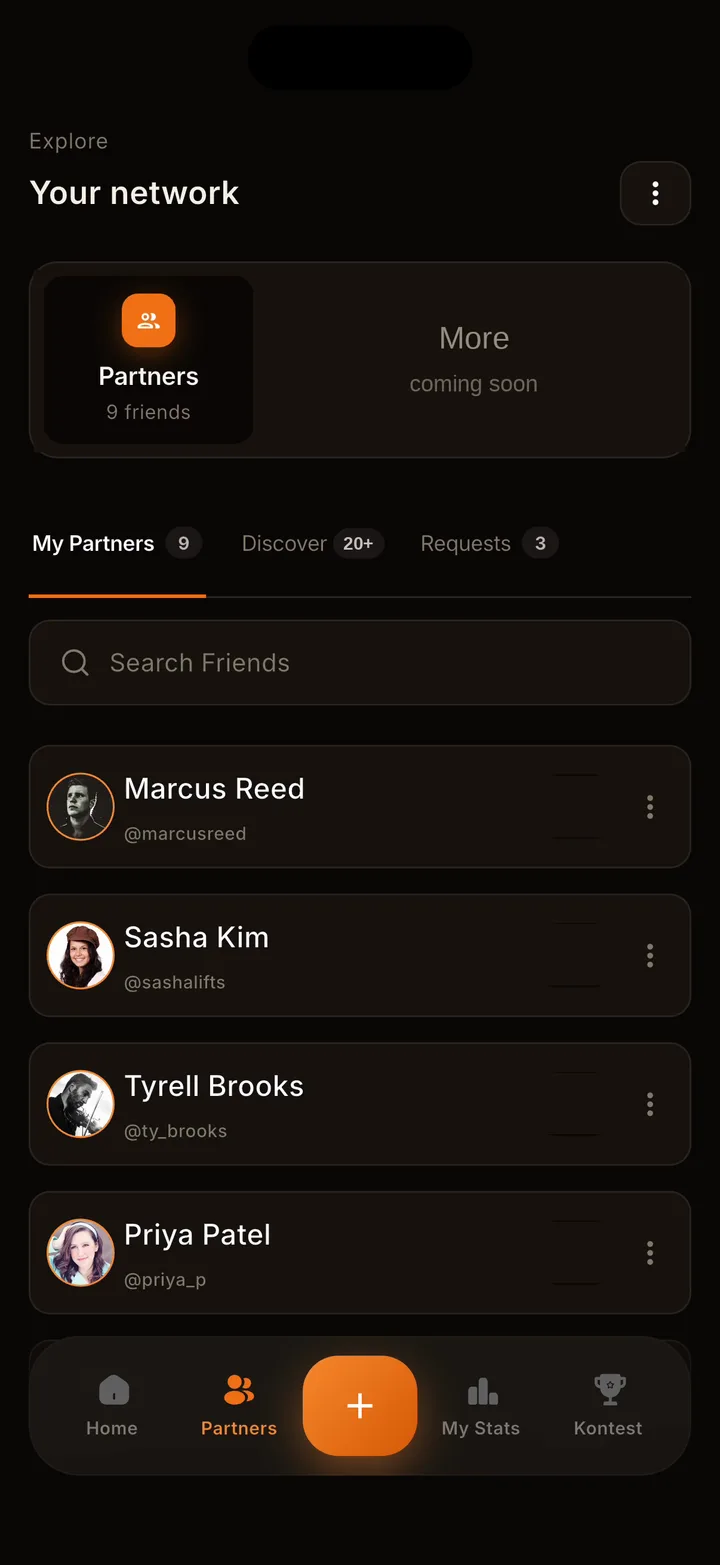
That's the whole idea behind Kontest. Create a kontest with whoever you're starting this plan with, log every Workout A and Workout B as you complete it, and build a streak the two of you can see. Kontest tracks your sessions, your PRs, and your streak automatically, and turns them into a head-to-head leaderboard, so showing up isn't just something you promised yourself, it's something your friend can see you did (or didn't) do. XP is positive-only, so a missed session doesn't tank your score, it just means there's more ground to make up next week.
Do the 12 weeks with a friend. Set up a kontest and make quitting expensive.
FAQ
Is a 3-day beginner workout plan enough to build muscle and strength? Yes. Three full-body sessions a week hits every major muscle group with enough frequency to drive real progress for a beginner, and it's a schedule most people can sustain far longer than a 5 or 6-day split. More days help eventually, but they're not necessary to get strong in your first 12 weeks.
What is the best beginner workout routine, full body or a split? Full body wins for beginners specifically because it repeats each movement pattern more often per week, which is what builds skill fastest early on. Splits make more sense once you're advanced enough to need higher weekly volume per muscle group than 2-3 full body sessions can provide.
How do I use a workout planner if I'm brand new to the gym? Pick a plan with a fixed number of sessions per week and specific sets, reps, and exercises for each one, like the tables above, then log every session as you complete it. A workout planner is only useful if you actually follow what it tells you to do and track whether you did it.
Is a 30 day workout plan long enough to see results? You'll likely notice better form, easier warm-ups, and a little more weight on the bar within 30 days, but meaningful strength gains for a true beginner usually need the full 12 weeks this plan is built around. Treat the first 30 days as proof you can stick with it, not a finish line.
How many rest days do beginners need between workouts? At least one day between sessions that hit the same muscles, which is why this plan runs Monday, Wednesday, Friday instead of three days in a row. Full recovery matters more than a beginner's ego usually wants to admit, since most of the actual strength adaptation happens on the rest days, not during the workout itself.
Do I need a gym for this plan, or can I run it at home? The phase 1 exercises only need a pair of dumbbells, so a well-equipped home setup can get you through the first four weeks. Phase 2 and phase 3 lean on a barbell and rack for squats, bench, and deadlifts, which is where most home setups run out of equipment and a gym membership starts to pay for itself.
Twelve weeks from now you won't be an advanced lifter, and that's fine, that was never the goal. This beginner workout plan was built to teach one skill that makes every program after it work: showing up on the days you didn't feel like it. Run the three phases in order, log every session, and find someone to do it with you.