Most lifters do best with 4 to 6 exercises per workout. That number moves up if you train full body and down if you run a tighter split, but it rarely needs to go past 8. More exercises past that point usually just means more fatigue for the same result.
Here is where that number comes from, and how to adjust how many exercises per workout you do based on your goal, your training age, and how many days a week you actually show up.
The short answer
Four to six exercises per session covers the muscle groups you are training that day without piling on junk volume. A full body day usually sits at the higher end (6 to 8) since you are hitting more muscle groups in one sitting. A split day (push, pull, legs, upper, lower) sits lower (4 to 6) since you are only training one or two muscle groups deeply.
The number itself matters less than what it is built from: enough hard sets per muscle group, spread across enough exercises to hit a muscle from a couple of angles, without so many that your last few sets are garbage.
Why more exercises is not more gains (junk volume)
Adding exercises feels productive. It is not automatically productive.
Research on training volume consistently finds a point where more sets stop producing more muscle. A 2025 meta-analysis on training volume and hypertrophy, using a "fractional" method that weights direct sets more heavily than indirect ones, found that 10 to 20 sets per muscle group per week meaningfully outperform 4 to 9 sets, but returns diminish sharply past around 11 weekly sets (Barbend). Stronger by Science's research summary on volume puts the ceiling a bit higher, in the 12 to 20 set range, noting that trained lifters see rapidly diminishing returns somewhere around 20 sets per muscle per week (Stronger by Science). Doubling your volume from 4 to 8 sets a week can roughly double your growth. Doubling from 15 to 30 rarely does.
That is a weekly number, not a per-workout one, but it explains why cramming ten exercises into one session backfires. Your first two or three exercises for a muscle group do the heavy lifting (literally). Exercise six, seven, and eight for the same muscle usually just add fatigue you have to recover from before your next session, without much extra growth to show for it. That is junk volume: sets performed, but sets that do not move the needle.
How many exercises by goal and training age (table)
There is no single study that hands you an exact "exercises per workout" number, because most research measures sets per muscle group per week, not exercises per session. The table below converts that research into a practical starting point. Treat it as a rule of thumb, not a law.
| Goal | Beginner (0–1 yr training) | Intermediate (1–3 yrs) | Advanced (3+ yrs) |
|---|---|---|---|
| General fitness / health | 6–8 exercises, full body, hitting every major muscle group | 5–7 exercises per session | 4–6 exercises per session, more intensity per set |
| Muscle growth (hypertrophy) | 5–6 exercises, full body, 2–3 sets each | 4–6 exercises per muscle group on a split | 3–5 exercises per muscle group, pushed closer to failure |
| Pure strength | 4–5 exercises, built around a main compound lift | 3–5 exercises per session | 3–4 exercises: the main lift plus 1–2 accessories |
Beginners generally need more total exercises per session because they are not yet training a muscle group directly and often enough on its own. As you get more advanced and start splitting your week (push pull legs, upper lower), each session covers fewer muscle groups, so you need fewer exercises per session to hit your weekly set targets.
How many sets per workout
The American College of Sports Medicine released its first major update to resistance training guidelines in 17 years, drawing on 137 systematic reviews across more than 30,000 participants (ACSM). For strength, it recommends 2 to 3 sets per exercise at roughly 80% of your one-rep max. For hypertrophy, it lands on approximately 10 sets per muscle group per week as a baseline target.
Run the math and it lines up with the exercise counts above. If you want 10 to 15 sets on a muscle group this week and you are training it twice, that is 5 to 8 sets per session. At 2 to 3 sets per exercise, that is 2 to 4 exercises directly hitting that muscle group per session, plus whatever secondary work it gets from other lifts.
Sets per workout, then, is really a function of how many muscle groups you are training that day multiplied by how many sets each one needs. A push day hitting chest, shoulders, and triceps at 6 to 8 sets each lands around 20 to 24 total sets. A full body day spreading fewer sets across more muscle groups will land in a similar total range, just distributed differently.
How many days per week
The standard public health guideline, echoed by the CDC, is muscle strengthening work for all major muscle groups at least 2 days a week (CDC). That is the floor, not the ceiling, and it is aimed at general health, not physique or performance goals.
For lifters chasing muscle growth or strength, 3 to 5 days a week is the sweet spot for most people. Fewer than that and you are often leaving weekly volume on the table. More than that and recovery becomes the limiting factor before your programming does.
If three days a week is your ceiling, a full body or upper/lower rotation gets every muscle group trained enough. If you can commit to four or five days, a split like 3-day workout split or push pull legs gives you room to add exercises and volume per muscle group without any single session running long. The right split depends on your schedule more than your goals: pick the one you can actually run every week, not the one that looks best on paper.
How to audit your own sessions with your training log
Guessing how many exercises per workout you actually did last month is a bad way to find out if your programming is working. Your training log already has the answer, if you actually look at it.
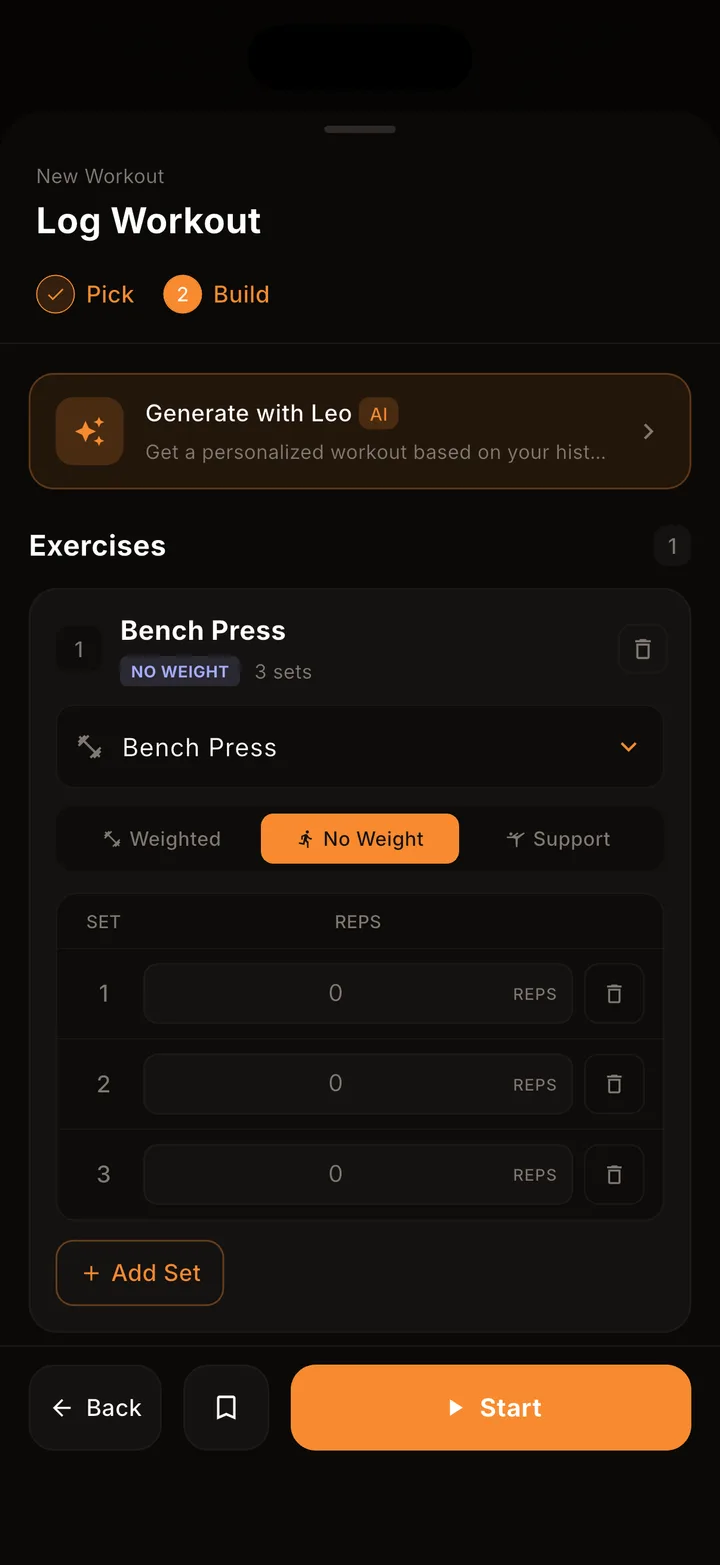
Every set you log in Kontest becomes part of your training history, so instead of guessing whether your sessions are productive or just long, you can look back and count. Are you doing four exercises for chest on push day and none of them overlapping in the muscle they hit? Or are you doing six exercises that are all just variations of the same bench press angle? One of those is smart volume. The other is padding your set count without padding your gains.
Ask your own training data. Kontest MCP lets you query every set you have ever logged in plain English, so you can ask something like "how many sets did I do for legs last month" and get a real answer instead of a guess. Download Kontest and start a kontest with a training partner and you have a reason to actually check the log every week instead of letting the question sit there unanswered.
FAQ
Is 3 exercises per workout enough? Yes, if they are the right 3. A session built around one or two compound lifts and one accessory can cover a muscle group's weekly volume needs, especially for strength-focused training. It is usually too few for a full body day covering multiple muscle groups.
How many exercises per muscle group per workout? Most lifters land between 2 and 4 exercises for a given muscle group in a single session. That is generally enough to hit the muscle from a few angles without stacking so many sets that your last exercise gets junk volume.
Do supersets count as two exercises? Yes. A superset is still two separate exercises performed back to back with no rest between them. It changes how you manage rest and fatigue, not how you count exercises or sets toward your weekly volume.
How many exercises should a beginner do in one workout? Beginners typically do best with 6 to 8 exercises spread across a full body session, since they are usually training 2 to 3 times a week and need to cover every major muscle group each time.
Is it bad to do too many exercises in one workout? It is not dangerous, but it is usually inefficient. Once you have logged enough hard sets for a muscle group, extra exercises mostly add fatigue and time in the gym without adding meaningful growth. That fatigue then eats into your next session.