Push pull legs is a training split that groups every lift by the movement pattern it uses: push days for chest, shoulders, and triceps, pull days for back and biceps, leg days for everything below the waist. Run it three, four, or six days a week and it still works, because you're never asking the same muscle group to recover overnight.
That's the short version. The rest of this guide is the program itself: exact sets, reps, and RPE for a full 6-day PPL, honest variations for people who can't train six days, and the progression rules that actually move the needle week to week.
What is the push pull legs split
PPL organizes your training week around three sessions instead of body parts or full-body circuits:
- Push: chest, shoulders, triceps. Anything where you're extending a joint away from your body (bench press, overhead press, dips).
- Pull: back, biceps, rear delts. Anything where you're pulling a load toward your body (deadlifts, rows, pull-ups).
- Legs: quads, hamstrings, glutes, calves. Squats, hinges, and everything that keeps your lower body strong.
Run the cycle once a week (3 days) or twice (6 days), and every muscle group gets hit hard, then gets real recovery time before you touch it again. That's the whole appeal: it's simple to plan and hard to mess up, which is exactly why it's one of the most searched training splits out there.
Who PPL is for (and who should skip it)
PPL rewards people who can commit to a consistent schedule and who care about pushing real weight on compound lifts. If you've got 3 to 6 days a week and a goal of getting stronger and bigger, this split fits you well.
It's a good fit if:
- You want a program built around progressive overload, not random workouts.
- You can train at least 3 days a week, reliably, most weeks.
- You care more about long-term strength and muscle than burning calories in a single session.
Skip it, or modify it hard, if:
- You can only manage 2 days a week. A full-body or upper/lower split will get you more total volume per muscle group with fewer sessions.
- You're brand new to lifting and still learning basic bar path and bracing. PPL works, but a simpler full-body routine for your first 8 to 12 weeks will teach you the fundamentals faster.
- Your schedule changes constantly. PPL's biggest weakness is that it falls apart when you miss a day and the order gets scrambled. If that's you, an upper/lower split recovers from missed days more gracefully.
The complete 6-day PPL program (tables per day)
This is a real 6-day PPL cycle: Push, Pull, Legs, twice through the week, one rest day. Train Monday through Saturday, rest Sunday, or shift the whole block to whatever days fit your life. The A and B days aren't harder and easier versions of each other, they hit the same muscles with a different emphasis so nothing gets stale.
RPE (rate of perceived exertion) tells you how close to failure to take a set. RPE 8 means you could've done 2 more reps. RPE 9 means 1 more rep, tops.
Day 1: Push A
| Exercise | Sets | Reps | RPE |
|---|---|---|---|
| Barbell bench press | 4 | 5-6 | 8 |
| Overhead press | 3 | 6-8 | 8 |
| Incline dumbbell press | 3 | 8-10 | 8 |
| Lateral raise | 3 | 12-15 | 9 |
| Cable tricep pushdown | 3 | 10-12 | 8 |
| Dips or close-grip bench | 2 | 8-10 | 8 |
Day 2: Pull A
| Exercise | Sets | Reps | RPE |
|---|---|---|---|
| Deadlift | 3 | 5 | 8 |
| Pull-up (weighted if you can) | 4 | 6-8 | 8 |
| Barbell row | 3 | 8-10 | 8 |
| Face pull | 3 | 15 | 8 |
| Barbell curl | 3 | 10 | 8 |
| Hammer curl | 2 | 12 | 8 |
Day 3: Legs A
| Exercise | Sets | Reps | RPE |
|---|---|---|---|
| Back squat | 4 | 5 | 8 |
| Romanian deadlift | 3 | 8 | 8 |
| Leg press | 3 | 10-12 | 8 |
| Leg curl | 3 | 12 | 8 |
| Standing calf raise | 4 | 12-15 | 9 |
| Hanging knee raise | 3 | 12-15 | 8 |
Day 4: Push B
| Exercise | Sets | Reps | RPE |
|---|---|---|---|
| Incline barbell press | 4 | 8-10 | 8 |
| Seated dumbbell shoulder press | 3 | 8-10 | 8 |
| Cable fly | 3 | 12-15 | 8 |
| Lateral raise | 3 | 15-20 | 9 |
| Overhead tricep extension | 3 | 10-12 | 8 |
| Dips | 3 | 10-12 | 9 |
Day 5: Pull B
| Exercise | Sets | Reps | RPE |
|---|---|---|---|
| Pendlay row | 4 | 8 | 8 |
| Lat pulldown | 3 | 10-12 | 8 |
| Seated cable row | 3 | 10-12 | 8 |
| Rear delt fly | 3 | 15 | 8 |
| Preacher curl | 3 | 10 | 8 |
| Cable curl | 2 | 12-15 | 9 |
Day 6: Legs B
| Exercise | Sets | Reps | RPE |
|---|---|---|---|
| Front squat | 4 | 8 | 8 |
| Walking lunge | 3 | 12/leg | 8 |
| Leg extension | 3 | 12-15 | 8 |
| Seated leg curl | 3 | 12-15 | 8 |
| Seated calf raise | 4 | 15 | 9 |
| Cable crunch | 3 | 12-15 | 8 |
Be honest with yourself about recovery on this version. Six training days is a real commitment: your sleep, food, and stress have to hold up their end, or the volume works against you instead of for you. If Sunday rolls around and you're still sore from Friday's leg day, that's a sign to drop to the 4-day version below, not a sign to push through.
3-day and 4-day PPL variations
Not everyone has six training days. Here's how to run the same split without losing what makes it work.
3-day PPL (once through the cycle, weekly)
Train Monday, Wednesday, Friday: Push, Pull, Legs, in that order, then rest the weekend. Use the Push A, Pull A, and Legs A tables above as-is, or combine the A and B exercise lists into a single longer session per movement pattern if you want more volume per week. This version is the right starting point if you're new to PPL, short on gym days, or juggling a schedule that makes six sessions unrealistic. Since each muscle group only gets trained once a week, push every working set closer to that RPE 8-9 range instead of leaving reps in the tank.
4-day PPL (rotating schedule)
Run Push, Pull, Legs, then a 4th "catch-up" day built from whichever muscle group got the least attention that week (usually push or pull, since legs recover slower and benefit from the extra day off). Train Monday, Tuesday, Thursday, Friday, and let the cycle roll forward: if you start on Push this week, you'll start on Pull next week. Over a month you get more total sessions per muscle group than the 3-day version without the recovery demands of true 6-day PPL. This is the version most intermediate lifters land on once life stops cooperating with a daily gym schedule.
How to progress week to week
A PPL split without a progression rule is just six random workouts. Pick one of these and apply it consistently:
- Add reps first, weight second. If your program calls for 3 sets of 8-10, start at 8 and add a rep to one set each session until you hit 10 across all three. Then add weight and drop back to 8 reps.
- Add weight every week on your main lifts. Bench, squat, deadlift, and overhead press respond well to small, regular jumps: 2.5-5 lb on upper body lifts, 5-10 lb on lower body lifts, once you can complete every prescribed set and rep at the current weight.
- Track total volume, not just top sets. Sets x reps x weight, added up across a session or a week, is the real signal that you're progressing, especially on the accessory work where jumping straight weight isn't realistic every session.
- Deload every 4-6 weeks. Drop to about 60% of your working weights for one week before your joints tell you to. This isn't optional if you're running the 6-day version long-term.
None of this works if you're not logging the actual numbers. Guessing what you did last Push A day means guessing at your progress, too.
PPL vs upper lower vs bro split
All three splits can build muscle. The difference is in recovery and how forgiving each one is when life gets in the way.
| Split | Frequency per muscle group | Best for | Biggest downside |
|---|---|---|---|
| Push pull legs | 2x/week (6-day) or 1x/week (3-day) | Lifters who can commit to a consistent 3-6 day schedule | Falls apart when you miss a day and the order shifts |
| Upper/lower | 2x/week on a 4-day schedule | Lifters who want high frequency with fewer weekly sessions | Longer sessions, more fatigue management per workout |
| Bro split (one muscle group per day) | 1x/week | Lifters chasing single-muscle pump and isolation volume | Lowest frequency per muscle group of the three, slower strength gains |
If you want the highest frequency per muscle group with the fewest missed-day headaches, upper/lower usually wins. If you want the clearest mental separation between session types and don't mind a 6-day commitment, PPL wins. Bro splits are the least efficient of the three for strength, but they're still a legitimate choice if hypertrophy and mind-muscle connection are your only goals.
Common PPL mistakes
- Skipping legs first when a week gets busy. Legs day always seems to be the one that gets cut. Rotate which session you'd drop if you had to, don't default to always dropping legs.
- Copying someone else's 6-day split when you can only actually recover from 4. More days doesn't help if you're not sleeping or eating enough to back them up.
- Never changing exercises. Swap 1-2 accessory movements every 6-8 weeks to avoid staleness and keep hitting muscles from slightly different angles. Keep your main compounds (bench, squat, deadlift, overhead press) constant so you can actually track progress on them.
- Ignoring RPE and just grinding to failure every set. Training every set to a 10 wrecks your ability to recover for the next session. Save true failure for the last set of an exercise, if at all.
- Not tracking anything. This is the one that quietly kills more PPL programs than bad exercise selection ever does. If you don't know what you lifted last Push A, you can't know if this one was actually better.
Turn PPL into a competition
PPL is built for logging, six or three distinct sessions a week with clear numbers to beat. That makes it one of the easiest splits to turn into a real competition with a training partner instead of a solo grind.
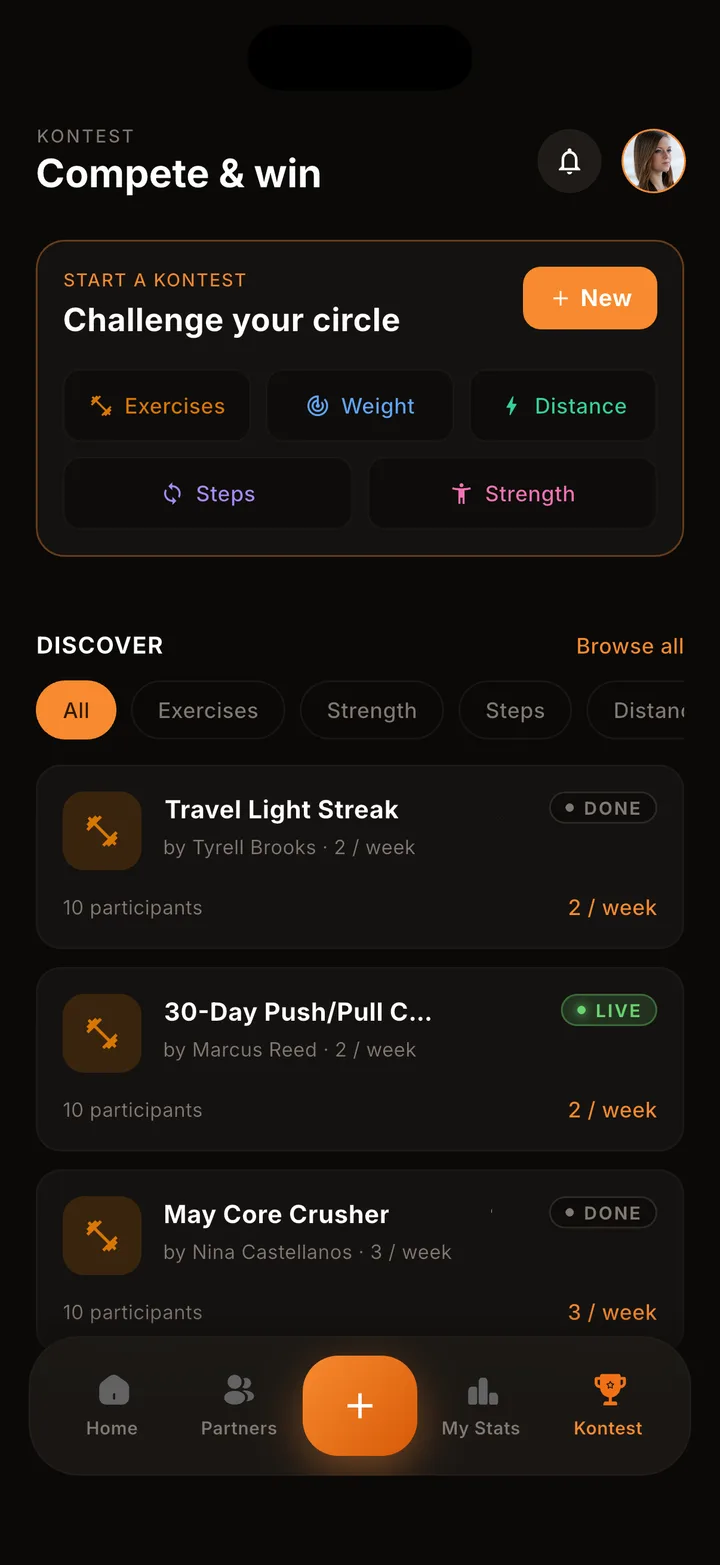
Kontest is built for exactly that. Log your PPL sessions and Kontest tracks total volume and PRs automatically, then turns your numbers into a leaderboard against whoever you're training with. Create a kontest with a friend running the same split and race for the biggest weekly volume, or just see who actually shows up for legs day more often. XP is positive-only, so a missed session doesn't tank your score, it just means there's more room for your friend to pull ahead. If you already run PPL solo, that's the PR mindset applied to a whole week instead of one lift. Download Kontest and log your PPL program starting with your next push day, then go race a friend to the biggest weekly volume.
FAQ
Is push pull legs good for beginners? Yes, with a caveat. PPL for beginners works best as the 3-day version, once through the cycle per week, with a heavy focus on learning the main compound lifts before adding volume. Jumping straight into 6-day PPL as a total beginner usually means more soreness than progress.
What is a PPLUL split? PPLUL means Push Pull Legs Upper Lower: a 5 or 6-day hybrid that runs a normal PPL cycle, then adds one or two extra upper and lower body days for more total frequency per muscle group. It's a step up in volume from standard PPL, best suited to intermediate and advanced lifters with the recovery capacity to handle it.
How many days should my PPL split be? 3 days if you're new to the split or can't reliably make it to the gym more than 3 times a week. 6 days if you want maximum frequency and can genuinely recover from six sessions a week, meaning your sleep and food are dialed in. Most lifters land on the 4-day version as the sustainable middle ground.
Can I build muscle on a 3-day PPL split? Yes. A well-run 3-day PPL routine with progressive overload builds muscle just as well as the 6-day version at first, since total weekly volume matters more than how it's spread across sessions. The 6-day version pulls ahead over time mainly because it allows more total volume per week for lifters who can recover from it.
Do I need rest days between push, pull, and legs? Not strictly, since each session hits different muscles. On the 6-day version you train 6 days straight with 1 rest day. On the 3-day version, spacing sessions out (Monday, Wednesday, Friday) gives each muscle group more recovery time before the next full cycle.
Push pull legs works because it matches your training days to how your body actually recovers: push muscles rest while you train pull, pull muscles rest while you train legs. Pick the 3, 4, or 6-day version that matches your real schedule, log every session, and let the numbers tell you when it's time to add weight.