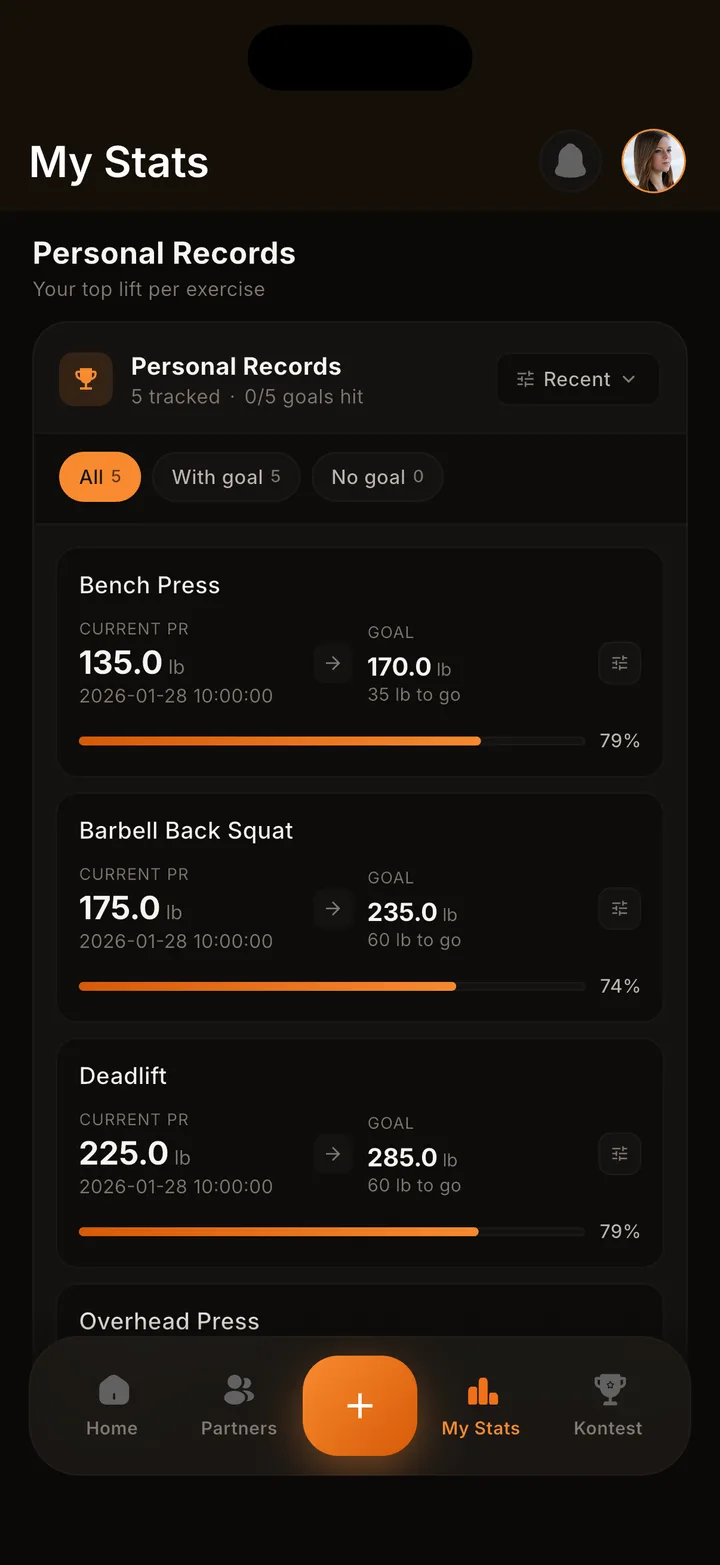
PR means personal record. It's the heaviest weight, the most reps, or the biggest total volume you've ever put up on a given lift, and every time you beat your old number, you've hit a new one.
That's the definition everyone searches for, and most articles bury it under three paragraphs of throat-clearing first. What matters more is what you do with it: how you track PRs, how often you should expect to hit them, and why lifters training with a rival hit them more often than lifters training alone.
Quick answer: PR stands for personal record. In the gym, a PR is the best result you have logged for a specific lift or workout, such as your heaviest squat, most bench-press reps at one weight, or highest total training volume. A one-rep max is one type of PR, but not the only one.
What PR means in the gym
PR is short for personal record (some gyms and lifters say personal best, or PB; more on that distinction below). It refers strictly to your own history, not a world record, not your training partner's numbers, just the highest mark you've personally set for a specific lift and rep range. The term isn't gym-only, either: in running, swimming, and most other sports, PR means the same thing — your own best recorded result, like a fastest mile or 5K.
A PR can be:
- 225 lb for a single rep on squat, when your old best was 215.
- 12 reps at 135 lb on bench, when you'd never gotten past 10.
- A faster 5K time than your last one.
- A longer unbroken set of pull-ups than you've ever done.
The common thread is that it's measurable, it's dated, and it's yours. If you can't point to the number you beat, it's not a PR. It's a guess.
The 5 types of PRs (and why most lifters only track one)
Most people hear "PR" and think "heaviest single rep." That's one type out of five, and fixating on it is a big reason so many lifters stall out, or get hurt chasing a number their joints aren't ready for yet.
| PR type | What it measures | Example |
|---|---|---|
| Weight (1RM) | Heaviest load for one rep | 315 lb deadlift for 1 rep |
| Rep | Most reps completed at a given weight | 15 reps at 185 lb on bench |
| Volume | Total weight moved (sets x reps x load) | 5x5 at 225 lb on squat day = 5,625 lb total |
| Time | Fastest time for a set distance or task | A sub-25-minute 5K |
| Streak | Longest run of consistent training or logging | 30 straight days without missing a session |
Weight PRs get all the attention, but volume and streak PRs are usually the more useful ones early on. A beginner who isn't ready to safely push a heavier single yet can still add a rep, add a set, or add a week to their streak. Those PRs stack up into real strength gains faster than staring at your 1RM and waiting for it to move.
What's a "good" PR? Strength standards, loosely held
Sooner or later every lifter googles whether their numbers are any good. Here are the rough benchmarks you'll commonly hear coaches use for the big barbell lifts, expressed as a multiple of your own bodyweight:
| Lift | Novice | Intermediate | Advanced |
|---|---|---|---|
| Squat | ~1x bodyweight | ~1.5x | ~2x |
| Bench press | ~0.75x bodyweight | ~1x | ~1.5x |
| Deadlift | ~1.25x bodyweight | ~2x | ~2.5x |
| Overhead press | ~0.5x bodyweight | ~0.75x | ~1x |
Treat these as scenery, not a test. They're rules of thumb, not standards from a study, they're typically quoted for adult male lifters (typical figures for women are usually quoted lower on the upper-body lifts and much closer on squat and deadlift), and they shift with bodyweight, age, limb lengths, and how long you've trained. The only standard with zero asterisks is the one in your own log: the number you beat is yours, at your bodyweight, in your gym. That's the one worth chasing.
Why PRs beat motivation for long-term progress
Motivation runs out. It always does, usually around week three, right when the soreness fades and the routine gets boring. PRs don't run out, because they're not a feeling. They're a scoreboard.
When your goal is "stay motivated," you're relying on a mood that shifts with sleep, work stress, and whether your favorite squat rack happens to be open. When your goal is "beat last week's number," you have something concrete to chase on the days motivation is nowhere to be found. You just need the log.
This is also why programs built around progressive overload work: they turn "get stronger" into a series of specific, checkable PRs instead of a vague hope. Add a little weight, a rep, or a set most weeks, and the PRs take care of themselves.
If you want the exact progression rules, use this 12-week progressive overload workout plan. It shows when to add weight, when to add reps, and how to adjust when a lift stalls.
How to set up PR tracking (log every set)
You cannot chase a PR you didn't record. That sounds obvious, and it's still the reason most lifters have no real idea what their numbers are.
- Log every working set, not just your top set: weight, reps, and how it felt.
- Separate PRs by rep range. A 1-rep PR and a 10-rep PR on the same lift are two different numbers, and both matter.
- Review your log weekly, not just at the end of a program. A five-minute Sunday scan tells you which lifts are moving and which have stalled.
- Set a target before you walk in. Deciding "I'm going for 8 reps at 185" before your set beats discovering afterward that you had more in the tank.
If tracking sounds like a chore, that's the whole reason the app exists. Log a set in seconds in Kontest (build it, repeat it from your history, or quick-record it) and it tracks every PR type above automatically, without you touching a spreadsheet. Once your history is logged, you can even ask questions about it in plain English through Kontest MCP, things like "which lift am I closest to PRing on this month?"
How to test a 1RM PR without wrecking your week
When you do go after a weight PR, treat it like an event, not an impulse:
- Schedule it. Test at the end of a training block, fresh, after a normal night of sleep — not at the end of a full leg day because the rack was free.
- Work up in singles. After warming up, take small jumps: roughly 5 reps at half the target, then singles around 70%, 80%, 90%, then the attempt. Long rests between them.
- Stop while the bar still moves. A grinding, form-breaking rep isn't a PR attempt, it's a gamble. If a rep slows to a crawl, call it — learning to judge that effort honestly is exactly what RPE is for.
- Use a rack with safeties or a spotter on squat and bench. Every time. Missing a lift should cost you nothing but pride.
And remember from the table above: you don't need to test a true 1RM often. Rep PRs at submaximal weights build the same strength with far less risk, and your heaviest sets already tell you roughly where your max sits.
How often should you PR? Realistic timelines by training age
This is where a lot of lifters get discouraged for no good reason. Training age matters a lot here, and expecting a five-year lifter's rate of progress in month two is a fast way to feel like you're failing when you're actually right on schedule.
| Training age | Realistic PR frequency |
|---|---|
| 0-6 months (novice) | Weekly, sometimes on multiple lifts per session |
| 6 months-2 years (intermediate) | Every 2-4 weeks per lift |
| 2-5 years (advanced) | Every 1-3 months, often just a few pounds at a time |
| 5+ years (highly trained) | A handful of true 1RM PRs per year, with more frequent rep or volume PRs |
This is a rough guide built from coaching experience, not a study, and your own timeline will move around based on sleep, stress, and how hard you're actually training. Notice the general pattern, though: as you get stronger, weight PRs slow down, but rep and volume PRs don't have to. That's exactly why tracking all five types matters more the longer you've been training, not less.
The friend effect: why lifters PR more with rivals
Here's the part most PR guides skip entirely. The single biggest lever for hitting more PRs isn't a supplement, a program tweak, or a better bar path cue. It's having someone to beat.
Training solo, you might rack the bar at your planned weight and call the session done. Training with a rival, or watching a leaderboard you're currently losing on, you find the extra rep. That's the actual mechanism behind why head-to-head competition works as a training tool, not just a nice thing to say about friendship.
That's the entire idea behind kontests, the challenges Kontest is built around. You and your friends log real training, earn XP for it, and climb a shared leaderboard together. The app is positive-only: it never punishes a missed session, it only rewards effort, so the competition stays fun instead of becoming another way to feel bad about training. If your gym group needs a finish line to chase, start one with the fitness challenge app side of Kontest — pick reps, weight, distance, steps, or strength and let the board settle it. Been logging PRs alone in a notes app? Download Kontest and never lose a PR again, then go find a friend willing to lose to you.
That's what PR means in the gym: your own number, beaten. Log every set, track all five types, and find someone worth losing to.
FAQ
What does PR stand for in the gym? PR stands for personal record: the best result you have ever logged on a specific lift or workout. Your heaviest squat single, your most push-ups in one set, and your biggest total session volume are all PRs.
Is a PR the same as a PB? Yes, in the gym. PR (personal record) and PB (personal best) mean the same thing. PR is more common in the US, PB more common in the UK and Australia.
What's the difference between a PR and a 1RM? Your 1RM (one-rep max) is your best single-rep lift for a given movement, full stop. A PR is broader: it covers any personal best, including reps, volume, or time, not just a single max lift. Every 1RM PR is a PR, but not every PR is a 1RM.
What does PR mean in sports like running? The same thing it means in the gym: your own best recorded result. A runner's PR might be a fastest mile or marathon time. Some sports and countries say PB (personal best) instead, but the idea is identical — you against your own history.
How do I know if something actually counts as a PR? If you can point to a logged number you beat, on the same lift and under comparable conditions (same rep range, similar rest, no extra assistance you didn't have before), it counts. If you're not logging your sets, you're guessing, not tracking.
How do I celebrate a PR without being that guy? Post it if you want to, just skip the gym-selfie caption novel. A short message to your training partner or a quiet mental fist pump covers it. The people who actually care are the ones training with you, which is sort of the point.
Why haven't I hit a PR in weeks? Check three things first: are you actually logging every set (see the tracking section above), are you increasing something (weight, reps, or volume) week to week, and are you recovering (sleep, food, stress)? A plateau is usually a tracking or recovery problem before it's a genetics problem.
What does "hit a PR" mean? It means you beat a personal best you had already recorded. That could be more weight, more reps at the same weight, more total volume, a faster time, or a longer consistency streak.
Does a PR still count if a spotter or a belt helped you? A spotter who only stands by for safety doesn't change the number, so the lift still counts. A spotter who touches the bar and helps move the weight does, since the lift wasn't fully yours. Gear you already train in regularly (a belt, wraps, straps) is fine to keep using; the line to watch is adding help you didn't have last time you hit that number, since that's not a fair comparison anymore.
What does PR mean in CrossFit or group classes? Same idea, wider scope. A CrossFit PR can be a heaviest lift, but it's just as often a fastest time on a benchmark WOD, the most rounds completed in an AMRAP, or the first time you string together a skill like unbroken pull-ups. The lift or workout changes; "your own best number, beaten" doesn't.
Does a PR ever expire or reset? No. Once you've hit a number, it's your PR until you (or a future session) beats it, no matter how much time passes. What can change is your current working weight after a long layoff, illness, or injury, since detraining lowers what you can safely lift today. Treat an old PR as the target you're rebuilding toward, not a number that's been erased.