RPE stands for rate of perceived exertion: a 1 to 10 scale for how hard a set felt, where 10 means you couldn't have gotten another rep. Pair it with an RPE calculator and it also tells you, within a percent or two, what portion of your one-rep max you just lifted.
That's the short version. Below is the full RPE scale, the RPE to percentage conversion chart lifters actually use, a calculator that does the math for you, and the honest truth about why most people's RPE calls are wrong.
What RPE means
RPE is a self-rating of how close to failure a set took you, not how heavy the weight felt in the abstract. A 405 lb deadlift can be an RPE 6 for one lifter on a good day and an RPE 9.5 for the same lifter three weeks into a hard training block, same weight, completely different effort.
The scale traces back to Gunnar Borg's original perceived exertion scale from exercise science, adapted for barbell training and popularized in strength sports by coach Mike Tuchscherer's Reactive Training Systems (RTS). The RTS version is the one lifters mean when they say "RPE" today, and it's built around one simple question after a set: how many more reps could you have done?
That question is really asking about reps in reserve (RIR). RPE and RIR are the same idea from opposite directions: RPE 9 means 1 rep in reserve, RPE 7 means 3 reps in reserve, and so on. Most programs now write both, because "leave 2 in the tank" and "RPE 8" mean the exact same thing on the bar.
The RPE scale from 1 to 10 (chart)
Here's the full scale. Everything below RPE 6 is warm-up territory, easy enough that lifters don't usually bother rating it precisely.
| RPE | Reps in reserve | What it feels like |
|---|---|---|
| 10 | 0 | Maximal effort. Could not add a rep or more weight. |
| 9.5 | 0-1 | Might have 1 more, genuinely not sure. |
| 9 | 1 | Definitely 1 more rep, no more than that. |
| 8.5 | 1-2 | Between 1 and 2 clean reps left. |
| 8 | 2 | 2 more reps, bar speed noticeably slower on the last rep. |
| 7.5 | 2-3 | Between 2 and 3 reps left. |
| 7 | 3 | 3 reps left. Still solid, controlled work. |
| 6.5 | 3-4 | Between 3 and 4 reps left. |
| 6 | 4 | Working weight, but you're not close to struggling. |
| 5 and below | 5+ | Warm-up sets. Bar speed is fast and form is easy. |
Most programming only cares about RPE 6 through 10. Anything lighter is a warm-up, not a working set, and rating it doesn't tell your coach (or your training log) anything useful.
RPE vs percentage of 1RM (conversion table + calculator)
Once you know your RPE and rep count, you can back into roughly what percentage of your one-rep max you just moved. This is the standard RTS conversion chart, and it holds up well for the big barbell lifts (squat, bench, deadlift, overhead press):
| Reps | RPE 10 | RPE 9.5 | RPE 9 | RPE 8.5 | RPE 8 | RPE 7.5 | RPE 7 | RPE 6.5 | RPE 6 |
|---|---|---|---|---|---|---|---|---|---|
| 1 | 100% | 98% | 96% | 94% | 92% | 90.5% | 89% | 87.5% | 86% |
| 2 | 95% | 93.5% | 92% | 90.5% | 89% | 87.5% | 86% | 84.5% | 83% |
| 3 | 92% | 90.5% | 89% | 87.5% | 86% | 85% | 84% | 82.5% | 81% |
| 4 | 89% | 87.5% | 86% | 85% | 84% | 82.5% | 81% | 80% | 79% |
| 5 | 86% | 85% | 84% | 82.5% | 81% | 80% | 79% | 77.5% | 76% |
| 6 | 84% | 82.5% | 81% | 80% | 79% | 77.5% | 76% | 75% | 74% |
| 7 | 81% | 80% | 79% | 77.5% | 76% | 75% | 74% | 73% | 72% |
| 8 | 79% | 77.5% | 76% | 75% | 74% | 73% | 72% | 70.5% | 69% |
| 9 | 76% | 75% | 74% | 73% | 72% | 70.5% | 69% | 68% | 67% |
| 10 | 74% | 73% | 72% | 70.5% | 69% | 68% | 67% | 66% | 65% |
Reading it: if you hit 5 reps at RPE 8, you moved roughly 81% of your one-rep max on that set. Punch in your numbers below and skip the lookup.
RPE to Percentage Calculator
This chart is a well-established autoregulation tool built from RTS's published RPE methodology, not a precise science. Bar speed, sleep, stress, and how many sets came before it all shift the real number by a few percent in either direction. Use it to plan your training week, not to argue with your training partner over decimal points.
How to actually gauge RPE (most people sandbag)
Most lifters call their RPE lower than it actually was, especially early on. A set you rated RPE 7 that actually took 4 minutes to recover from and left your hands shaking was probably an RPE 9. Sandbagging your RPE doesn't make you tougher, it just makes your training log useless for planning next week's weights.
A few honest checkpoints:
- Bar speed is the tell. If the bar visibly slows down on the last rep compared to the first, you're at RPE 8 or higher, no matter how "fine" it felt.
- Could you talk through the last rep? If you could hold a conversation mid-set, you weren't above RPE 6-7. If you couldn't get a full sentence out after racking the bar, you were at 9 or above.
- Would one more 5 lb jump have been possible right then? If yes, you weren't at RPE 10. This one catches more people overrating than underrating, especially on machines and isolation work.
- Rate the set immediately, not after you've rested. RPE fades fast. Waiting 90 seconds to decide how hard a set was almost always rounds the number down.
The fix isn't overthinking it, it's rating every set the same way every time so your numbers stay consistent with each other, even if they're not perfectly calibrated to the chart.
When to use RPE vs fixed percentages
Neither approach is universally better, they solve different problems.
Fixed percentages work well when your one-rep max is current and accurate, and your recovery is consistent week to week. Beginners fall into this camp most often: their maxes move fast enough that percentage-based programming from a recent test keeps them honest without needing to interpret how a set felt.
RPE earns its keep once your training life gets less predictable, which is most lifters most of the time. A percentage-based program doesn't know you slept five hours last night or that you're three weeks into a hard block and running on fumes. RPE does, because it's measuring today's effort instead of a number from a max test six weeks ago. It's also the better tool when you genuinely don't know your current 1RM on a lift, since guessing wrong throws off every percentage that follows it.
Most well-built intermediate and advanced programs blend both: percentages for lifts where hitting an exact number matters (competition prep, testing weeks), RPE for everything building toward those peaks. If you're stacking a lot of exercises into one session, how hard you can honestly push the last few movements also depends on how many exercises you're loading into that workout in the first place, since RPE 8 on exercise two feels very different from RPE 8 on exercise seven.
Using RPE in your log to autoregulate
Autoregulation just means adjusting today's weight based on how today is actually going, instead of blindly following a spreadsheet written weeks ago. RPE is the input that makes that possible.
The practical version: pick a target RPE for your working sets (RPE 8 is a common default for main lifts), then adjust the weight set to set until you land there. If your first set at your planned weight comes in at RPE 6, add weight. If it's already RPE 9, hold or drop slightly. You're hitting a feeling, not just a number on a plate.
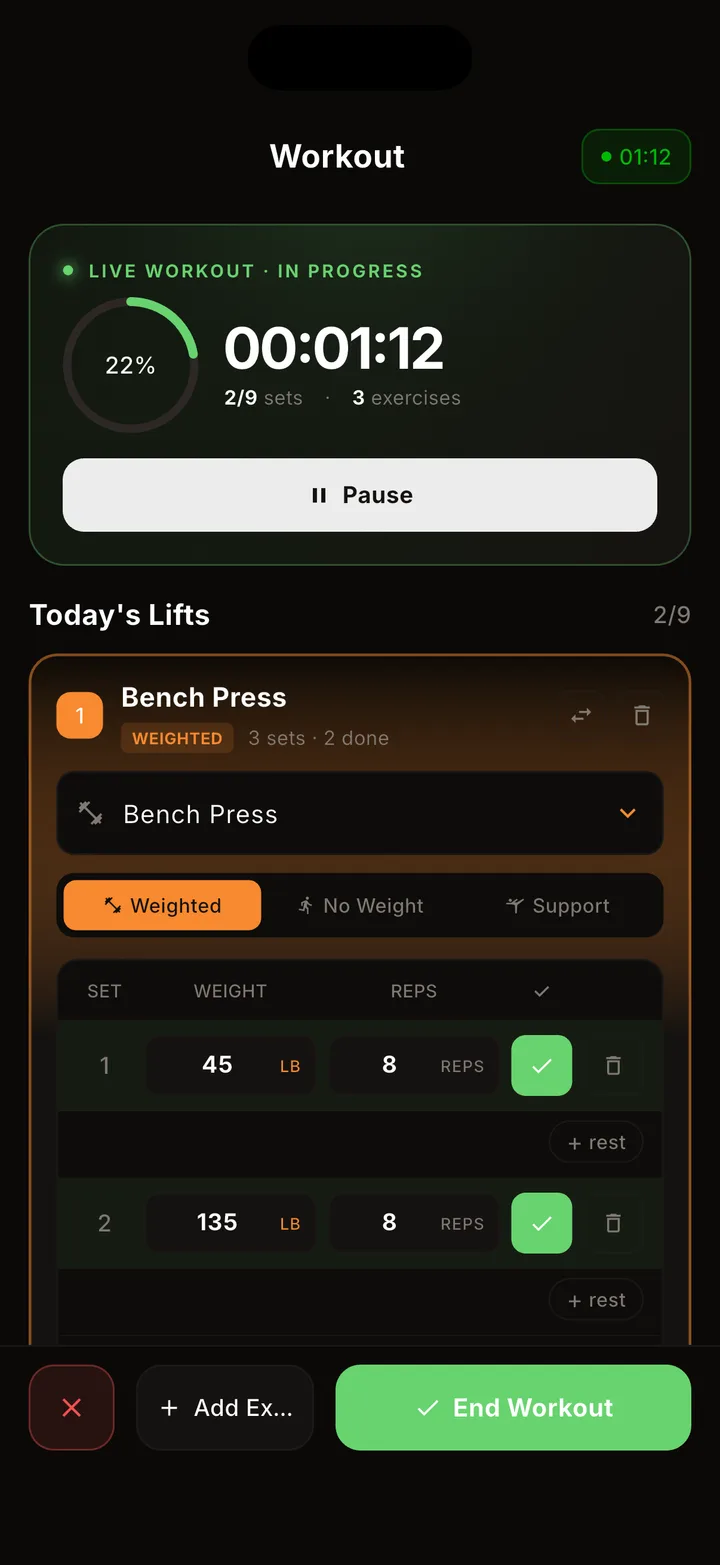
None of this works if you're not writing it down. A workout log that only has weight and reps tells you what happened, not whether it was hard. Logging intensity alongside the numbers, even as a quick note on how the session felt, is what lets you look back in a month and tell the difference between a real strength gain and a day you were just fresh. Kontest logs every session you enter, tracks your PRs automatically, and keeps a running history you can check against how each workout actually felt, so you can see whether your honest RPE calls are turning into real progress over time. Download Kontest and start logging the effort, not just the numbers.
FAQ
What does RPE mean in weightlifting? RPE stands for rate of perceived exertion, a 1 to 10 scale for how hard a set felt. RPE 10 means you couldn't have done another rep, RPE 8 means you had about 2 reps left.
What is RPE 8 vs RPE 9? RPE 8 means you had roughly 2 reps left in the tank after the set. RPE 9 means you had 1 rep left, and could not have done a second one. The difference is small on the bar but meaningful for how close to your max you actually were.
Is RPE or percentage-based training better for beginners? Percentages are usually easier for beginners because their one-rep max is changing fast enough that a recent test stays accurate. RPE becomes more useful once your training gets less predictable, or once you don't have a current max to work from.
How do I convert RPE to a 1RM? Use the reps and RPE from a set with the conversion chart above: find the percentage for that rep and RPE combination, then divide the weight you lifted by that percentage. A calculator that does this automatically is built into this page.
What's a good RPE for building strength vs building muscle? Strength-focused training usually lives around RPE 7-9 on the main lifts, leaving enough in reserve to hit heavy weights consistently across a week. Hypertrophy work can push closer to RPE 8-10 on isolation and accessory movements, since taking those sets closer to failure carries less injury risk than doing the same on a heavy squat or deadlift.
RPE isn't a replacement for tracking your numbers, it's a second data point that tells you what those numbers actually cost you. Rate your sets honestly, log them somewhere you'll actually look back at, and the percentage chart above will start matching your real training within a few weeks.