An upper lower split trains your whole body twice a week over four sessions: two upper body days, two lower body days. It's the split most intermediate lifters end up on once six-day programs stop fitting real life, because it gives you high frequency per muscle group without needing to show up every day to get it.
That's the short answer. Below is the full program: exact sets, reps, and RPE for all four days, honest 2 and 3-day versions for weeks that don't cooperate, and the progression rules that decide whether this split actually builds you strength or just burns four evenings a week.
What is the upper lower split
The upper lower split divides your training week into two session types instead of body parts or full-body circuits. Upper days hit chest, back, shoulders, and arms. Lower days hit quads, hamstrings, glutes, and calves. Run the cycle twice a week (four sessions total) and every major muscle group gets trained twice, with two to three days of recovery between hits.
That two-a-week frequency is the whole point. A single chest workout on a bro split leaves your chest undertrained for six days until it comes back around. Upper lower cuts that gap in half without asking for a six-day commitment, which is why it shows up so often in "best split for building strength" conversations.
Most upper lower programs run Monday, Tuesday, Thursday, Friday: two sessions, a rest day, two more sessions, then the weekend off. That layout also happens to be the most forgiving schedule in strength training. Miss Tuesday and you've still got Thursday and Friday to make up the week. Miss a day on a 6-day PPL split and the whole rotation shifts.
Why 4 days beats 6 for most lifters
Six-day programs look better on paper. Four-day upper lower usually wins in practice, for one reason: it's the split most people can actually run for a full year without missing half their sessions.
A few reasons the 4-day version keeps working when 6-day splits fall apart:
- It matches most people's real schedule. Two lifts on weeknights and two more later in the week fits around a job, a commute, and a life that isn't built around the gym.
- It has built-in redundancy. With only four required sessions in a seven-day week, you've got three off-days to absorb a late night at work, a sick kid, or a day you just don't have it in you. A 6-day split has none of that slack.
- It keeps your logging streak alive. The lifters who actually get stronger over a year are the ones who show up consistently, not the ones who do the hardest possible program for three weeks and quit. Four realistic sessions you'll actually complete beats six ambitious ones you'll skip half of.
- The volume difference is smaller than it looks. Two lower body sessions a week on a 4-day split get you close to the total weekly volume of a 6-day PPL rotation, once you account for how often PPL lifters actually miss their sixth day.
None of this means six-day training is wrong. If you can genuinely recover from six sessions and your schedule allows it, it works. But if you've started and abandoned a 6-day program before, the upper lower split 4 day version is usually the fix, not a worse compromise.
The complete 4-day program (upper A, lower A, upper B, lower B tables)
This is a real 4-day upper lower routine: two upper sessions, two lower sessions, run Monday, Tuesday, Thursday, Friday with Wednesday and the weekend off. The A and B days aren't harder and easier versions of each other, they shift the rep ranges and exercise selection so the same muscles get trained differently each time instead of going stale.
RPE (rate of perceived exertion) tells you how close to failure to take a set. RPE 8 means you could've done 2 more reps. RPE 9 means 1 more rep, tops.
Day 1: Upper A
| Exercise | Sets | Reps | RPE |
|---|---|---|---|
| Barbell bench press | 4 | 5 | 8 |
| Barbell row | 4 | 6-8 | 8 |
| Overhead press | 3 | 6-8 | 8 |
| Lat pulldown | 3 | 8-10 | 8 |
| Lateral raise | 3 | 12-15 | 9 |
| Cable tricep pushdown | 3 | 10-12 | 8 |
Day 2: Lower A
| Exercise | Sets | Reps | RPE |
|---|---|---|---|
| Back squat | 4 | 5 | 8 |
| Romanian deadlift | 3 | 8 | 8 |
| Leg press | 3 | 10-12 | 8 |
| Leg curl | 3 | 12 | 8 |
| Standing calf raise | 4 | 12-15 | 9 |
| Hanging knee raise | 3 | 12-15 | 8 |
Day 3: Upper B
| Exercise | Sets | Reps | RPE |
|---|---|---|---|
| Incline dumbbell press | 4 | 8-10 | 8 |
| Pull-up (weighted if you can) | 4 | 6-8 | 8 |
| Seated dumbbell shoulder press | 3 | 8-10 | 8 |
| Seated cable row | 3 | 10-12 | 8 |
| Cable fly | 3 | 12-15 | 8 |
| Hammer curl | 3 | 10-12 | 8 |
Day 4: Lower B
| Exercise | Sets | Reps | RPE |
|---|---|---|---|
| Deadlift | 3 | 5 | 8 |
| Walking lunge | 3 | 12/leg | 8 |
| Leg extension | 3 | 12-15 | 8 |
| Seated leg curl | 3 | 12-15 | 8 |
| Seated calf raise | 4 | 15 | 9 |
| Cable crunch | 3 | 12-15 | 8 |
Keep 2-3 minutes rest between the main compound lifts (bench, squat, deadlift, overhead press) and 60-90 seconds on accessory work. A full session should run 60-75 minutes if you're not spending half of it scrolling your phone between sets.
2-day and 3-day versions for busy weeks
Some weeks four sessions isn't happening. Here's how to keep the split's logic without forcing a schedule you can't hit.
2-day upper lower (minimum effective dose)
Combine the A and B exercise lists into one longer upper session and one longer lower session, then train them once each on whatever two days you can guarantee, ideally 2-3 days apart (Monday and Thursday, for example). You'll train each muscle group once a week instead of twice, which is a real step down in frequency, but it's a far better outcome than skipping the gym entirely during a packed week. Treat this as a maintenance week, not your normal program.
3-day upper lower (rotating schedule)
Run Upper, Lower, Upper on Monday, Wednesday, Friday, then flip to Lower, Upper, Lower the following week. Over a two-week block you get four upper and four lower sessions, the same total volume as the 4-day version, just spread across three weekly sessions instead of four. This is the right call if your schedule realistically supports three gym days but not four, and it beats permanently downgrading to the 2-day version.
Whichever version you land on, don't try to make up a missed session by adding a fifth day or doubling up exercises the next time you train. Just resume the schedule on the next day it's due. A missed Tuesday doesn't erase the sessions you did complete, and chasing it usually just wrecks your recovery on the days that matter.
Progression rules
An upper lower split without a progression rule is just four random workouts a week. Pick one of these and apply it consistently:
- Add reps first, weight second. If your program calls for 3 sets of 8-10, start at 8 and add a rep to one set each session until you hit 10 across all three. Then add weight and drop back to 8 reps.
- Add weight every week on your four main lifts. Bench, squat, overhead press, and deadlift respond well to small, regular jumps: 2.5-5 lb on upper body lifts, 5-10 lb on lower body lifts, once you complete every prescribed set and rep at the current weight.
- Track total volume, not just top sets. Sets x reps x weight, added up across a session or a week, is the real signal you're progressing, especially on accessory work where jumping straight weight isn't realistic every session.
- Deload every 4-6 weeks. Drop to about 60% of your working weights for one week before your joints force the issue. Two lower body sessions a week adds up fast on your knees and lower back, so don't skip this.
None of these rules work if you're not logging the actual numbers. Guessing what you lifted on last week's Upper A is guessing at your progress too.
Upper lower vs PPL vs full body
All three splits can build real strength and muscle. The difference is in how much weekly commitment each one demands and how well it survives a missed day.
| Split | Frequency per muscle group | Sessions per week | Best for | Biggest downside |
|---|---|---|---|---|
| Upper/lower | 2x/week | 4 | Lifters who want high frequency with the fewest weekly sessions | Longer sessions, more fatigue to manage per workout |
| Push pull legs | 2x/week (6-day) or 1x/week (3-day) | 6 or 3 | Lifters who can commit to a consistent 3-6 day schedule | Falls apart when you miss a day and the order shifts |
| Full body | 2-3x/week | 3 | Beginners and anyone who wants maximum frequency in minimum days | Longer, more fatiguing individual sessions than either split |
The upper lower vs PPL decision usually comes down to your schedule, not which split is "better." If you want the highest frequency per muscle group with the fewest weekly gym trips and the most forgiveness for a missed day, upper lower usually wins. If you'd rather train more often with shorter, more specific sessions and your schedule can absorb a 6-day week, push pull legs is the stronger fit. Full body earns its place mainly with beginners who need more total practice on the main lifts before splitting anything up.
Common mistakes
- Turning "upper" into a random chest and back day. The point of upper lower is balanced upper body training, not defaulting to whatever you feel like pressing. Keep push and pull movements roughly even on every upper session.
- Under-training lower body because upper days are more fun. Two lower sessions a week only work if you actually show up for both. Skipping Lower B and calling it an upper lower split is how people end up with strong arms and no leg progress.
- Copying a 6-day bodybuilder's split volume into 4 days. More sets per session doesn't help if you're not recovering from them. Match your volume to what you can actually sleep and eat your way through.
- Ignoring RPE and grinding every set to failure. Training every set to a 10 wrecks your ability to recover for the next session, and on a 4-day split you're back in the gym within 48-72 hours either way.
- Not tracking anything. This is the mistake that quietly kills more upper lower programs than bad exercise selection ever does. If you don't know what you lifted on last week's Lower A, you can't tell if this week's session was actually harder.
Turn your 4-day split into a streak you can't break
Upper lower is built for consistency, four fixed sessions with clear numbers to beat each time they come around. That makes it one of the easiest splits to turn into a streak instead of a routine you quietly stop doing in October.
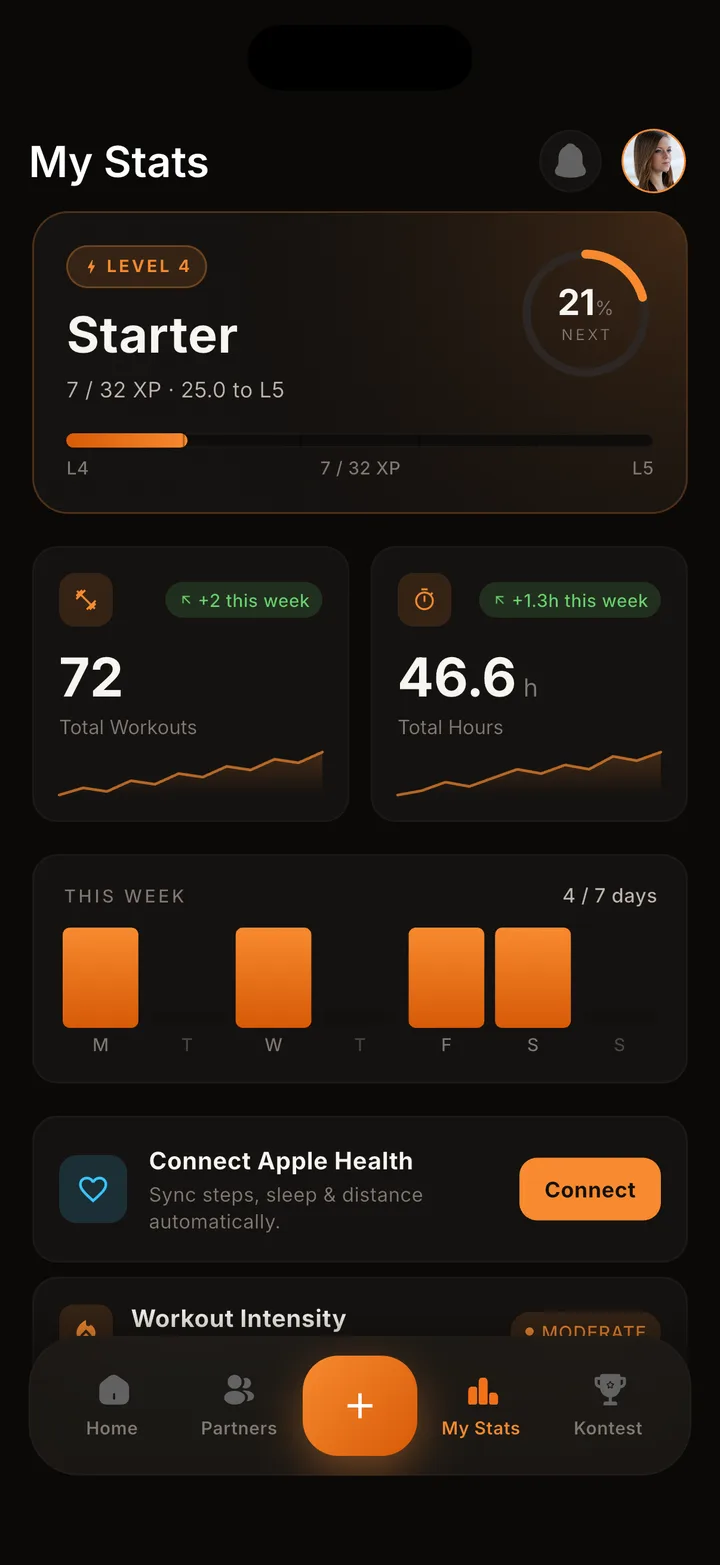
Kontest tracks every session you log, your PRs, and your streak automatically, and turns those numbers into a leaderboard against whoever you're training with. Log all four sessions in Kontest and keep your weekly streak alive, then create a kontest with a friend running the same split and race for who logs every session first, or who adds the most volume to their deadlift by the end of the month. XP is positive-only, so one missed session doesn't tank your score, it just means there's more ground for your friend to make up. Download Kontest and log your next Upper A session to start the streak.
FAQ
What is a good 4 day upper lower split? A good upper lower split 4 day program alternates Upper A, Lower A, Upper B, Lower B across Monday, Tuesday, Thursday, Friday, with each pair of A/B days using different rep ranges and exercise selection so the same muscles aren't trained the exact same way twice. The tables above are a complete example you can run as written.
Is upper lower better than PPL? Neither is objectively better. Upper lower vs PPL comes down to schedule and recovery: upper lower gets you higher frequency per muscle group in fewer weekly sessions and survives a missed day better, while PPL lets you train more specifically and more often if your schedule can handle 5-6 days a week.
Can I do upper lower 3 days a week? Yes. Run Upper, Lower, Upper one week and Lower, Upper, Lower the next, which averages out to the same total volume as the 4-day version over a two-week block. It's a legitimate long-term option, not just a fallback.
How long should an upper lower workout be? Most upper lower sessions run 60-75 minutes including warm-up, assuming you're resting 2-3 minutes on the main compound lifts and 60-90 seconds on accessories. Sessions that regularly run past 90 minutes usually have too much volume for the frequency.
Do I need cardio on an upper lower split? It's not required for the split to work, but 1-2 short cardio sessions a week (20-30 minutes, easy pace) on your off days support recovery and don't interfere with strength progress. Keep it easy enough that it doesn't eat into your energy for the next lifting session.
The upper lower split earns its popularity by matching how most people actually live: four solid sessions a week, real recovery time built in, and enough slack to survive a missed Tuesday without falling apart. Run the 4-day version if your schedule supports it, drop to 3 days if it doesn't, and log every session so you know the program is actually working instead of guessing.