A 28 day walking challenge works because it's short enough to finish and long enough to build a real habit, four clean weeks, no rest week built in to lose momentum. This one gives you a target that climbs slowly instead of demanding 10,000 steps starting on day one, a full calendar so you never have to guess today's number, and a way to run it with friends so you're not the only one checking in.
Below is the whole thing: every one of the 28 days spelled out, the difference between tracking steps and tracking minutes, three ways to make it harder once week one feels easy, and how to turn it into a real head to head challenge with the group chat that keeps saying "we should walk more."
Why a 28 day walking challenge beats a 30 day one
Twenty eight days is four exact weeks, not four weeks with two stray days tacked onto the end like most "30 day challenge" templates. That matters more than it sounds. A round number of weeks means the calendar below lines up cleanly with a Monday through Sunday routine, and it matches Kontest, which runs its own kontests in whole weeks, from one to five. A 30 day walking challenge always gets rounded down to four weeks plus two extra days nobody ends up tracking anyway.
The other reason is psychological. Four clean weeks reads as a specific, finishable thing. Thirty days reads as "basically a month," which is vague enough that missing the last couple of days doesn't feel like failing, it just feels like the challenge quietly ended. Twenty eight days has a hard finish line at day 28. You either got there or you didn't, and there's no fuzzy math to hide behind either way.
The challenge: week by week walking targets (full calendar)
The structure is simple. A daily walk that gets a little longer each week, one flex day built into every week for the day life gets in the way, and a longer finisher walk to close out day 28. Track it by time or by steps (more on picking one below), log every walk, and this is the entire 28 days spelled out.
| Week | Walking Days | Daily Target | Weekly Minutes | Added Steps/Day (approx) |
|---|---|---|---|---|
| 1 | 6 + 1 flex day | 20 min | 135 min | ~2,000 |
| 2 | 6 + 1 flex day | 25 min | 165 min | ~2,500 |
| 3 | 6 + 1 flex day | 30 min | 195 min | ~3,000 |
| 4 | 6 + 1 finisher | 35 min (45 on Day 28) | 255 min |
Step estimates assume a brisk pace of roughly 100 steps a minute. Adjust up or down for your own stride, and treat these as steps added by the dedicated walk, not a total daily step count you're starting from zero.
Week 1: Days 1-7
| Day | Target | Notes |
|---|---|---|
| 1 | 20 min brisk walk | Easy pace. The only job today is starting. |
| 2 | 20 min brisk walk | |
| 3 | 20 min brisk walk | |
| 4 | 20 min brisk walk | |
| 5 | 20 min brisk walk | |
| 6 | 20 min brisk walk | |
| 7 | Flex day | 15 min easy walk, or make up a missed day at full length |
Week 2: Days 8-14
| Day | Target | Notes |
|---|---|---|
| 8 | 25 min brisk walk | |
| 9 | 25 min brisk walk | |
| 10 | 25 min brisk walk | Try one hill or incline if there's a route nearby |
| 11 | 25 min brisk walk | |
| 12 | 25 min brisk walk | |
| 13 | 25 min brisk walk | |
| 14 | Flex day | 15 min easy walk, or make up a missed day |
Week 3: Days 15-21
| Day | Target | Notes |
|---|---|---|
| 15 | 30 min brisk walk | |
| 16 | 30 min brisk walk | Pick up the pace for the middle 10 minutes |
| 17 | 30 min brisk walk | |
| 18 | 30 min brisk walk | |
| 19 | 30 min brisk walk | |
| 20 | 30 min brisk walk | |
| 21 | Flex day | 15 min easy walk, or make up a missed day |
Week 4: Days 22-28
| Day | Target | Notes |
|---|---|---|
| 22 | 35 min brisk walk | |
| 23 | 35 min brisk walk | |
| 24 | 35 min brisk walk | Good day to try rucking or an incline route |
| 25 | 35 min brisk walk | |
| 26 | 35 min brisk walk | |
| 27 | 35 min brisk walk | |
| 28 | Finisher: 45 min walk | Longest walk of the challenge. Go somewhere that makes it worth it. |
Steps vs. minutes: pick your metric
Every target above is listed in minutes, but steps work just as well if that's what your phone or watch already counts. A brisk 20 minute walk lands around 2,000 steps for most people, scale that up or down for your own stride length and pace. Pick one metric on day 1 and stick with it for all 28 days. Switching back and forth between minutes and steps mid challenge is how people lose track of whether they actually hit the target.
If you're going with steps, ignore the 10,000 a day number you've probably heard. It's a round figure that stuck because it's round, not because your body treats it as a real threshold. The targets in the calendar above are steps added by the dedicated walk on top of whatever you're already doing in a normal day, not a total daily count you need to hit starting from zero.
Whichever you pick, log it somewhere that doesn't rely on memory. In Kontest, that's a Steps kontest if you're counting steps, or a Distance kontest if you'd rather track minutes or miles. Either way, the daily number lands in the same place you already log your training, instead of a mental tally that quietly stops being accurate by day 10.
Making it harder: pace, incline, and rucking
By week 3, 30 minutes at a comfortable pace stops being a real challenge for a lot of people. Here are the three levers that actually add difficulty, instead of just adding more time on your feet.
Pace. Move from a casual 2.5 to 3 mph stroll to a brisk 3.5 to 4 mph pace, the kind where you could talk but not sing. Power walking pushes into 4 to 4.5 mph and starts working your glutes and calves closer to the way a slow jog would, without the impact.
Incline. A 3 to 6 percent grade on a treadmill, or just choosing the hilly route over the flat one outside, raises your heart rate and works your posterior chain far more than flat ground at the same pace. It's the single easiest way to make the same 30 minutes feel like a real workout.
Rucking. Load a backpack with roughly 10 percent of your bodyweight (about 15 to 20 lb for a 170 lb person) and walk with it. Start light in week 3 and add weight gradually into week 4. Rucking turns a walk into real loaded carry work for your back, shoulders, and legs.
Pick one lever at a time. Stacking pace, incline, and a loaded pack all in the same week, on top of a target that's already climbing, is how people quit in week 3 instead of finishing week 4.
Running it as a group challenge: scoring and handicaps for mixed fitness levels
A walking challenge is one of the easiest challenges to pull an entire friend group into, including the people who groan at the word "workout." Nobody needs a gym membership or any real fitness base to hit day 1's 20 minute target, which makes it the rare kontest where the least active person in your group chat can actually compete from day one.
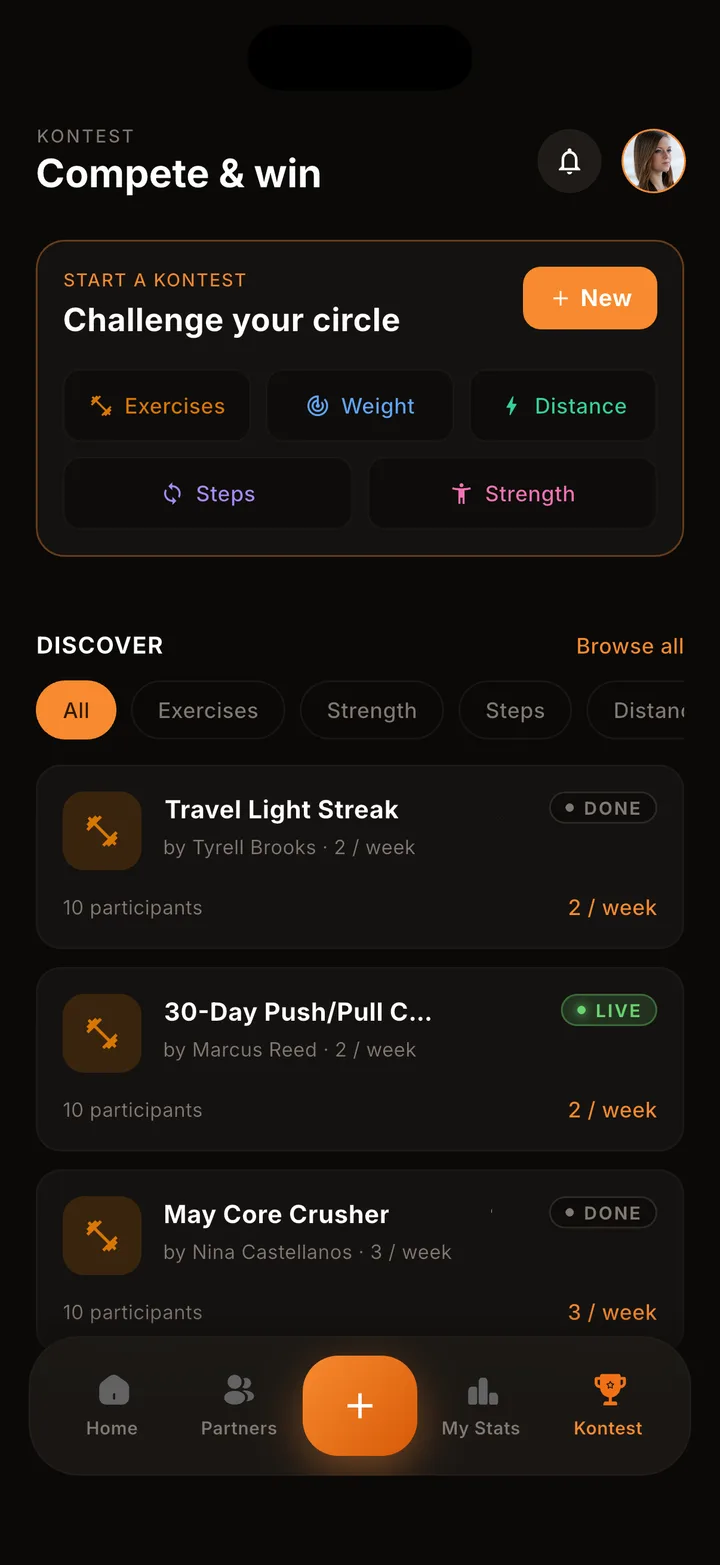
Set it up as a Steps or Distance kontest in Kontest (that's our app, full disclosure) using the same weekly targets above, invite the group, and let everyone log their own walks. The leaderboard updates the moment anyone logs one, so nobody's manually tallying screenshots at the end of the week.
The scoring problem shows up fast in a mixed group. Your friend who runs half marathons and your friend who hasn't walked further than the mailbox in a year are not competing on the same curve if you just add up raw steps or minutes. Score by percentage of each person's own daily target hit instead of raw totals. Everyone chasing 100 percent of their own number keeps it fair without slowing down the person who could walk circles around the rest of the group. For more scoring setups built the same way, our list of fitness challenge ideas covers 25 of them, each with its own handicap for exactly this problem.
What results to expect (the honest version)
Four weeks of daily walking will not turn into a dramatic before and after. Be honest with yourself about that going in, or day 20 starts to feel like failure when it's actually right on schedule.
What you can expect: a walking habit that's stopped requiring willpower by week 3, because it's simply what you do at a certain time of day now. More steady energy through the afternoon, since a short walk beats a second coffee for most people. Slightly easier breathing on stairs or a light jog by week 4, since your cardiovascular system responds to consistent low intensity work faster than most people expect. If weight loss is part of your goal, walking helps, but the calorie burn from 20 to 45 minutes a day is modest on its own. The real value is that a habit you can sustain past day 28 beats a harder plan you quit on day 10.
What you shouldn't expect: a transformed physique, a specific number on the scale, or results that outpace what four weeks of moderate cardio actually produces. This challenge is a floor to build from, not a finish line for your fitness.
Day 29: what's next
Day 28 ending doesn't mean the walking should. Three reasonable moves from here.
Keep the same routine going, just at week 4's level (35 minutes, or your steps equivalent), since you've already built the habit and there's no reason to let it lapse the day after you finish. Run it again at a harder level: add rucking sooner, push the finisher walk out to 60 minutes, or set a distance goal for day 28 instead of a time goal. Or add strength on top of the cardio base you just built. If lifting has been on your list, our 30 day workout plan is built the same way this one was, progressive, with a catch up day in every week, and it's a natural next step now that daily movement isn't the hard part anymore.
Whatever you pick, keep the kontest running. A 28 day walking challenge works because the finish line forces you to show up, but the habit only sticks if something keeps you accountable after day 28 stops being special. Start your first walking kontest free in Kontest and get the whole group chasing the same calendar.
FAQ
How many steps should I walk a day to see results from a walking challenge? There's no single magic number. A commonly cited range for general health benefits is somewhere between 7,000 and 10,000 total daily steps, including whatever you already walk in a normal day, not just a dedicated walk. The calendar above adds roughly 2,000 to 4,500 of those steps on top of your baseline, which is meaningful progress for most people without needing to hit a big round number starting on day 1.
What's the difference between a 28 day and a 30 day walking challenge? Functionally, almost nothing, both are close to a month of daily walking. The practical difference is that 28 days divides evenly into four full weeks, so the calendar and any weekly targets land on the same days each week, while a 30 day walking challenge leaves two extra days that don't fit a weekly structure and often get skipped or tacked onto the end unplanned.
What is a good walking challenge for someone who is completely out of shape? Start at the bottom of the calendar above, 20 minutes a day, and don't skip ahead to a harder week just because it feels slow at first. The entire point of a sedentary starting point is that consistency at an easy level beats intensity you can't repeat, and this progression is built to get you moving without requiring any base fitness at all.
What are some walking challenge ideas to make it more social or more difficult? For difficulty, add incline, pace, or a weighted pack, all covered above. For social, turn it into a group kontest and score it by percentage of each person's own target instead of raw totals, so mixed fitness levels can actually compete on the same page instead of the fittest person winning by default.
Can a walking challenge help with weight loss? It can contribute, but walking alone rarely produces fast weight loss on its own. Twenty to 45 minutes of walking a day burns a modest number of calories. The bigger value is that walking is sustainable enough to stick with well past day 28, and a sustained habit beats an aggressive plan you abandon in two weeks, every time weight loss is the actual goal.