A 30 day workout plan doesn't fail because the exercises are wrong. It fails because almost everyone who tries one hits the same wall around day 17, right when the workouts stop feeling new and the results still aren't visible yet. This one is built around that wall instead of pretending it won't happen: progressive but forgiving, with a catch-up day built into every week and a full calendar below so you never have to guess what today's session is.
Here's the whole thing: the complete 30 day calendar with every session filled in, three ways to scale it to where you actually are, the exact rule for catching up a missed day without wrecking the week, and an honest answer to what 30 days can and can't do for you.
Why most 30 day challenges fail at day 17
Most 30 day workout challenges are designed to look hard on day one, not to still be running on day twenty. They start you at full intensity, six or seven days a week, with no plan for the inevitable Tuesday you're exhausted or sick or just don't want to go. The first missed day feels like failure. The second one feels like proof the whole thing was a bad idea. By day 17, roughly the point where the initial motivation of "new month, new me" has worn off and the soreness has stopped being novel, most people quietly stop.
That's not a discipline problem. It's a design problem. A plan that has no room for a bad week is a plan that ends the first time you have one.
This calendar is built differently on purpose. Training four days a week instead of six leaves real recovery in the schedule instead of squeezing it out. Every week ends with a flex day built for catching up, not just resting. And the day that lands on day 17 in the calendar below is deliberately an easy one, active recovery instead of a hard session, right when motivation typically craters. You're not fighting the plan and your own energy at the same time on the day it matters most.
The 30 day workout plan: full calendar
The structure is a 4-day upper/lower split: two upper body sessions and two lower body sessions a week, split into an A and a B version of each so nothing gets stale before day 30. Two active recovery days and one catch-up day round out the week. Rest 2-3 minutes between the first two exercises on each day and 60-90 seconds on the rest.
Upper A
| Exercise | Sets | Reps | RPE |
|---|---|---|---|
| Barbell bench press | 4 | 6-8 | 7-8 |
| Seated dumbbell shoulder press | 3 | 8-10 | 7-8 |
| Lat pulldown | 3 | 10-12 | 7 |
| Dumbbell lateral raise | 3 | 12-15 | 7 |
| Triceps pushdown | 2 | 12-15 | 7 |
Lower A
| Exercise | Sets | Reps | RPE |
|---|---|---|---|
| Barbell back squat | 4 | 6-8 | 7-8 |
| Romanian deadlift | 3 | 8-10 | 7-8 |
| Walking lunge | 3 | 10/leg | 7 |
| Standing calf raise | 3 | 12-15 | 7 |
| Hanging knee raise | 3 | 10-12 | 7 |
Upper B
| Exercise | Sets | Reps | RPE |
|---|---|---|---|
| Barbell row | 4 | 6-8 | 7-8 |
| Incline dumbbell press | 3 | 8-10 | 7-8 |
| Pull-up (assisted if needed) | 3 | 6-10 | 7-8 |
| Face pull | 3 | 12-15 | 7 |
| Dumbbell biceps curl | 2 | 10-12 | 7 |
Lower B
| Exercise | Sets | Reps | RPE |
|---|---|---|---|
| Barbell deadlift | 3 | 5 | 8 |
| Front squat or goblet squat | 3 | 8-10 | 7-8 |
| Hip thrust | 3 | 10-12 | 7-8 |
| Seated leg curl | 3 | 12-15 | 7 |
| Plank | 3 | 30-45 sec | 7 |
Here's every day mapped out. Start on whatever day of the week works for you, day 1 doesn't have to be a Monday.
| Day | Session | Notes |
|---|---|---|
| 1 | Upper A | Log your working weights, you'll want them for day 29 |
| 2 | Lower A | |
| 3 | Active recovery | 20-30 min walk, stretch, or easy bike. No lifting |
| 4 | Upper B | |
| 5 | Lower B | |
| 6 | Active recovery | |
| 7 | Catch-up / rest | Make up one missed session, or rest if you didn't miss one |
| 8 | Upper A | Repeat day 1's weights, add a rep or 5 lb if it felt like RPE 7 or under |
| 9 | Lower A | Same progression rule |
| 10 | Active recovery | |
| 11 | Upper B | |
| 12 | Lower B | |
| 13 | Active recovery | |
| 14 | Catch-up / rest | Halfway point. Worth a quick check of how the weights are moving |
| 15 | Upper A | Third pass, same rule: push a rep or the load if last time was easy |
| 16 | Lower A | |
| 17 | Active recovery | Deliberately easy, see "why most challenges fail at day 17" above |
| 18 | Upper B | |
| 19 | Lower B | |
| 20 | Active recovery | |
| 21 | Catch-up / rest | |
| 22 | Upper A | Fourth pass, this should feel noticeably more automatic than day 1 |
| 23 | Lower A | |
| 24 | Active recovery | |
| 25 | Upper B | |
| 26 | Lower B | |
| 27 | Active recovery | |
| 28 | Catch-up / rest | |
| 29 | Test day | Repeat one lift from day 1 at the same reps and compare the weight directly |
| 30 | Active recovery | Light walk, then log what changed since day 1. Read "day 31" below |
Scaling: beginner, intermediate, spicy
Beginner. Swap the barbell lifts for dumbbell or machine versions of the same movement (goblet squat for back squat, dumbbell bench for barbell bench) and hold RPE at 6-7, meaning 3-4 reps left in the tank on every set. If two active recovery days a week isn't enough, turn one of the catch-up days into a full rest day too. Nobody fails a 30 day workout plan by going too easy in week one.
Intermediate. Run it exactly as written. RPE 7-8 across the board, and the rule for adding weight is simple: if you hit the top of your rep range on every set, add weight or a rep next time that session comes around. If you didn't, repeat the same numbers.
Spicy. Add a fifth training day (an arms and core finisher works well), push the last set of each main lift to RPE 9, and cut rest on the accessory work to 60 seconds. Keep the active recovery days even if you're tempted to cut them, they're doing real work for your joints and your nervous system, not just filling a calendar square.
The catch-up day rule
Days 7, 14, 21, and 28 exist for exactly one purpose: catching up a single missed session from that week. If you skipped Lower B on Friday because of a late meeting, that's what the catch-up day is for.
The rule has one hard limit: catch up one missed session, never two. If you missed two sessions in a week, do the more recent one and let the older one go. Doubling up sessions in a single day doesn't recover the lost training, it just makes you too sore to train well the next day, which usually costs you a second session on top of the first.
If you didn't miss anything that week, the catch-up day is just a bonus rest day. Take it. You've earned it and you'll need the recovery for the week ahead.
What results to actually expect in 30 days (honest)
A 30 day workout plan will not transform your body. Anyone promising visible muscle gain or a dramatically different physique in 30 days is selling something, not coaching you. What 30 consistent days actually builds is a habit and a skill set, and both of those are worth more than they sound like on paper.
By day 29's test, expect the same weight to feel easier, or a rep or two more than day 1 at the same weight. Expect your form on the main lifts to look noticeably cleaner on video than it did on day 1, since four weeks of repetition is enough to smooth out a lot of early awkwardness. Expect the walk from your car to the gym to require less negotiating with yourself by week three. Those are real, measurable wins. They're just not the kind you can see in a before-and-after photo.
The physique change everyone actually wants takes months, not weeks, of the exact consistency this plan is training you to build. Treat these 30 days as proof you can do that, not as the finish line itself.
Do it with someone: the completion rate difference
The single biggest difference between a 30 day challenge that gets finished and one that quietly dies around day 17 is whether someone else is expecting you to show up. Skipping a solo workout costs you nothing but your own progress. Skipping on a training partner costs you a conversation you'd rather not have.
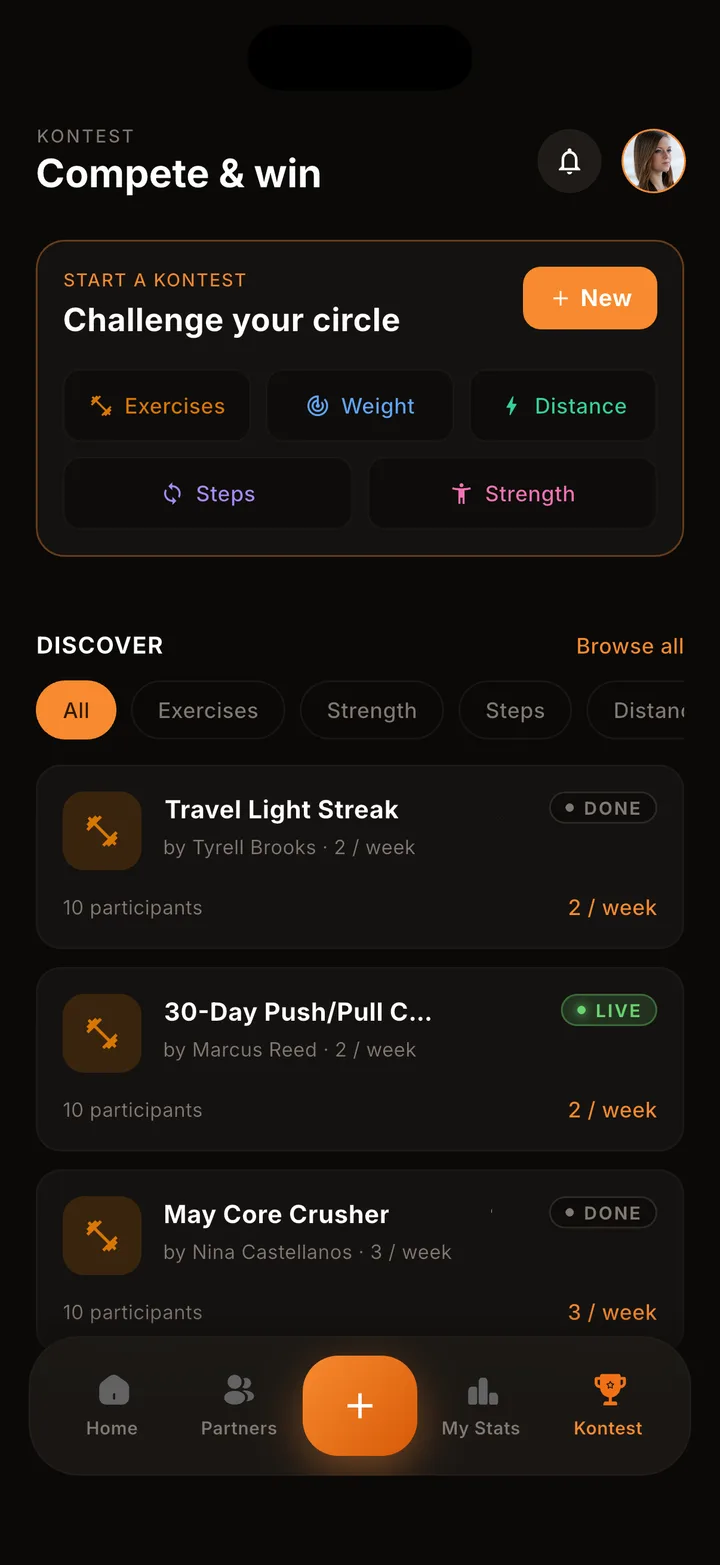
Kontest is built around exactly that. Start a kontest around this plan (you can build one by exercises, weight, distance, steps, or strength), invite whoever's doing this 30 days with you, and log every session as you complete it. Kontest tracks your sessions and your current PR for each lift automatically, and turns them into a shared leaderboard so both of you can see who's actually shown up. XP is positive-only, so a missed day never tanks your score, it just means there's more ground to make up on the next catch-up day.
If 30 days goes well and you and your training partner want more ways to keep competing, our fitness challenge ideas post has two dozen more to pick from once this one's done.
What to do on day 31
Day 31 is a decision point, not an ending. Three good options, depending on how the last 30 days felt.
If the four-day upper/lower split felt good and you want more structure for the next stretch, our beginner workout plan lays out a 12-week progression built on the same principle of showing up over optimizing, with a clear phase-by-phase plan instead of a single 30 day block.
If four days a week is more than your schedule can protect long term, our 3-day workout split covers how to get similar weekly volume in fewer sessions, which is often the more sustainable choice once the challenge-week adrenaline wears off.
If you just want to keep the exact rhythm you built, run this calendar again. Start the numbers where day 29 left off, not where day 1 did. That's the whole point of the log you've been keeping.
Whatever you pick, don't take a week off first "to recover" unless you're actually run down. A week off after 30 days of building a habit is usually how the habit ends.
FAQ
What is a good 30 day workout challenge for a complete beginner? Start with the beginner scaling above: dumbbell and machine versions of the main lifts, RPE 6-7, and don't hesitate to turn a catch-up day into a full rest day if two active recovery days a week isn't enough yet. The goal in month one is finishing the calendar, not lifting heavy.
Is a 28 day workout challenge basically the same as a 30 day one? Functionally, yes. Two days barely changes the training stimulus. If you're running a 28 day version of this plan, drop the last active recovery day and go straight from day 28's catch-up to a day 29 test, the structure holds either way.
Can you actually build muscle in a 30 day exercise challenge? You can start the process, you can't finish it. Thirty days is long enough to build real technique and a training habit, and you'll likely add some strength on your main lifts, but visible muscle growth generally needs a few months of consistent training beyond that, not 30 days.
What happens if I miss more than one day during the 30 day challenge workout? Use the catch-up day to make up the most recent missed session and let the older one go, per the rule above. If you miss most of a full week, don't restart the whole 30 days, just pick the calendar back up on the next scheduled training day.
Do I need a gym for this 30 day workout plan? The beginner scaling only needs a pair of dumbbells, which a decent home setup can cover. The intermediate and spicy versions lean on a barbell and rack for squat, bench, row, and deadlift, which is where most home gyms run out of equipment.
A 30 day workout plan is a short enough commitment that "I don't have time" stops being a real excuse, and long enough to prove to yourself you can actually finish something you start. Run the calendar, use the catch-up day when you need it, and start a kontest with the person you want showing up on day 30 next to you.