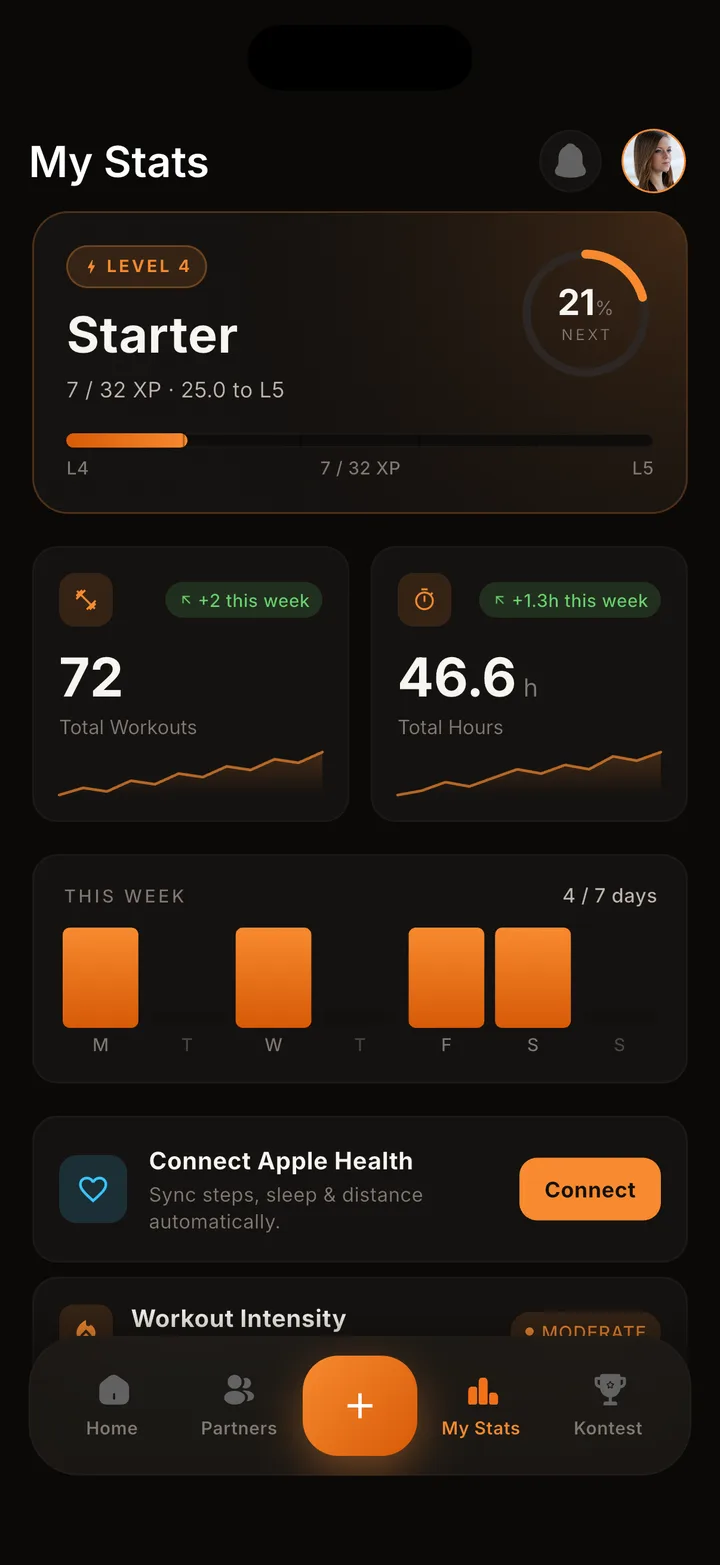
A fitness challenge only works if two people can look at the leaderboard and agree who's winning. Everything else, the theme, the prize, the group chat trash talk, is decoration.
Below are 25 real fitness challenge ideas, sorted by who you're doing them with: friend groups, couples, offices, gym vs. gym, and solo. Every one comes with actual rules: duration, what counts, how you score it, and how to handicap it so the fittest person in the group doesn't win by default. Then the part most fitness challenge lists skip: why most of these die by week two, and what actually fixes it.
What makes a fitness challenge stick
Three things separate a challenge that finishes from one that quietly dies in a group chat nobody checks anymore.
Short duration. Two to four weeks beats twelve every time. Long challenges lose people to a bad week 3, and once someone's out of contention they stop logging entirely, which drags the whole group down with them. Every idea below is built to run in one month or less.
Clear scoring. One number, decided before anyone starts. "Most consistent" is not a score. "Most workouts logged, ties broken by total volume" is a score. Write it down before day one, not after someone's already ahead.
A visible leaderboard. A challenge that lives in someone's head or a scattered group chat thread dies the moment that person gets busy. A challenge everyone can check any time they want stays alive on its own.
Challenges for friend groups (8 ideas)
1. The Streak Challenge. Log a workout every day for 21 days straight, no zero days. Scoring: whoever has the longest active streak at the end wins; a missed day resets you to zero, no exceptions, no "it doesn't count because I was traveling." Handicap: a 20-minute walk counts as a full workout day, so this rewards consistency, not intensity. It's the simplest challenge on this list and usually the one that pulls in the person who "isn't really a gym person" but will absolutely show up for a streak.
2. Push-Up Ladder. Do push-ups equal to the day of the month: 1 on day 1, 15 on day 15, 30 on day 30. Scoring: total reps completed across the whole month, missed days count as zero reps for that day rather than disqualifying you. Handicap: knee push-ups count at full credit, since this is about showing up daily, not push-up form purity. Split it into 2-3 sets across the day if 30 straight feels like a lot by month's end.
3. Mileage Race. Most combined miles run, walked, or biked over 4 weeks, however you rack them up. Scoring: total logged distance, straight leaderboard, no bonus points for pace. Handicap: weight cycling and biking miles at 40% of running miles, since a biked mile takes a fraction of the cardiovascular effort of a run, and without that adjustment the person with a bike wins by default every time.
4. PR Chase. Everyone picks one lift at the start, has to stick with it, and whoever adds the most weight to it in 4 weeks wins. Scoring: percentage increase from your week-1 number, not raw pounds added, so a 220 lb squatter adding 15 lb and a 315 lb squatter adding 20 lb are actually competing on the same scale. Set a baseline number in week 1 before anyone starts chasing it, or the whole challenge is built on guesses.
5. No-Skip Week. Everyone writes down their own planned workouts for the week, then has to hit every single one, every week, for a month. Scoring: fewest missed sessions against your own stated plan, not against anyone else's. This one rewards the person who plans realistically over the person who plans the most, since padding your schedule with five workouts just to miss two doesn't help your score.
6. Exercise Variety Bingo. Build a 5x5 bingo card of exercise types before you start (a run, a leg day, a new class, a hike, a bodyweight circuit, and so on). Log a matching workout to mark a square. First person to complete a full row, column, or the entire board wins. Duration: 3 weeks. Good for a group that's stuck doing the same three workouts and needs a reason to branch out.
7. Plank Progression. Everyone logs their max plank hold once a week for 4 weeks, filmed or timed by a phone so nobody's fudging the number. Scoring: biggest total improvement in seconds from week 1 to week 4, not the longest single hold, so it rewards progress over whoever already had a strong core walking in. Great starter challenge for a group with wildly different fitness levels.
8. Volume Bracket. Total weight lifted (sets times reps times load) across every logged workout in a month, added up across the whole group's training. Scoring: straight leaderboard by total pounds moved, no adjustments. This one openly favors people who train more often and lift heavier, which is exactly the point, it's the one challenge on this list built for the group's most committed lifters to actually compete against each other.
Couples challenges (4 ideas)
9. Loser Cooks. Whoever logs fewer workouts each week cooks dinner for the other that weekend. Scoring: simple workout count, reset weekly so one bad week doesn't haunt you for the rest of the month. Low stakes, high accountability, and it turns a normal Tuesday into a reason to get one more session in before the week resets.
10. Step Duel. Daily step count, head to head, for 2 weeks straight. Scoring: total steps across the two weeks, loser picks where the winner takes them to celebrate at the end. It's a challenge that pays for itself either way, and it's an easy way to turn "we should walk more" into something that actually happens.
11. Mirror Challenge. Same workout, same day, different weights and reps scaled to each person's actual level. Instead of comparing who lifted more, score effort: rate how each set felt (easy, moderate, all-out) and compare those ratings instead of the number on the bar. This one works especially well for a couple at very different training experience, since nobody's chasing a number they were never going to hit.
12. Sunrise Streak. Work out together before 8am, 4 days a week, for 4 weeks straight. Scoring: combined completion rate as a team against a shared target, not against each other, so a missed morning is a shared miss, not a loss. This one's designed to build a habit together rather than create a winner and a loser out of two people who live together.
Office and group chat challenges (7 ideas)
13. Step Count Standings. Team step challenge, tracked weekly in a shared channel or spreadsheet. Scoring: weekly total per person, lowest total buys coffee for the group that Friday. Keep it running 3 to 4 weeks before it goes stale, longer than that and the same one or two people usually stop bothering to report their numbers.
14. Standing Desk Streak. Log hours spent standing or moving during the workday instead of sitting the whole shift. Honor system, self-reported in the group chat each evening before logging off. Scoring: most days hitting a shared target (3 hours is realistic for most desk jobs) over 2 weeks. Works well paired with a standing desk, but a "walk while you're on calls" rule gets most people there without one.
15. Stair Climb Challenge. Total flights climbed in the office building over 2 weeks, self-tracked by whatever counting method the group agrees on (a fitness watch, or just an honest tally). Scoring: total flights, leaderboard updated daily in the group chat so people can see where they stand before the elevator temptation hits. Works best in a building with more than two floors and an elevator everyone's tempted to take instead.
16. Lunch Walk League. Commit to a set number of lunchtime walks a week, 3 is realistic for most schedules. Scoring: total walks completed over a month, group leaderboard, one point per walk. Bonus rule: walks with a coworker count double, since half the point of this one is getting people away from their desks together instead of just hitting a personal number alone.
17. Hydration Challenge. Hit a daily water goal (half your bodyweight in ounces is a common rule of thumb), tracked as a streak in the group chat. Scoring: longest active streak over 2 weeks, one missed day resets you back to zero. Simple, low-effort, and a good starting challenge for a team that isn't ready to commit to anything harder yet.
18. Sleep Streak. Log 7 or more hours of sleep a set number of nights per week, self-reported honestly in the group chat each morning. Scoring: most nights hitting the target over 3 weeks. It's an unusual office challenge, but it tends to get more genuine buy-in than another step count, since everyone already knows they should be sleeping more.
19. Desk Break Challenge. A set number of 2-minute movement breaks per workday (stand, stretch, walk the hallway, anything that gets you off the chair). Scoring: total breaks logged over 2 weeks, self-tallied at the end of each day. Not glamorous, but it's the one most desk jobs actually need, and it's an easy entry point for coworkers who'd never sign up for a "fitness" challenge by name.
Gym vs. gym challenges (3 ideas)
20. Total Volume Battle. Combined pounds lifted across all participating members in a month, added up across every logged workout on both sides. Scoring: total volume divided by number of participants, so a gym fielding 8 people isn't just beating a gym fielding 4 on headcount alone. Agree on the participant list and the per-capita math before anyone starts logging, or the final tally becomes its own argument.
21. Attendance War. Total check-ins across 4 weeks between two gyms or two training groups, however members choose to log a session. Scoring: check-ins per member, the same per-capita handicap as the volume battle above, since raw totals just reward whichever group has more people signed up, not whichever group is actually showing up more consistently.
22. Big Three Improvement. Combined percentage improvement across squat, bench, and deadlift for every participant, measured over 4 weeks against a baseline everyone records in week 1. Scoring: average percentage gain per lifter, not total pounds added, so a beginner's fast early progress counts for as much as an advanced lifter's slower, harder-won gains on the same three lifts.
Solo challenges that still work (3 ideas)
23. Beat Last Month. Total workout count or total volume, this month versus last month, no group required and no one else's numbers involved. Scoring: percentage improvement over your own baseline from the previous month. The only opponent is who you were 30 days ago, which makes this the easiest challenge on the list to actually stay honest about.
24. The No-Break Streak. 30 consecutive workouts, no skipped days, entirely self-imposed with no one else to answer to but yourself. Scoring: pass or fail, you either hit all 30 or you restart the count from day one. Brutal, simple, and effective for building a habit fast, precisely because there's no partial credit to talk yourself into.
25. One Habit, 30 Days. Pick one small thing (a 10-minute walk, a 5-minute mobility routine, hitting a daily protein target) and do it every day for a month, nothing more ambitious than that. Scoring: completion rate out of 30 days. This is the one to start with if the other 24 feel like too much, since a habit that's actually easy to keep beats an ambitious one you quit in week one.
Why most group challenges die by week 2
It's rarely motivation. It's scorekeeping.
Someone forgets to text their step count. Someone disputes whether a 15-minute walk counts as a "workout." Someone's been quietly ahead the whole time but nobody's actually tallied it, so the leaderboard everyone's supposedly racing on doesn't exist anywhere except as a vague sense of who's been posting the most in the group chat. By week two, the challenge hasn't officially ended, it's just stopped being real to anyone.
The fix isn't more willpower. It's removing the job nobody signed up for: the one person manually adding up everyone else's numbers from screenshots and honesty.
How to run any of these in Kontest
Every idea above needs three things to survive: a name, a length, and a way to track who's actually doing the work. That's what a Kontest is built to be.
When you start one in the app, you pick a challenge type first: Exercises (a weekly workout count, the simplest option), Weight, Distance, Steps, or Strength. That alone covers most of this list without any workaround. The Streak Challenge and No-Skip Week run on Exercises, Mileage Race and Step Duel or Step Count Standings run on Distance or Steps, and Volume Bracket or Total Volume Battle run on Weight.
From there it's a couple minutes of setup: name it, set the weekly target for whichever type you picked, choose public (anyone with the link can join) or private (you invite people directly), and pick a start and end date.
Once it's running, every logged workout, weigh-in, or distance entry from every participant counts automatically. Nobody has to self-report into a group chat, and the leaderboard updates on its own as people log, so the scorekeeping problem above just doesn't happen.
A few ideas here still fall outside all five types. Most of the office ones (hydration, standing desk time, sleep, desk breaks) don't map to any Kontest type, so those still work best kept in the group chat by hand. For anything scored by percentage improvement rather than a raw total, like the PR Chase or Big Three Improvement, check the Strength type when you set one up, otherwise fall back to logging everyone's numbers in the same Kontest and comparing manually.
One note on duration: Kontests run in whole weeks, from 1 to 5. A "30 day fitness challenge" rounds cleanly to 4 weeks, close enough that nobody will notice the two missing days.
Pick one and launch it in your group chat tonight. Kontest keeps score so nobody argues. And if the challenge itself isn't the hard part but getting your group to actually show up is, that's its own problem worth reading about.
FAQ
What's a good 30 day fitness challenge for beginners? Start with something binary and forgiving, like the Streak Challenge with a 20-minute walk counting as a full day, or One Habit, 30 Days built around a single small target. Avoid anything scored on raw performance (heaviest lift, fastest mile) as a beginner's first challenge; those favor whoever's already fittest, not whoever's most consistent.
How do you make a fitness challenge fair when people are at different fitness levels? Score percentage improvement over each person's own baseline instead of raw numbers, and handicap different activity types (a biked mile isn't a run mile) before the challenge starts, not after someone complains. Every idea above includes a specific handicap rule for exactly this reason.
What's the best fitness challenge app for friends? That depends on what you want tracked, but Kontest (our app) is built around exactly this list: create a challenge around exercises, weight, distance, steps, or strength, invite people, and it tracks everyone's numbers against the target automatically with a leaderboard, instead of you tallying it by hand.
How long should a workout challenge run? Two to four weeks is the sweet spot. Long enough to build a real habit, short enough that one bad week doesn't tank someone's motivation to keep logging for the rest of it.
What should the prize be for a fitness challenge? Keep it small and immediate. Loser buys coffee, loser cooks dinner, loser picks the next challenge. Big prizes (a trip, real money) raise the stakes enough that people start gaming the scoring instead of just working out.
Pick one of the 25 above, set the rules before anyone starts, and put a real leaderboard behind it. That's the entire difference between a fitness challenge that's still running in week 4 and one that quietly died in a group chat nobody's checked since week 2.