A good beginners running workout does not start with running. It starts with walking, on purpose, in planned chunks, so your joints and lungs catch up to your ambition. This plan runs 3 days a week for 6 weeks, uses run/walk intervals from day one, and ends with you running 30 minutes straight without stopping.
If you've tried to start running before and quit inside two weeks, you probably didn't fail. You probably just ran too far, too often, before your body was ready, and your shins or your motivation gave out first. Fix the plan and the running mostly takes care of itself.
Why run/walk beats running until you die
Most people who "start running" pick a distance, run it at whatever pace their legs allow, and stop when they can't breathe. That's not a training plan, it's a stress test, and stress tests are a bad way to build a habit you want to keep for years.
Run/walk intervals work because they let you accumulate real running time without asking your cardiovascular system and your connective tissue to adapt at the same terrifying rate. The walk breaks aren't a consolation prize. They're the mechanism that lets week 1 you and week 6 you both finish every session upright and willing to come back.
This is the same adherence-first logic behind our beginner workout plan for lifting: three days a week, movements you can actually recover from, clear numbers so you're never guessing. Running for beginners works on the identical principle. The version of the plan that gets finished beats the version that looks impressive on paper and dies in week two.
Think of this as a couch to 5k alternative built for people who want a shorter runway. Classic run/walk programs often stretch to 9 weeks. This one compresses the same idea into 6 by starting your run intervals a little longer and progressing a little faster, which works for most beginners as long as you're willing to repeat a week when it kicks your butt.
The 6-Week Beginner Running Workout (Full Plan)
Run this 3 non-consecutive days a week (Monday, Wednesday, Friday works well). Every session opens with a 5 minute walk warm-up and closes with a 5 minute walk cool-down, on top of the intervals below. If a week feels genuinely too hard by the last session, repeat it before moving on. Nobody is grading your speed.
Weeks 1 through 5
| Week | Session (run this 3x that week) | Total running time |
|---|---|---|
| 1 | Run 1 min / walk 2 min, x8 | 8 min |
| 2 | Run 2 min / walk 2 min, x6 | 12 min |
| 3 | Run 3 min / walk 2 min, x5 | 15 min |
| 4 | Run 5 min / walk 2 min, x4 | 20 min |
| 5 | Run 8 min / walk 90 sec, x3 | 24 min |
Week 6: building to a continuous 30 minutes
| Day | Session | Total running time |
|---|---|---|
| Day 1 | Run 15 min, walk 3 min, run 10 min | 25 min |
| Day 2 | Run 20 min, walk 2 min, run 8 min | 28 min |
| Day 3 | Run 30 minutes straight, no walk breaks | 30 min |
That last session is the whole point of the plan. Everything before it exists to get your legs and your lungs ready for 30 unbroken minutes without it feeling like an emergency.
How to know you're ready for the next week
Ready doesn't mean easy. It means you finished every run interval that week at the prescribed length without stopping early, and you could have done roughly one more round if the session had asked for it. If the last run interval of the week left you desperate for the walk break to start, run that same week again before adding time. There's no prize for rushing a 6 week plan into 4, and there's a real cost to skipping ahead on legs that aren't ready yet: shin pain, knee pain, or a burnout that takes you out for longer than the extra week would have.
Pace: how slow is slow enough
Slower than you think, every time. The single most common mistake in a beginner running plan is running the "easy" intervals at a pace that isn't actually easy, which cooks your legs by week 3 and turns the walk breaks into recovery from a sprint instead of active rest.
Use the conversation test. If you can't say a full sentence out loud without gasping for air mid-word, you're running too fast for these intervals. Slow down until you can, even if that means a pace that feels almost embarrassingly gentle. Your 10-minute run in week 5 is supposed to feel sustainable, not heroic.
This will feel slow compared to what you picture when you imagine "running." That's fine. Every fast runner you've ever seen ran this slow at some point too, they just didn't stay here.
Shoes and gear (the short honest list)
You need less than the running aisle wants you to buy. A pair of running shoes fitted for your foot at a specialty running store, replaced roughly every 300 to 500 miles, matters more than anything else on this list. Worn-out cushioning is a bigger injury risk than almost any other gear decision you'll make.
Beyond that: moisture-wicking socks and a shirt (cotton stays wet and chafes), layers you can tie around your waist once you warm up, and sunscreen if you're out in daylight. A phone armband or running belt is nice for carrying your phone, but it's optional, not required, for anything in this plan.
Skip the smartwatch upgrade, the compression everything, and the gel packs until you actually know you'll keep running past week 6. Buy gear to solve a problem you've actually had, not one you're anticipating.
One more that costs nothing: dress for the temperature 10 to 15 degrees warmer than it actually feels standing still, since you'll heat up fast once you're moving. Bring water on anything past 20 minutes or in real heat, and if it's genuinely dangerous out (extreme heat, ice, air quality warnings), a treadmill or indoor loop is a smarter call than gutting out an outdoor session for the sake of the streak.
Breathing, side stitches, and other week 1 problems
Breathing feels impossible in week 1
It usually settles by week 2 or 3 as your body adapts to the new demand. In the meantime, breathe through your mouth and nose together, not just your nose, and find a rhythm (in for two steps, out for two steps is a common starting point) rather than overthinking every breath.
Side stitch, that sharp pain under your ribs
Side stitches are usually tied to shallow breathing or a meal eaten too close to your run. Slow to a walk, take a few deep breaths that fill your belly rather than just your chest, and try exhaling hard the moment the foot opposite the stitch side lands. Give your last real meal at least 90 minutes before you run.
Shins or knees feel achy after a session
Some new soreness in week 1 is normal. Sharp, specific pain that doesn't fade within a day or two is your body asking for more recovery than the plan is giving it, which usually means repeating the current week instead of pushing forward. The run/walk structure exists specifically to prevent this, so trust it over your impatience.
When to add distance vs speed
Once you finish week 6 and can run 30 minutes straight, you've got two honest directions to take it, and you don't have to pick just one forever.
Add distance if your goal is endurance: keep the same easy pace and stretch your continuous run by 2 to 3 minutes a week. This is the direct path toward a 5K (roughly 30 to 35 minutes for most new runners at an easy pace) and eventually longer distances.
Add speed if 30 minutes already feels comfortable and you want to get faster, not just longer: keep most of your weekly runs easy, but let one session a week feel a little harder, run at a pace where a full sentence gets tougher to finish. Don't do both at once. Runners who chase more distance and more speed in the same week are the ones who end up hurt.
Whichever direction you pick, move gradually. Add a few minutes to one run a week, not all three, and hold the other two sessions at your current comfortable length. Jumping from 30 minutes to 45 across the board in a single week is the same mistake as skipping ahead in this plan, just with a longer runway before it catches up to you.
Do it with a friend (the completion rate case)
The same mechanism that keeps lifters consistent works just as well for running: visibility, a small stake, and something to protect. We go deeper on the research behind all three in our breakdown of workout accountability, and none of it is running-specific. A person who can see whether you ran today beats a training plan sitting alone in a bookmark, every time.
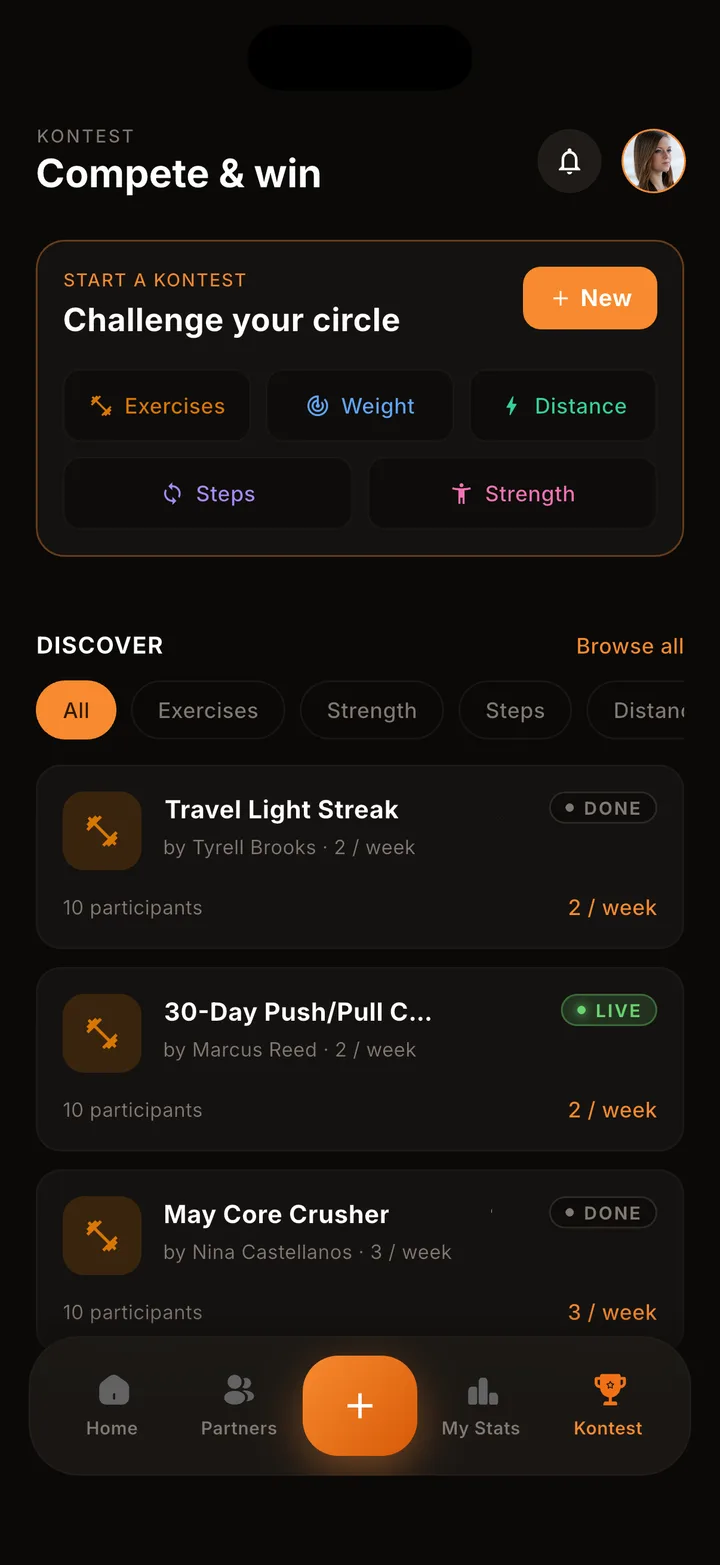
This is easy to set up without overthinking it. Start a Distance kontest with a friend who also wants to run these 6 weeks, and log every session as you finish it, even a quick one-line log with total time counts. If you've already connected Apple Health or Google Fit, the distance from a tracked run adds to your kontest automatically, no double-logging required. Either way, you both get a live leaderboard and a streak that makes skipping day 12 cost something more than a shrug.
Positive-only XP means a missed run doesn't tank your score, it just leaves more ground to make up. That matters for a beginner running plan specifically, because the plan above is designed to survive a missed session; your motivation system should be too.
FAQ
How do I start running if I've never run before? Start with run/walk intervals, not a continuous run. Running for beginners fails most often because people try to run further than their current fitness supports on day one. Week 1 of this plan is just 1 minute of running at a time, repeated 8 times, which is a realistic starting point for almost anyone who can walk comfortably for 30 minutes.
How long should a beginner running plan be? Long enough to progress gradually without rushing your joints and lungs past what they can adapt to in a week. Six weeks works if you're willing to repeat a tough week before moving on; some people need 8 or 9 weeks to reach the same continuous 30-minute run, and that's not a failure, it's just a different starting fitness level.
Is walking part of a run considered bad for beginners? No. Walk intervals are the feature, not a consolation prize. They let you accumulate more total running minutes per week than you could running continuously from day one, because you're not sidelined by injury or burnout from starting too hard.
Is this a good couch to 5k alternative, or should I just do the original? Either works. The classic couch to 5k format runs about 9 weeks and progresses a little more gradually; this plan compresses the same run/walk idea into 6 weeks by starting with slightly longer run intervals. If 6 weeks feels aggressive once you're in it, there's no penalty for stretching any week to two sessions before you move on.
How many days a week should a beginner run? Three, on non-consecutive days, is the sweet spot for almost every new runner. It's enough frequency to build real fitness and too little to prevent recovery between sessions, which is exactly the gap where shin splints and burnout live.
Six weeks from now you won't be a marathoner, and that was never the goal. This beginner running workout was built to get you through one continuous 30-minute run without stopping, using the same run/walk intervals that work for absolutely everyone who's patient enough to follow them in order. Log every run in Kontest, start a kontest with a friend who'll run it alongside you, and let the leaderboard handle the days your motivation doesn't show up.