Motivation gets you to the gym on day one. It does not get you there on day forty, when it's raining, you slept five hours, and nothing hurts enough yet to remind you why you started. If you've quit a program before, that's not a willpower problem. It's a design problem, and the fix is an accountability partner, not another burst of inspiration.
This is the thesis of every serious behavior-change study on exercise: motivation is a mood. It spikes after a good workout, a new program, a body-fat scan. Then it decays, on a schedule, the same way every time. Accountability is the opposite. It's a system that doesn't care how you feel that day. Build the system and the feelings become irrelevant.
Motivation runs out on schedule
You can predict the drop-off almost to the week. New Year's resolution gyms are packed in January and back to normal by the second week of February. Most people who start a new program lapse inside the first six weeks, right around the point where novelty wears off and the workouts stop feeling like an event and start feeling like a chore.
That's not a character flaw. Motivation is a feeling, and feelings are unreliable fuel for a task you need to repeat 150-plus times a year. Waiting to "feel like it" is a bet you will lose, because feeling like it was never the mechanism that got you there in the first place. Novelty, identity, a looming goal, those got you there. Once they fade, you need something sturdier.
Accountability is sturdier because it doesn't ask how you feel. It asks whether you showed up, and it makes not showing up cost something: a text you have to send, a streak you have to break, a friend who's going to notice.
What the research says about accountability and adherence
Two bodies of research back this up, and they point at different mechanisms.
The first is implementation intentions, a concept from psychologist Peter Gollwitzer. The idea is simple: a vague goal ("I'll work out more") rarely survives contact with a Tuesday. A specific if-then plan ("if it's 6 p.m. Tuesday, I go to the 6:15 class with Sam") survives a lot more Tuesdays. A 2006 meta-analysis by Gollwitzer and Paschal Sheeran, reviewing 94 separate studies, found that people who formed this kind of concrete plan were substantially more likely to hit their goal than people who just intended to, a medium-to-large effect (d = .65) in a field where most interventions barely move the needle. An accountability partner is a forcing function for exactly this kind of plan, because you can't set a vague, someday if-then with another person. You have to pick a day and a time they'll actually show up expecting you.
The second is commitment contracts, the economics side of the same problem. A field experiment by economists Heather Royer, Mark Stehr, and Justin Sydnor paid employees at a Fortune 500 company to hit gym-attendance targets. Attendance jumped while the money was on the table, which is not surprising, cash works. What's more interesting is what happened after the incentive ended: people who'd only had the cash incentive mostly reverted. People who'd paired the incentive with a voluntary commitment contract, a self-imposed stake tied to showing up, kept a meaningfully higher attendance rate a full year later. The money faded. The commitment structure didn't.
Neither study is about a training partner specifically. Both point at the same underlying lever: a plan tied to a real consequence beats a plan tied to nothing but your own intentions.
The 3 ingredients: visibility, stakes, streaks
Strip out the jargon and effective accountability comes down to three things. Miss any one and the system gets easy to quietly abandon.
Visibility. Someone else has to actually see whether you did the thing. A workout only you know about is a workout you can silently skip. A workout your partner can see on a shared log, or that shows up in a group chat, has a witness. That's the whole mechanism, not guilt, just the simple fact that skipping in front of someone feels different than skipping alone.
Stakes. Something has to be at risk. It doesn't need to be money, though money works well because loss aversion is a strong, well-documented bias, we feel the sting of losing something more than the pleasure of gaining the equivalent. Stakes can be social too: a leaderboard you'd drop on, a streak you'd break, a friend who'd genuinely be annoyed. The point is that missing has to register as a loss, not a neutral non-event.
Streaks. A running count turns "should I go today" into "do I want to break this." Streaks work because they reframe the decision. You're no longer deciding whether today's workout is worth it in isolation, you're deciding whether to torch a number you've been building for weeks. That's a much harder thing to talk yourself into.
You don't need all three to be extreme. A group chat with three friends who log their sessions gives you visibility and a mild social stake. Add a streak counter and you've got all three, which is why apps that combine logging, a visible feed, and streaks tend to outperform apps that just track numbers in private.
How to choose an accountability partner (and the contract to set)
Pick someone whose consistency you respect more than someone whose personality you love. A partner who's flaky lets you be flaky by osmosis, you'll both find reasons to skip the same week. A partner who shows up, even a little grumpy about it, drags you along on the days you'd have talked yourself out of it.
Beyond that, look for someone whose schedule genuinely overlaps with yours, whose fitness level is close enough that neither of you is constantly waiting around or getting left behind, and who's willing to actually say something when you flake, not just quietly note it. An accountability partner who never calls you out isn't an accountability partner, they're just a workout buddy, which is a different and lesser thing.
Once you've picked someone, put the actual terms in writing. It sounds stiff, but a two-minute conversation prevents the slow drift where "we'll figure it out" becomes "we stopped." A simple version:
| Term | Example |
|---|---|
| Frequency | 3 sessions a week, minimum |
| Fixed days | Monday, Wednesday, Friday, 6 p.m. |
| Notice required | Text by 9 a.m. if you can't make it |
| Miss consequence | You owe the group coffee, or you post the miss in the chat |
| Check-in | Log the session somewhere the other person can see it |
| Review point | Revisit the deal in 4 weeks, adjust if it's not working |
That last line matters. Most accountability partnerships that die don't die from one big blowup, they die from silently drifting out of relevance because nobody ever revisited the terms.
Remote accountability: when your gym buddy lives elsewhere
Not everyone gets to train next to their most reliable friend. If your best accountability partner moved cities, or you've always trained with people who live nowhere near your gym, the mechanism still works, you just need a substitute for the "someone can see this" part.
The lowest-effort version is a shared thread: you post a one-line update after every session, they do the same. It's not much, but it restores visibility, which is the ingredient that matters most and the one that's hardest to fake alone.
A better version is a shared log both of you can actually check, not just a chat you can scroll past. Seeing an actual workout, sets and weight and all, land in a feed is a stronger signal than a text that says "done, lol." It's also easier to notice when someone's log has gone quiet for a week, which is exactly the moment a good accountability partner is supposed to say something.
If you're building your training habit from scratch and want the structure locked in before you add a partner, our beginner workout plan walks through a 12-week framework that's easy to hand to a friend and say "let's both do this."
Apps that do this well (short honest list, Kontest included with disclosure)
A few apps are actually built around the accountability mechanism above, not just workout logging with a social feed bolted on.
Strava is the biggest name in social fitness tracking. It's built more for cardio and running than lifting, but the club challenges and segment leaderboards deliver real visibility and light competitive stakes. It's free to use, with a subscription (currently $79.99 billed annually, or higher month to month) unlocking route planning, deeper analytics, and custom challenges.
StepBet, from WayBetter, takes the stakes ingredient literally. You set your own step goal, put money into a shared pot with other players, and split what's left with everyone who hit their target. It's a clean, if narrow, demonstration that a real financial stake changes behavior, and it lines up with what the Royer, Stehr, and Sydnor research found about commitment contracts.
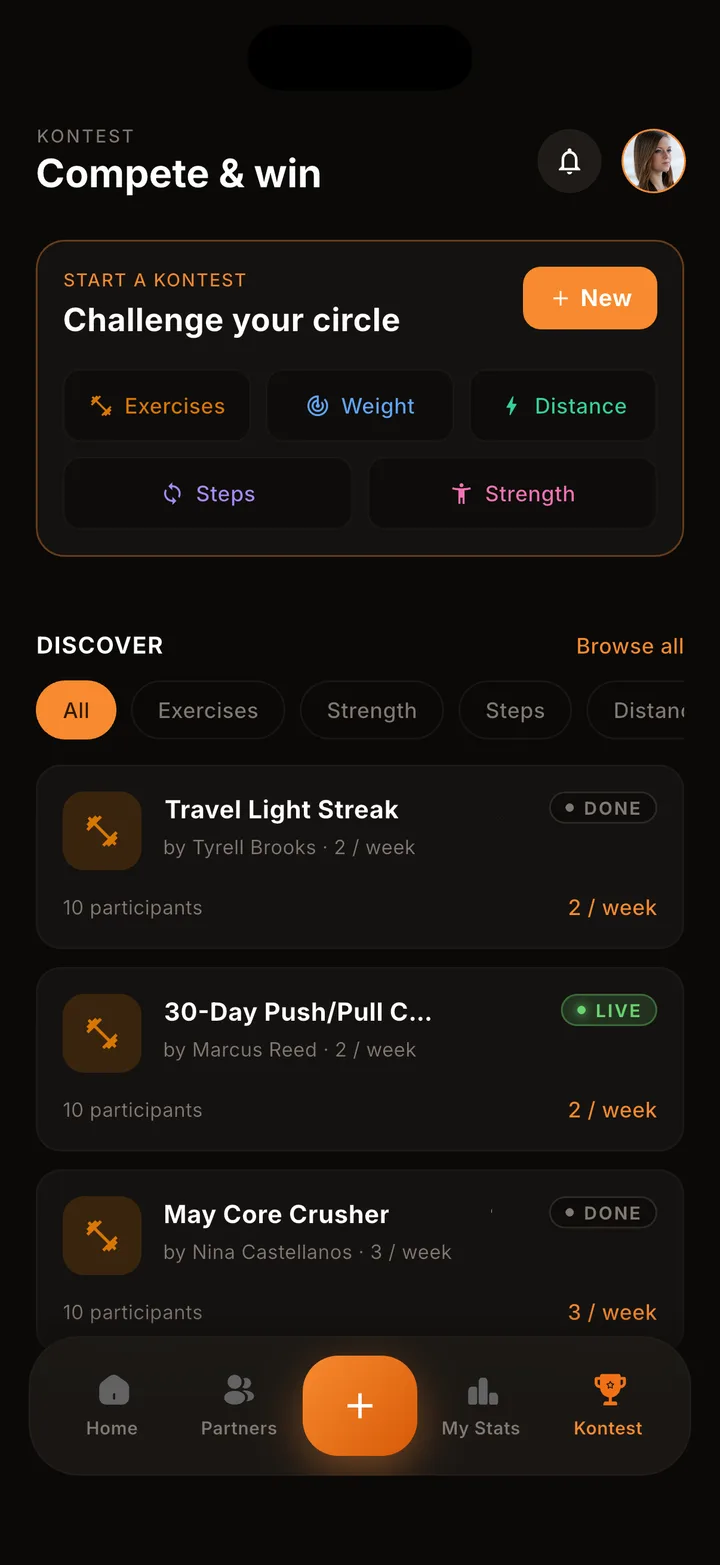
Kontest (full disclosure, that's the app we make) is built around the same three ingredients directly for strength training: you create or join a kontest with friends, every logged set is visible to the group, XP and a live leaderboard supply the stakes, and a running streak gives you something to protect. It skips the financial betting layer and uses competition and social visibility instead, the same mechanism, aimed specifically at lifters rather than steps or cardio.
None of these apps do the accountability for you. They just make the three ingredients above easier to set up than doing it by hand in a group chat.
FAQ
What is an accountability partner for working out? An accountability partner is someone who knows your training plan and checks whether you followed it, in person, by text, or through a shared log. The value isn't companionship, it's the visibility and mild social stake that make skipping a workout feel like a real decision instead of a quiet non-event.
How do I find a gym accountability buddy if I don't already have one? Start with someone whose schedule already overlaps with yours, a coworker, a neighbor, someone from a class you both attend. If nobody in your circle fits, a workout accountability app with a leaderboard or shared feed can supply the visibility and light competition even without an existing friendship to build on.
Do fitness accountability apps actually work, or is it just a gimmick? The mechanism behind them, visibility plus stakes, has real research support even outside app-specific studies: implementation intentions and commitment contracts both show measurable, lasting effects on follow-through. An app doesn't replace the mechanism, it just makes it easier to maintain long-term than an informal arrangement.
What makes a good accountability contract with a workout partner? Write down the specifics: which days, what time, how much notice is needed to cancel, and what happens if someone flakes. Vague plans ("let's work out together sometime") don't survive a busy week. Specific if-then plans do, by a wide margin, according to the implementation-intentions research above.
Can accountability apps for working out replace a real training partner? Not entirely. A human partner adds social pressure an app can't fully replicate. But when a real partner isn't available, either because of scheduling or distance, a well-built app can supply the same visibility and stakes, and for a lot of people that's enough to keep the habit alive.
Motivation was never going to carry you through a full year of training. An accountability partner will, because it doesn't ask how you feel about today's workout, it just asks whether you showed up. Pick someone reliable, write down the actual terms, and if you can't find a partner nearby, download kontest and let a group of friends supply the visibility and stakes instead.