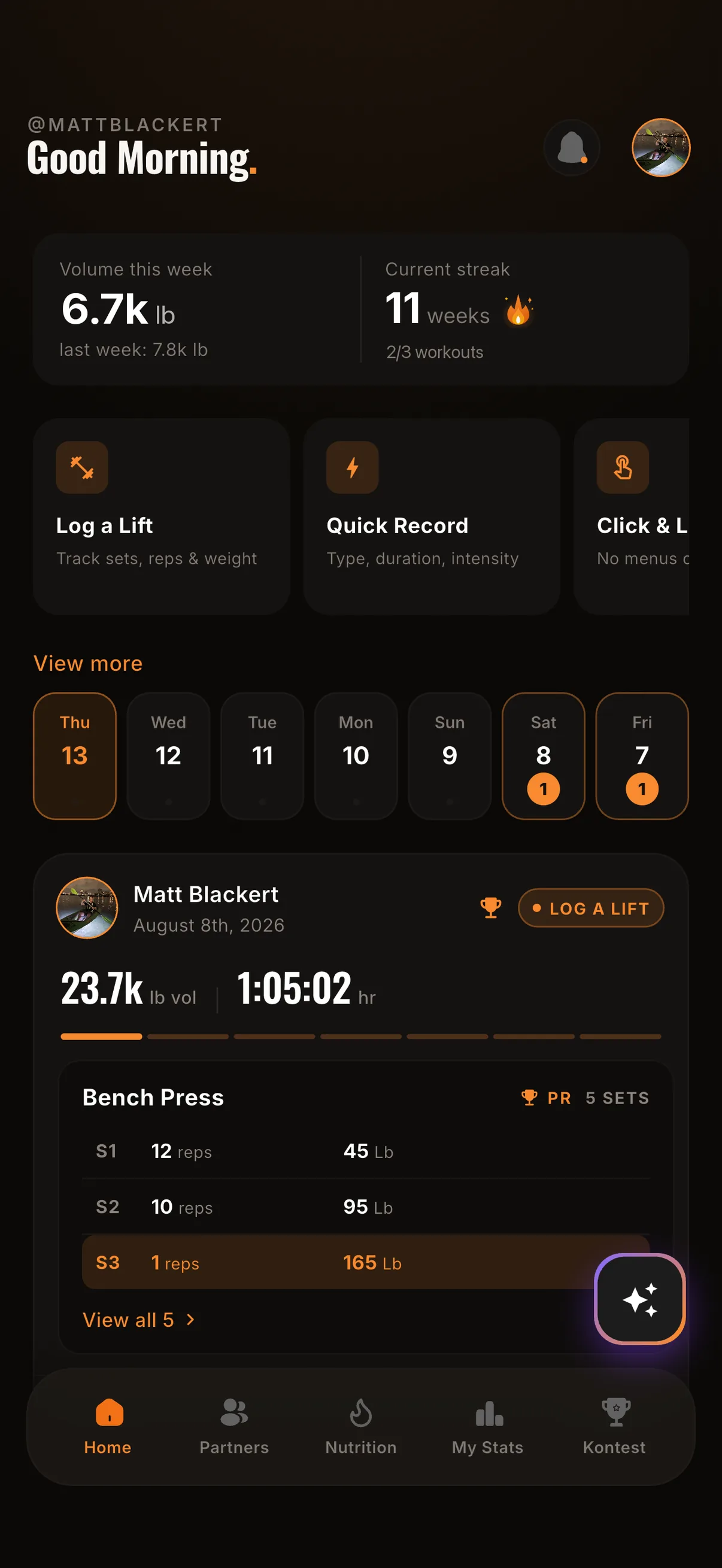
How to track macros without turning it into a second job: set a calorie and protein target from your bodyweight and goal, log what you actually eat for two weeks straight, and stop chasing decimal-point precision once your weight trend and your energy tell you the plan is working. That's the whole system. The math takes ten minutes. The part that actually decides whether it works is whether you're still logging in week three.
Most macro guides sell you the math and skip the part that makes people quit. Below is both halves: the targets, the tracking method that fits your actual life, and the habits that keep you logging past the point where most people give up.
What Tracking Macros Actually Means
Macros (short for macronutrients) are the three categories your calories come from: protein, fat, and carbohydrate. Counting calories tells you how much you're eating. Counting macros tells you what that food is actually made of, which matters because 2,000 calories of chicken, rice, and vegetables builds and holds muscle very differently than 2,000 calories of whatever's fastest to eat standing up.
How to count macros, in one sentence: you set a daily target for grams of protein, fat, and carbs based on your bodyweight and goal, then log your food against that target until logging stops feeling like homework. The number that matters most for a lifter is protein, since it's the one macro most people fall short on and the one most directly tied to keeping (or building) muscle while your calories move.
Each macro does a different job, which is why the split matters and not just the total. Protein repairs and builds the muscle you broke down in the gym, and it's the most filling of the three per calorie, which is part of why a higher-protein plan tends to be easier to stick to in a deficit. Fat supports hormone production and needs a floor, not just a ceiling; dropping it too low for too long is a common, avoidable way a cut stalls out. Carbs fuel the training itself, topping off the muscle glycogen a hard set burns through, which is why lifters who slash carbs too aggressively tend to feel flat and weak under the bar before the scale shows anything.
You don't need to track macros forever to benefit from it. Most of the value shows up in the first month, while you're learning what 40 grams of protein or 600 calories actually looks like on a plate. After that, plenty of people track loosely, or only during specific phases, and still keep the results.
Step 1: Set Your Targets (The Simple Math)
Start with your maintenance calories, the amount that keeps your weight roughly flat, then adjust from there based on your goal.
Estimate your maintenance calories (TDEE). The standard formula is Mifflin-St Jeor for your baseline metabolic rate (BMR), then a multiplier for activity:
- Men: BMR = 4.54 × weight in lb + 15.88 × height in inches − 5 × age + 5
- Women: BMR = 4.54 × weight in lb + 15.88 × height in inches − 5 × age − 161
Multiply your BMR by an activity factor to get your total daily energy expenditure (TDEE):
| Activity level | Multiplier | Roughly means |
|---|---|---|
| Sedentary | 1.2 | Desk job, little intentional exercise |
| Lightly active | 1.375 | Light exercise 1-3 days a week |
| Moderately active | 1.55 | Training 3-5 days a week |
| Very active | 1.725 | Hard training 6-7 days a week |
Adjust for your goal. These are the accepted ranges used in sports nutrition, not a single magic number:
| Goal | Daily calories | Protein | Fat | Carbs |
|---|---|---|---|---|
| Fat loss | TDEE minus 15-25% | 0.8-1.0g per lb bodyweight | 0.3-0.4g per lb bodyweight | Fill remaining calories |
| Maintenance | TDEE | 0.7-0.9g per lb bodyweight | 0.3-0.4g per lb bodyweight | Fill remaining calories |
| Muscle gain | TDEE plus 10-15% | 0.7-0.9g per lb bodyweight | 0.3-0.4g per lb bodyweight | Fill remaining calories |
Protein and fat get set first, in grams. Carbs fill whatever calories are left, since carbs are your training fuel and the macro that can flex the most without hurting your goal.
A worked example. Say you're a 180 lb, 5'10", 30-year-old man who lifts four days a week (moderately active).
- BMR ≈ 1,780 calories
- TDEE (× 1.55) ≈ 2,760 calories
- Cutting target (TDEE minus 20%) ≈ 2,200 calories
- Protein at 1g/lb: 180g (720 calories)
- Fat at 0.35g/lb: 65g (585 calories)
- Carbs, filling the rest: about 225g (900 calories)
Final target: roughly 2,200 calories, 180g protein, 65g fat, 225g carbs. Round every number. If tracking macros to lose weight is the goal, weigh in weekly and adjust calories down another 100-150 if your weight hasn't moved in two to three weeks, not daily based on a single number that's mostly water.
Same math, different goal. Say instead you're a 140 lb, 5'5", 26-year-old woman lifting four days a week and eating to gain muscle.
- BMR ≈ 1,375 calories
- TDEE (× 1.55) ≈ 2,130 calories
- Muscle-gain target (TDEE plus 12%) ≈ 2,390 calories
- Protein at 0.8g/lb: 110g (440 calories)
- Fat at 0.35g/lb: 50g (450 calories)
- Carbs, filling the rest: about 375g (1,500 calories)
Same formula, same table, a completely different set of numbers because the inputs (bodyweight, sex, activity, goal) changed. That's the whole point: there's no universal macro target, only a universal method for getting to your own.
Step 2: How to Track Macros Day to Day (Apps, Photos, and Weighing, Compared Honestly)
Once you have targets, you need a way to log against them that you'll actually keep doing. There's no single right method, only a trade-off between effort and accuracy.
| Method | Effort per meal | Accuracy | Best for |
|---|---|---|---|
| Food scale + logging app | High | Tightest | Your first 2 weeks, or any time you're stuck and need real numbers |
| Logging by serving size or memory | Medium | Solid for most goals | Ongoing tracking once you know your usual foods |
| Describing the meal in plain language | Low | Rougher, still directionally useful | Busy days, keeping the log going without a full breakdown |
| Eyeballing or hand portions | Low | Loosest | Maintenance, once your normal portions are dialed in by feel |
Food Scale + Logging App
Weighing food in grams and logging it against a database entry is the closest you'll get to your actual intake without a lab. It's the right call for your first two weeks, since it's the only method that tells you whether your eyeballed portions were ever close to right in the first place, and it's worth going back to any time your results stall and you suspect your logging has quietly drifted.
Logging By Serving Size or Memory
Once you know what a serving of rice or a chicken breast actually looks like on your plate, you can log by serving size instead of weighing everything and usually land close enough to the scale number to keep making progress. This is where most people settle in for the long haul, accurate enough for real results without turning every meal into a lab exercise.
Describing the Meal in Plain Language
Typing or saying "grilled chicken, a cup of rice, and some broccoli" and letting an app estimate the macros trades some precision for a lot of speed. It's the difference between logging something and logging nothing on a day you're genuinely too busy for a full breakdown, and a rough number beats a blank day every time your streak is on the line.
Eyeballing or Hand Portions
A palm of protein, a fist of carbs, a thumb of fat, is loose but fast, and it works fine once you already know your targets by feel from weeks of closer tracking. It's a maintenance tool, not a starting point: you need the more precise methods first to calibrate what your hand portions actually mean in grams.
A dedicated macro tracking app removes most of the friction here, since it's doing the lookup and the math instead of you. Kontest logs meals with USDA-backed nutrition data when you search and log a specific food, and lets you just describe what you ate in plain words for a fast estimate when you don't have time to break a plate down ingredient by ingredient. Neither is more "correct" than the other, they're two settings for the same job: precise when you need it, fast when you don't.
Whichever method you pick, log the small stuff too. If you're tracking macros to lose weight, an untracked splash of oil or a handful of something from someone else's plate is exactly the kind of thing that quietly erases a deficit over a week. The same goes for supplements: if you take creatine, log it the same way you log a meal or a snack, a quick "5g creatine in water" note, so it's part of the same daily record instead of a separate thing you have to remember.
Step 3: Survive the First Two Weeks
The math is the easy part. The first two weeks are where most people quit, usually for one of three reasons: they forget to log until the day is already over, they treat one messy day as a reason to stop entirely, or the whole process feels heavier than the results justify yet.
Log before you eat, not after. Pulling up the app while your food is in front of you takes fifteen seconds. Trying to reconstruct what you ate at 9pm, after a full day, is where accuracy (and motivation) actually falls apart.
Don't restart after a bad day. One day over target doesn't undo a week of good ones, and it's not a reason to scrap the log and start fresh next Monday. Log the bad day too. It's more useful data than a gap.
Repeat your meals for the first two weeks. You don't need a new plan every day while you're learning your targets. Eating the same three or four meals on rotation means you only have to do the lookup once per meal, not once per day.
Pay attention to timing around training, not just totals. If you're logging a big pre-workout meal, how long you should wait before training depends on the meal's size, not just its macros, and that timing question comes up constantly once you're actually paying attention to what and when you eat.
Two weeks is roughly how long it takes for logging to stop feeling like a new task and start feeling like something you just do, the same way checking your phone does.
How Accurate Do You Need to Be? (The 80/20 Answer)
Gram-perfect tracking isn't the goal, and chasing it is one of the fastest ways to burn out on the whole habit. Landing within about 10g of your protein target and within 150-200 calories of your total most days gets you the large majority of the result a "perfect" log would.
The reason this works is that your body responds to trends over weeks, not the exact number on any single day. A log that's consistently close, five or six days a week, beats a log that's perfect three days and abandoned the other four every time. If a food doesn't have exact nutrition info (a homemade dish, a restaurant plate), take your best estimate, log it, and move on. Don't let the search for a perfect number cost you the log entirely.
The one macro worth being more careful about is protein, since it has the least room for error if the goal is holding onto muscle. If you're going to double check one number before closing the app, make it that one.
Judge your progress on a weekly average, not a single day. Pull your total calories and protein for the week, divide by seven, and compare that to your target instead of scrutinizing Tuesday in isolation. A week that averages close to target, even with one messy day inside it, is a week that worked.
Eating Out, Weekends, and Other Lie-to-Your-Log Moments
Weekdays are easy. A dinner out, a party, or a weekend with no set schedule is where most tracking habits actually break, not because the food is impossible to estimate, but because logging it feels like more effort than it's worth in the moment.
Log your best guess before you eat, not your exact numbers after. Most restaurant meals can be estimated close enough from a similar item you already have logged. Waiting for perfect information means not logging at all.
Order like you're going to log it. A protein-forward main, a side you can estimate (rice, potatoes, vegetables), and a sauce on the side keeps a restaurant meal inside the range of things you can actually track, without turning dinner into a math problem at the table.
Bank calories conservatively, not aggressively. If you know Saturday is a bigger day, shifting 100-150 calories from earlier in the week is reasonable. Skipping meals all day to "save up" for a big dinner usually backfires into overeating once you're actually there.
Log the day even when it's over target. A weekend that's 400 calories over isn't a failure, it's one data point in a week that still averages out fine if the other six days were on target. The days people stop logging are the ones that quietly turn into the days they stop tracking altogether.
Alcohol counts, log it. A couple of drinks add up fast, mostly as carbs, and folding them invisibly into "dinner" is a common reason the numbers stop matching the mirror. Log it as its own line item so a heavier social week shows up in your data instead of just in your recovery.
How Long You Actually Need to Track
There's no single finish line, but there's a useful pattern most people follow.
The first 2-4 weeks are non-negotiable if you want targets that mean anything. This is where you learn what your actual portions look like, catch the foods you were underestimating, and figure out which tracking method you'll actually stick with.
Through an active fat loss or muscle gain phase, keep tracking closely. This is when precision matters most, since small daily gaps compound into your results being slower than they should be over a 12-plus week block.
Once you're at maintenance and know your numbers, you can loosen up. Plenty of people move to logging a few representative days a week, or logging closely again only when their weight starts drifting, and hold their results just fine. Tracking macros to lose weight is a phase, not a life sentence. It's a tool you pick back up when you need precision and set down when you don't.
The Habit Mechanics: Streaks, Friends, and Visible Logs
The single biggest predictor of whether macro tracking works isn't which app you use or how precise your targets are. It's whether you're still logging in week six. That's a habit problem, not a nutrition problem, and it responds to habit tools better than it responds to more accurate math.
A running streak works because it reframes the decision. Once you've logged ten days in a row, skipping day eleven doesn't feel like a neutral non-event, it feels like giving something up. Kontest tracks a logging streak alongside your nutrition summary, so you can see today's calories and macros against your targets and how many days in a row you've actually kept the log going, in the same screen.
Visibility helps the same way it does with training. Put your logging where a friend or a kontest can see it and skipping stops being invisible. Kontest's XP is positive-only, so a day you don't log doesn't cost you anything, it just means there's more ground for whoever you're competing with to make up, the same mechanic that already works for workout streaks.
If you'd rather ask than scroll, connect Kontest MCP and ask Claude, ChatGPT, or Gemini a plain question like "what did I eat yesterday, and where does that leave me for today," pulled straight from your actual log instead of your memory of what you think you ate.
FAQ
How do I start tracking macros as a complete beginner? Calculate your maintenance calories with the formula above, pick protein and fat targets from the ranges in the table, let carbs fill the rest, then log everything you eat for two weeks using whichever method (scale, app, or plain description) you'll actually keep doing. Macro tracking for beginners goes wrong most often from targets that are too aggressive or too complicated to sustain, not from imperfect logging.
What's the best macro tracking app? The best macro tracking app is whichever one you'll still open in three weeks. A food scale and a detailed database app gets you the tightest numbers; an app that lets you log meals by describing them in plain language, like Kontest, trades a little precision for speed on the days a full breakdown isn't realistic. Both beat a spreadsheet you abandon by day ten.
How do I track macros to lose weight specifically? Set calories at 15-25% below your maintenance TDEE, keep protein at 0.8-1.0g per lb of bodyweight to protect muscle while you're in a deficit, and let fat and carbs fill the rest. Weigh in weekly rather than daily, and adjust calories down further only if your weight hasn't trended down over two to three full weeks.
Do I need to track macros forever? No. Most people track closely for the first month to learn their portions, keep tracking through an active fat loss or muscle gain phase, then loosen up once they're at maintenance and know their numbers by feel. Picking it back up whenever your goal or your weight trend changes works fine.
How accurate does my logging actually need to be? Close counts. Landing within about 10g of your protein target and 150-200 calories of your total most days gets you nearly all the benefit of gram-perfect tracking, without the burnout that comes from chasing exact numbers on every plate.
How to track macros, in the end, is less about the math and more about which version of tracking you'll still be doing in a month. Set targets from the ranges above, pick the logging method that matches your actual schedule, and protect the streak over the perfect day. Kontest is free to start if you want the targets, the logging, and the streak in one place.