How to count macros for weight loss comes down to two decisions, not twenty: how big your deficit is, and how much protein you protect while you're in it. Get those two right and everything else, fat, carbs, meal timing, which app you log in, is detail work built around them.
Every macro calculator on the internet will hand you a number. Almost none of them tell you what to do in week three, when the scale stops moving and you have to decide whether to panic, hold the line, or actually adjust something. That's the part of counting macros for weight loss that this guide covers, and the part most calculators skip entirely.
The Two Numbers That Matter: Deficit Size and Protein Floor
Strip away the spreadsheet and a fat loss plan has exactly two load-bearing numbers. Everything else is downstream of them.
Deficit size decides how fast you lose weight and how much of it is muscle versus fat. Too small and you're technically dieting but not seeing anything for months. Too large and you're losing weight fast, some of it off the bar, with hunger and fatigue that make the plan impossible to hold past week two. The evidence-based range for a sustainable cut sits at 15 to 25% below your maintenance calories (your TDEE). Inside that range, faster isn't better, it's just a different trade between speed and how much muscle and strength survives the process.
Protein floor decides how much of the weight you lose is fat instead of muscle. If you already know your macro basics (what protein, carbs, and fat each do), our breakdown of what macros actually are covers that ground. For cutting specifically, protein is the one number you don't flex downward no matter how the rest of the math shakes out. Set it first, in grams per pound of bodyweight, not as a percentage, since a percentage-based protein target quietly shrinks every time you cut calories, right when you need it most.
Fat and carbs matter too, but they're negotiable inside their own floors. Deficit and protein aren't. Get those two numbers right and cutting macros stops being a guessing game.
How to Count Macros for Weight Loss, Step by Step
Step 1: Estimate your maintenance calories. Your TDEE (total daily energy expenditure) is the number that keeps your weight flat. Our guide on how to track macros walks through the full Mifflin-St Jeor formula if you want the precise version. As a working shortcut, a moderately active adult (training three to five days a week) burns roughly 15 calories per pound of bodyweight per day. A 170 lb lifter is looking at a TDEE around 2,550 calories. Treat this as a starting point, not gospel. Two weeks of honest logging against the scale will tell you if your real number runs higher or lower.
Step 2: Pick your deficit. Cut 15 to 25% off that TDEE number. A 20% deficit is the reasonable default: aggressive enough to see weekly progress, conservative enough to hold for months without your training falling apart. Save the 25% end of the range for shorter, harder pushes (a wedding, a photo shoot, a competition weigh-in), not for six months straight.
Step 3: Set your protein floor. Protein for fat loss runs 0.8 to 1.0 gram per pound of bodyweight. Lean toward the top of that range the bigger your deficit and the leaner you already are, since both of those make muscle harder to hold onto. A 170 lb lifter cutting hard lands around 153 to 170 grams of protein a day. Round to whatever's easiest to hit consistently.
Step 4: Set your fat floor. Fat doesn't drop just because calories do. Keep it at 0.3 to 0.4 gram per pound of bodyweight even in an aggressive cut. Below that for an extended stretch and you risk the kind of hormonal stall that shows up weeks later and gets blamed on everything except the actual cause.
Step 5: Let carbs fill what's left. Once calories, protein, and fat are set, carbs take whatever room remains. This is also the macro you flex around training days, more carbs on heavy lifting days, fewer on rest days, without touching your protein or your deficit.
A worked example. Take that same 170 lb lifter: TDEE ≈ 2,550, a 20% deficit brings the target to about 2,040 calories. Protein at 0.9g/lb is 153g (612 calories). Fat at 0.35g/lb is 60g (540 calories). Carbs fill the remaining 888 calories, about 222g. That's the whole calculation: one deficit decision, one protein decision, and two macros that fall out of the math automatically.
Sample Macro Setups by Bodyweight
These assume a moderately active adult, a 20% deficit (the middle of the sustainable range), protein at 0.9g/lb, and fat at 0.35g/lb. Your exact numbers will shift with height, age, and activity level, so treat this table as a starting range to log against and adjust, not a final answer.
| Bodyweight | Daily Calories (~20% deficit) | Protein | Fat | Carbs |
|---|---|---|---|---|
| 130 lb | ~1,560 | 115g | 45g | 174g |
| 150 lb | ~1,800 | 135g | 53g | 196g |
| 170 lb | ~2,040 | 153g | 60g | 222g |
| 190 lb | ~2,280 | 171g | 67g | 248g |
| 210 lb | ~2,520 | 189g | 74g | 275g |
| 230 lb | ~2,760 | 207g | 81g | 301g |
Notice what stays proportional across every row: protein and fat scale directly with bodyweight, and carbs absorb whatever calories are left. That's the pattern worth remembering more than any single number in the table.
Week 3: When the Scale Stalls
Somewhere around week three, almost everyone hits a stretch where the scale doesn't move for several days, sometimes longer, even with the log showing a clean deficit. Before you touch your macros, work through the boring explanations first, because they're right far more often than a genuine metabolic plateau.
Water is doing most of the damage to your read. Sodium, poor sleep, a hard training block, and (for women) where you are in a cycle can all shift water weight by two to four pounds in either direction, completely independent of fat loss. A single bad morning weigh-in means nothing. A seven-day average tells you the truth a daily number can't.
Check adherence before you check the math. The gap between "I'm eating my macros" and "I'm logging most of my macros" is exactly where cuts quietly stop working. A handful here, a splash of dressing there, a bite off someone else's plate: none of it feels like cheating, and all of it adds up to a deficit that's smaller than the one on paper.
Give it two to three full weeks before adjusting anything. If your weekly average genuinely hasn't moved over that stretch, and logging has actually been tight, drop calories by another 100 to 150, not further, and not immediately. That's a small enough cut to keep working without turning an already-lean deficit into an unsustainable one. Resist the urge to slash 300 to 500 calories out of frustration. That's how a cut that was working turns into one that isn't.
A stall is data, not a verdict on your metabolism. Most of the time it resolves itself once the water weight clears, whether or not you change a single number.
Training While Cutting: Keep the Weights Heavy
The fastest way to lose muscle in a deficit isn't eating too little protein, it's training like you're not trying to keep it. The signal that tells your body "hold onto this muscle" is heavy, hard training. Take that signal away and no amount of protein fully compensates.
Keep your working weights where they were before the cut started. If a lift genuinely stalls because recovery is harder on fewer calories, trim a set or two off the workout before you trim the weight on the bar. Volume is the flexible variable here, intensity isn't.
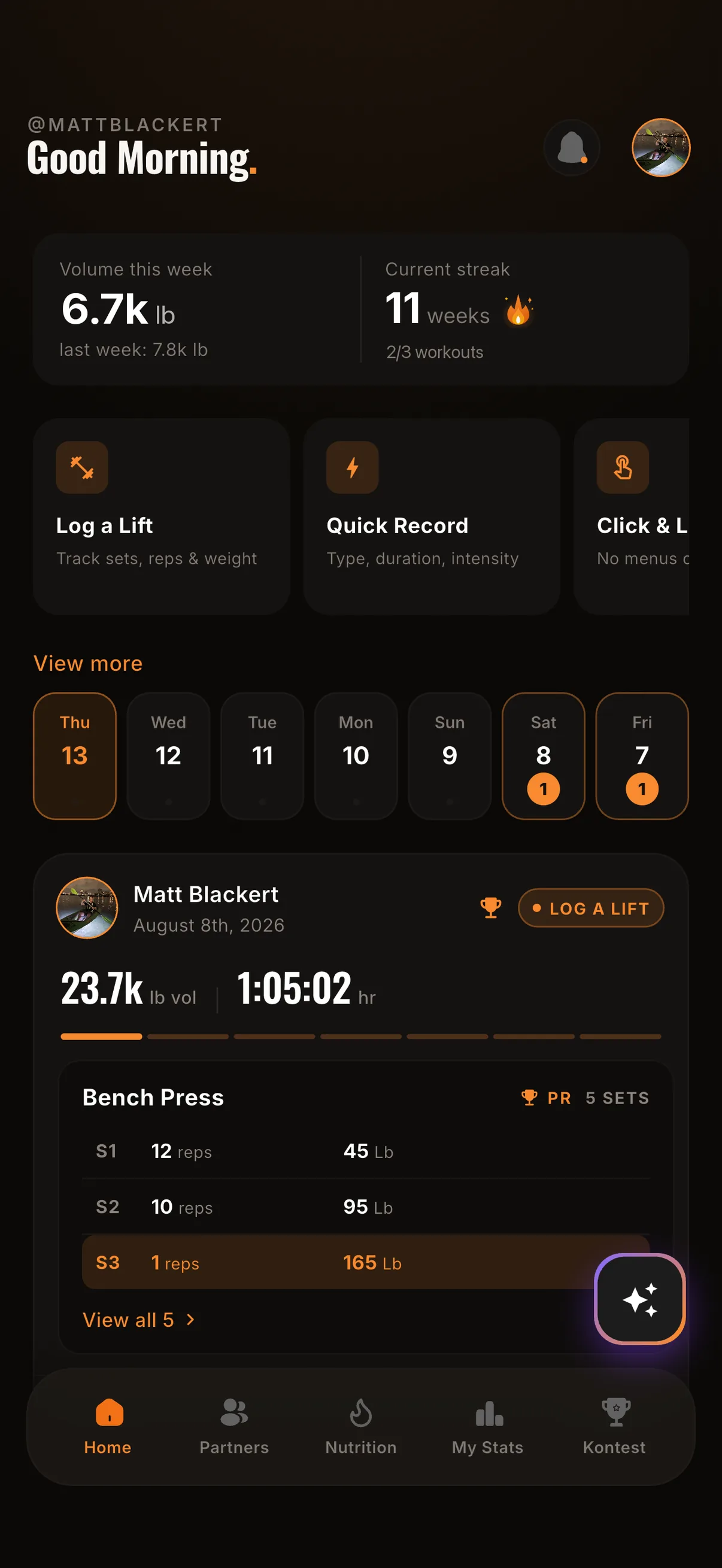
Expect strength to hold roughly flat during a moderate cut, not climb. That's a win, not a disappointment. The goal of training while cutting macros is to protect what you already built, not to set new PRs, and a lifter who finishes a cut at the same numbers they started with has done the job correctly. Track meals and lifts in one place so the cut costs you fat, not PRs. Watching both numbers on the same screen (the calorie trend and the weight on the bar) makes it obvious the moment one starts dragging the other down.
Tracking Honestly: Weekends Count
A cut rarely fails on a Tuesday. It fails on the Saturday you didn't log, repeated often enough that the weekly average quietly drifts above your target while every weekday log looks perfect.
Alcohol is the biggest silent leak. A few drinks add up fast, mostly as carbs, and skipping the log because "it's just drinks" is how a deficit disappears without a single meal ever going untracked. Log it the same way you'd log a meal.
Restaurant meals don't need to be perfect, just logged. Our full walkthrough on tracking macros without making it a part-time job covers the eating-out playbook in more detail, but the short version for a cut specifically: estimate close, log before you eat, and don't let the search for an exact number cost you the log entirely.
Judge the week, not the day. A Saturday that runs 400 calories over isn't a failed cut, it's one data point in a seven-day average that still works if the other six days held. The version of tracking that survives a cut is the one that keeps logging through the messy days, not the one that only shows up when everything's going perfectly.
FAQ
How do I calculate macros for weight loss? Estimate your maintenance calories (TDEE), cut 15 to 25% off that number for your deficit, set protein at 0.8 to 1.0 gram per pound of bodyweight, set fat at 0.3 to 0.4 gram per pound, and let carbs fill whatever calories remain. That's the full calculation, in that order.
What are good macros for weight loss? There's no single universal number, but a reasonable target for most lifters is a 15 to 25% calorie deficit, 0.8 to 1.0 gram of protein per pound of bodyweight, and a fat floor around 0.3 to 0.4 gram per pound, with carbs filling the rest based on your training volume.
How much protein do I need when cutting macros? Aim for 0.8 to 1.0 gram per pound of bodyweight, leaning toward the higher end the more aggressive your deficit is. Protein needs go up slightly when cutting, not down, because it's doing the work of protecting the muscle you already have while calories are lower.
Why has my weight loss stalled even though I'm tracking macros? Usually water retention (sodium, sleep, training stress, or a cycle), not fat loss actually stopping. Check your seven-day average instead of a single morning weigh-in, review whether logging has genuinely stayed tight, and give it two to three full weeks before dropping calories further.
Should I eat back the calories I burn training? Generally no. Your TDEE estimate already accounts for a typical activity level, including regular training, so your deficit is built on top of that. Eating back workout calories on top of an already-calculated deficit is one of the more common ways a cut quietly stops being a cut.
Counting macros for weight loss isn't complicated once you strip it down to what actually matters: a deficit you can hold for months, and a protein floor you never drop below. Set those two numbers, let fat and carbs fall into place around them, and log through the weeks that don't go perfectly. Kontest logs meals with USDA-backed nutrition data and tracks your lifts in the same app, so the cut and the training stay on one screen instead of living in two different places you have to check separately.