How long should you wait after eating to workout? Wait 1 to 3 hours, depending on how much you ate and how hard you're about to train. A small snack only needs 30 minutes to an hour. A full plate needs closer to 2 hours. A holiday-sized feast wants 3 to 4 hours, especially if you're lifting heavy or running hard.
That's the short version. Below is the exact timing chart by meal size and workout type, why lifting and cardio don't follow the same rule, what to eat if you're 30 minutes out the door, and when training on an empty stomach is genuinely fine.
The short answer: how long should you wait after eating to workout
How long you should wait after eating to work out comes down to two things: how much you ate, and how hard you're about to go.
Small snack, easy workout: 30 minutes is enough. A banana or a handful of pretzels isn't sitting heavy in your stomach.
Full meal, moderate to hard workout: give it 1 to 2 hours for lifting, 1.5 to 3 hours for running or other high-impact cardio. Your stomach needs time to move food along before you start bouncing or bracing hard.
Big meal (think holiday dinner, buffet, or anything heavy on fat and protein): 3 to 4 hours if you're lifting or doing hard cardio. This one matches Mayo Clinic's general guidance for pre-exercise eating: large meals get at least 3 to 4 hours, small meals or snacks get 1 to 3 hours.
If you're not sure which bucket you're in, round up. Working out too soon after a big meal costs you a rough 20 minutes of side stitches and reflux. Waiting an extra 30 minutes costs you nothing.
The timing chart: small snack vs. full meal vs. feast, by workout type
Here's the same answer, broken out by exactly what you ate and what you're about to do:
| Meal size | Lifting / strength training | Running, cycling, HIIT | Walking / light activity |
|---|---|---|---|
| Small snack (banana, granola bar, yogurt) | 30 min to 1 hour | 30 min to 1 hour | Anytime |
| Full meal (balanced plate, normal portion) | 1 to 2 hours | 1.5 to 3 hours | 10 to 30 minutes |
| Feast (holiday meal, buffet, high fat/protein) | 3 to 4 hours | 3 to 4 hours | 30 to 60 minutes |
This chart combines Mayo Clinic's meal-size guidance with the activity-type breakdown that outlets like Healthline pull from sports dietitians: snacks clear out fast regardless of what you're doing next, but the gap between lifting and hard cardio widens as the meal gets bigger. Treat the ranges as a starting point, not a rule. Some people digest faster than others, and you'll learn your own number after a few workouts of paying attention.
Lifting vs. cardio: why they differ
Lifting and cardio put different demands on a stomach that's still working.
When you run, cycle, or do anything with repeated impact, your food is getting jostled around while your stomach is trying to hold onto blood flow it now has to share with your legs. That combination is what causes side stitches, that heavy sloshing feeling, and in worse cases reflux. The higher the intensity, the more likely digestion gets interrupted mid-workout, which is why hard cardio wants the longest gap after a real meal.
Lifting is gentler on digestion in one sense (you're not bouncing) and harder on it in another (bracing for a heavy squat or deadlift means real intra-abdominal pressure on a stomach that's still full). A full meal before max-effort lifts usually shows up as discomfort during the brace, not mid-set nausea. That's why lifting gets a shorter window than hard cardio in the chart above, but it's not a free pass to eat a big meal and go straight to a heavy set.
Walking and other low-intensity movement barely touch digestion either way. If your plan is a walk after dinner, go ahead and go.
Training fasted: honest pros and cons
Training on an empty stomach isn't dangerous for most healthy people doing a normal workout, but it's not automatically better either.
The case for it: it's convenient if mornings are your only window and cooking beforehand isn't realistic. Some lifters genuinely prefer the way their stomach feels empty for certain workouts. And for low to moderate intensity sessions, plenty of people train fasted with no issue at all.
The case against it: performance on harder efforts tends to suffer without any fuel in the tank. Expect it to show up as fatigue setting in earlier, more grip and focus issues on your last few sets, or a workout that just feels heavier than the same weights felt last week. If you're chasing a PR or running intervals, a fasted session is not the day to test that.
The fat-loss argument for fasted cardio specifically (the idea that training empty makes your body burn more fat) is popular but the actual research on whether it meaningfully changes body composition over time is mixed at best. If fat loss is the goal, total calories and consistency matter far more than whether you ate breakfast first.
The honest answer: try both. If you feel fine and perform fine fasted, there's no rule that says you need to eat first. If your performance or mood tanks, eat something small and see if that fixes it.
Only have 30 minutes? Eat this
If you're walking out the door in half an hour, skip anything heavy, fatty, or high in fiber. All three slow digestion down exactly when you don't have time for that.
Good 30-minute options: a banana, a handful of dried fruit, a rice cake with a little honey, applesauce, or a small glass of juice. All of these are mostly fast-digesting carbs, which is what you want when time is short. A protein shake with minimal fat also works and won't sit heavy.
Skip: a big bowl of oatmeal loaded with nut butter, a sandwich with deli meat and cheese, fried food, or anything with beans, broccoli, or other high-fiber sides. Save those for after you train.
What to eat before a workout
For a normal pre-workout meal (the 1 to 2 hour window), lean on carbs first, moderate protein, and keep fat on the lighter side. Carbs are your body's preferred fuel for anything above an easy pace, and they're what actually lets you push harder or go longer.
Solid pre-workout choices: whole-grain cereal or toast, low-fat milk, a banana or other fruit, yogurt, or a small bowl of rice with some lean protein. None of these require a long digestion window, and they all leave you with usable energy instead of a heavy, sluggish feeling.
If you're logging what you eat anyway, this is also where a food log earns its keep. Once you've trained on the same pre-workout meal a few times and seen how you felt, you stop guessing and start repeating what actually works for you.
Bringing it together with Kontest
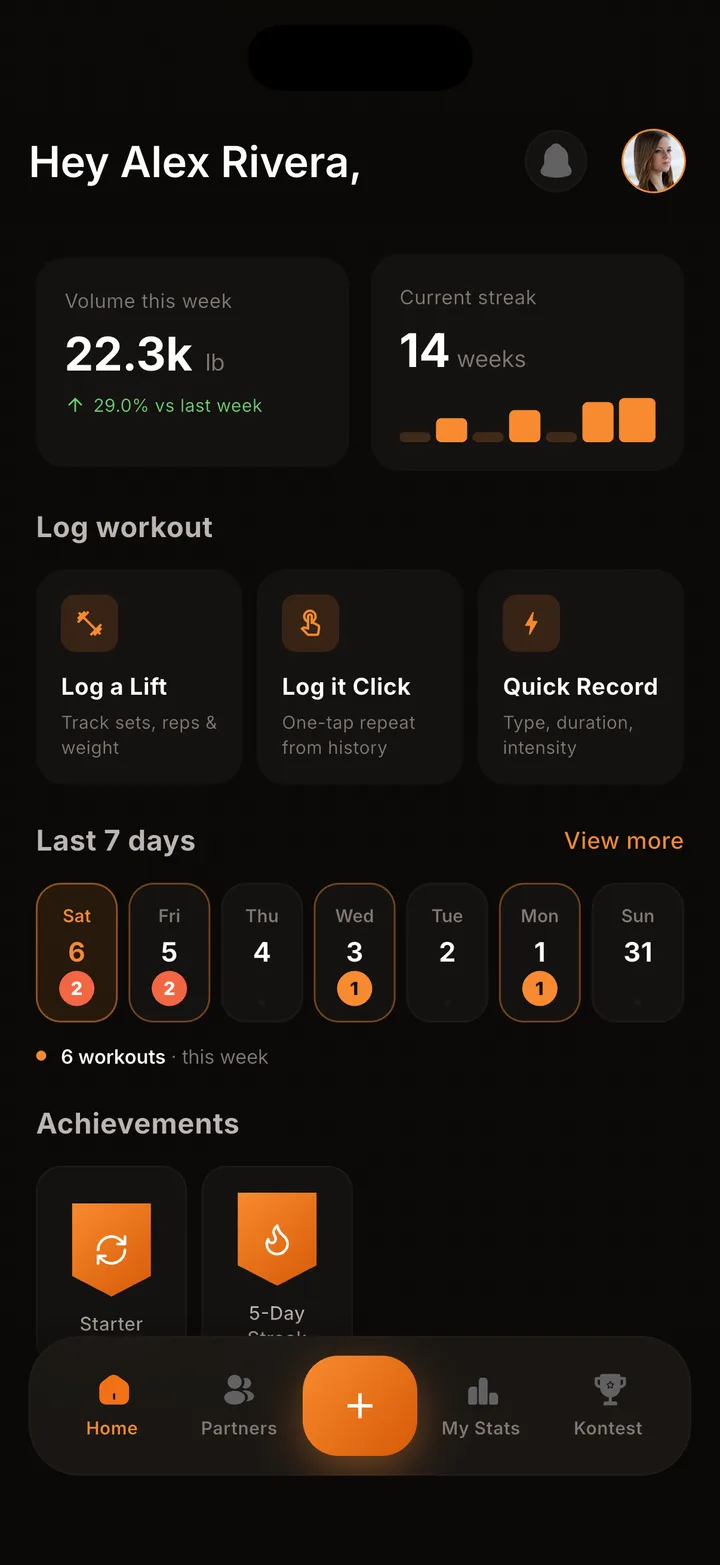
You don't need a perfect system for this, you need to not have to think about it every single day. Kontest logs your meals and your workouts in the same place, so when a session goes great (or goes rough), you can look back and see exactly what you ate beforehand instead of trying to remember. Log a workout, log what you ate before it, and after a few sessions the pattern tells you your own timing rule instead of a generic chart. Log your training and meals in Kontest and let your own data do the guessing for you.
If you're still building your weekly training rhythm, our beginner workout plan is a good next stop, and if you're also dialing in supplement timing, see our breakdown of creatine before or after your workout for the same kind of exact-timing answer.
FAQ
How long should I wait to work out after eating? 30 minutes to an hour after a small snack, 1 to 3 hours after a full meal depending on whether you're lifting or doing hard cardio, and 3 to 4 hours after a big, heavy meal.
How long after eating can I run? Give a full meal 1.5 to 3 hours before a hard run. Running jostles your stomach more than lifting does, so it needs a bigger gap. A light snack is fine after just 30 minutes to an hour.
Is it bad to work out right after eating? It's not dangerous for most people, but it's uncomfortable. Expect side stitches, sluggishness, or reflux if you go hard on a full stomach, especially with running or other high-impact cardio.
What should I eat 30 minutes before a workout? Something small and fast-digesting: a banana, a rice cake, applesauce, or a bit of juice. Skip anything high in fat or fiber, since both slow digestion down right when you don't have time for it.
Is it okay to work out on an empty stomach? For most healthy people doing a normal workout, yes. Just expect harder efforts to feel tougher without fuel on board. If a session is high intensity or you're chasing a PR, eat something first.
There's no single number that works for everyone, but the answer to how long you should wait after eating to workout almost always falls somewhere in the ranges above. Pay attention to how your stomach feels a few times, adjust from there, and you'll land on your own number faster than any chart can give it to you.