Your one-rep max (1RM) is the heaviest weight you can lift for a single clean rep on a given lift. The fastest way to determine your one-rep max isn't to load the bar and find out the hard way. It's to estimate it from a set you've already done.
Below is a calculator that does that in seconds, the two formulas it's built on and where they disagree, a real protocol for the rare cases you actually need to test a true max, and strength standards so you know what your number means.
Most people land here searching for a bench max calculator or a general strength calculator because they want one number, not a lecture. You'll get that number in the next section. The rest of this guide is for once you have it and want to know what to do with it, and whether to trust it.
Estimated vs. tested 1RM (you rarely need to test)
An estimated 1RM is a number a formula calculates from a submaximal set: the weight you lifted and how many reps you got. A tested 1RM is the real thing, an actual single all-out attempt with a bar loaded to what you think your limit is.
Most lifters only ever need the estimate. If you're programming your training, the 5-10 pound range an estimate might be off by doesn't change what you do Monday. You're still working in the same percentage brackets, adding the same small jumps week to week. The estimate updates itself every time you log a heavier top set, which is more useful day to day than a single number from a max-out session three months ago.
A true tested max matters more in a narrower set of cases: you're stepping on a competition platform and need to know your opener, your program calls for a specific percentage of a verified number, or you just want the experience of finding your actual ceiling under a bar. Outside of those, testing costs you a taxing, CNS-draining session for a number the calculator below gets you close enough to for free.
The 1RM calculator: determine your one-rep max in seconds
Pick your lift, enter the weight you used and how many reps you got, and this calculates your estimated 1RM using both major formulas. Works for bench, squat, deadlift, and overhead press, since the math is about your reps and load, not which bar you were under.
For the most accurate estimate, use a set where you got somewhere between 2 and 10 reps at a weight you couldn't have gone much past. A set of 20 easy reps will not give you a usable number (more on why below).
How the formulas work: Epley vs. Brzycki, and when they diverge
Both formulas turn a submax set into an estimated max. They just weight reps differently.
Epley: 1RM = weight × (1 + reps ÷ 30)
Brzycki: 1RM = weight × 36 ÷ (37 − reps)
Take a 225 lb bench for 5 reps. Epley puts your estimated max at 263 lb. Brzycki lands at 253 lb, about 10 lb more conservative. That gap is typical, not an error in either formula. Epley's multiplier grows in a straight line as reps go up, so it estimates progressively higher the more reps you did. Brzycki's formula curves, which makes it more conservative at higher rep counts and, some coaches argue, more realistic for sets past 5-6 reps.
Neither formula is "right." They're both regressions built from real lifting data, and they agree closely inside the 2-10 rep range, which is exactly why that's the sweet spot to use them in. Past 10 reps, both formulas get shaky, because the thing limiting a 15 or 20-rep set (muscular endurance, lactate tolerance) isn't the same thing that limits a 1-3 rep set (raw force production). A 20-rep set doesn't tell a formula much about your true single-rep ceiling, so don't feed it one.
If the two numbers disagree by more than 10-15 lb on the same set, that's usually a sign the set wasn't a clean, honest effort, either you had more in the tank than you think, or the last rep or two got ugly. The calculator's average splits the difference and is a reasonable number to actually program off.
The formula only trusts the set you give it, so a lazy input gives you a lazy output. A 185 lb bench set for 8 easy reps, stopped well short of failure, will underestimate your real max, because the formula assumes you were close to done. Use your last genuinely hard set on a lift, the one where the last rep or two were a real grind, and both formulas get meaningfully more accurate.
How to safely test a true 1RM (protocol)
If you do want a real tested max, don't just load a heavy bar and go. Use a ramp so your first attempt at your actual limit isn't also your first heavy rep of the day.
- Warm up thoroughly. 5-10 minutes of general movement, then start light on the bar itself.
- Ramp up in sets of decreasing reps. Something like: 50% for 8 reps, 65% for 5, 75% for 3, 85% for 1, 90% for 1, resting 2-3 minutes between sets. Each warm-up single should feel around an RPE 7-8, hard but not close to failure.
- Take your first true attempt at roughly 100-102% of your best guess. Use the calculator above on your most recent heavy set to get that guess.
- Rest 3-5 minutes, then attempt again if the first one moved well, adding 5-10 lb (2.5-5 lb for upper body lifts). Stop after a miss, or after 2-3 total attempts. Grinding out attempt after attempt is how testing days turn into injury days.
- Have a spotter or use safety pins on squat and bench, always. A missed max attempt with no safety net is the single most avoidable way lifters get hurt testing.
Cap true max testing at 2-4 times a year per lift. It's taxing on your joints and nervous system, and it doesn't tell you anything the calculator plus your logged sets won't already tell you in between.
1RM standards: how strong is strong
These numbers come from published strength-standard tables (originally in kilograms, converted and rounded to the nearest 5 lb here), for men ages 18-39. Treat them as a general reference for where you sit, not a hard target. Standards for women and other age brackets vary and aren't reflected below.
Bench press (1RM, lb)
| Bodyweight | Novice | Intermediate | Advanced |
|---|---|---|---|
| 132 lb | 125 | 155 | 210 |
| 165 lb | 155 | 185 | 255 |
| 198 lb | 175 | 215 | 290 |
Squat (1RM, lb)
| Bodyweight | Novice | Intermediate | Advanced |
|---|---|---|---|
| 132 lb | 170 | 205 | 280 |
| 165 lb | 205 | 250 | 340 |
| 198 lb | 230 | 285 | 390 |
Deadlift (1RM, lb)
| Bodyweight | Novice | Intermediate | Advanced |
|---|---|---|---|
| 132 lb | 210 | 245 | 340 |
| 165 lb | 255 | 300 | 410 |
| 198 lb | 290 | 335 | 460 |
"Novice" here means a few months of consistent training under your belt, not your literal first session. "Advanced" is years of dedicated, structured training, not a milestone most casual lifters need to chase. Landing between novice and intermediate for your bodyweight after your first year is normal, not a red flag.
Retest your estimate as you get stronger
Your estimated 1RM isn't a number you set once. Every time your top set goes up, whether that's more weight, more reps, or both, your real max moved with it, and the calculator above will tell you the new number in ten seconds.
This is where a progressive overload plan and your 1RM estimate connect directly. You're not chasing a bigger number for its own sake, you're adding weight or reps on a schedule, and your estimated max is just the running total of that work. A heavier single is also, by definition, a 1RM PR, so the same log you're using to track progressive overload is the log you need for this calculator too.
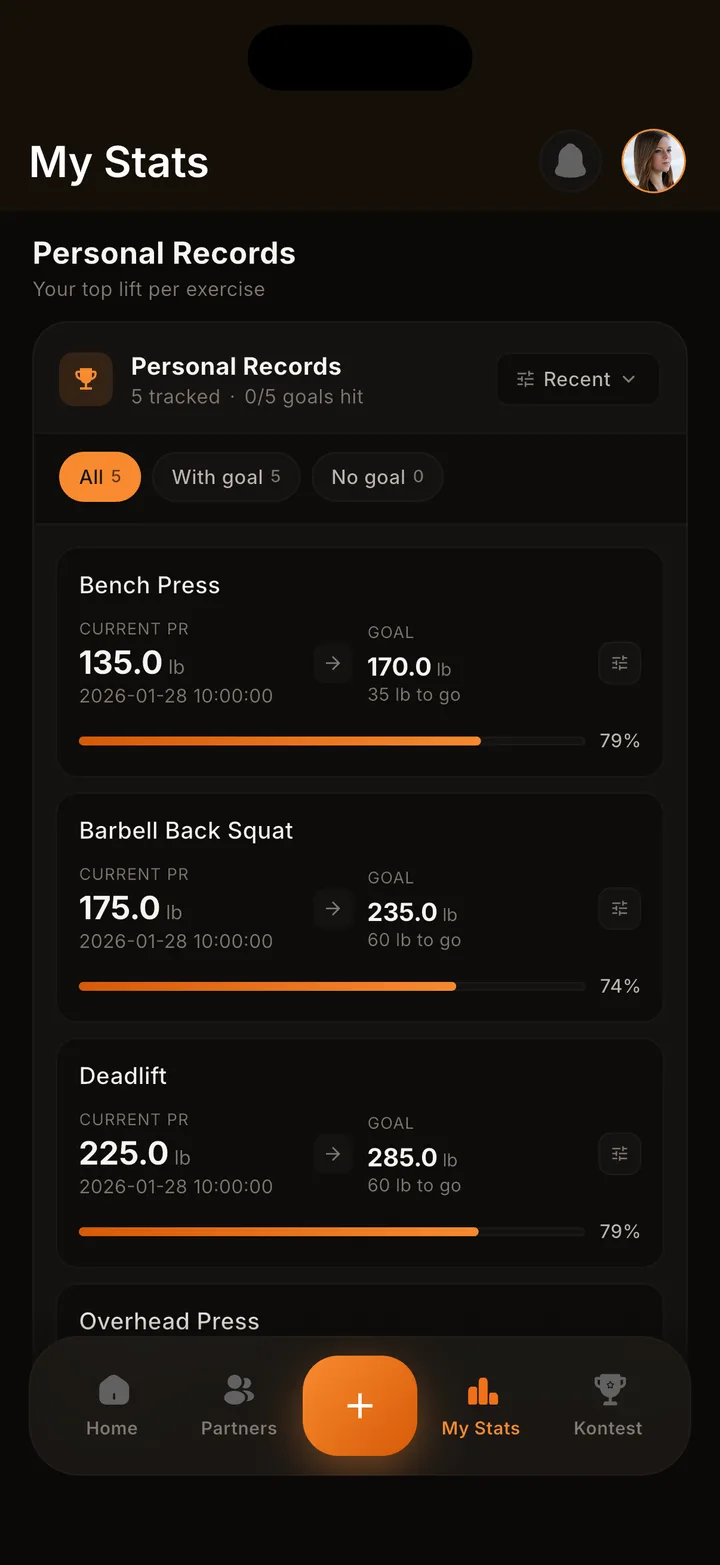
Kontest tracks every set you log, including your current PR for each lift. When you hit a new top set worth re-checking, pull the weight and reps straight from your log and drop them back into the calculator above for an updated estimate. It's not automatic yet, but it's a five-second habit once logging your sets already is one. Log your training in Kontest and you'll always have the real numbers on hand instead of guessing where your max landed months ago.
FAQ
Is Epley or Brzycki more accurate? Neither is universally more accurate. They agree closely in the 2-10 rep range, where both are built to work. Brzycki tends to run slightly lower (more conservative) than Epley, especially past 5-6 reps. If you want one number instead of two, average them.
How often should I test my true 1RM? 2-4 times a year per lift at most. Testing is taxing on your joints and nervous system, and an estimated 1RM from a recent heavy set gets you close enough for programming in between.
Can beginners use a 1RM calculator? Yes, with one caveat: your estimate will move around more than an experienced lifter's because your technique and force output are still improving fast. Use it as a rough guide for picking training weights, not a fixed target.
What's the difference between a 1RM and a PR? Your 1RM is your best single-rep lift for a given movement. A PR is broader: any personal best, including reps, volume, or time, not just a single max. Every 1RM is a PR, but not every PR is a 1RM.
Why did my calculator estimate change on the same weight? Because reps changed. If you lift 225 lb for 5 reps one week and 225 lb for 7 reps the next, your estimated max went up even though the weight on the bar didn't, because you got more reps out of the same load. That's a real strength gain, the formula is just reflecting it.
What percentage of my 1RM should I train at? It depends on the goal. Roughly 85-100% builds max strength with low reps, 65-85% is the classic hypertrophy range, and under 65% is better suited to technique work or high-rep conditioning. Once you have an estimate from the calculator above, multiply it by the percentage you need to get a target training weight for that session.
Determining your one-rep max doesn't require a max-out day. Plug your last honest heavy set into the calculator above, use the standards table to see where that puts you, and save the actual testing protocol for the few times a year it's worth the toll it takes.