A progressive overload workout plan works on one rule: every lift has to get harder over time, in a specific, trackable way, not just "harder" in the vague sense of feeling tired after. Add weight. Add reps. Add sets. Add density. Pick one, apply it on a schedule, and write down what happened so next week's decision is based on data instead of vibes.
That's the whole idea. Below is the actual plan: the four ways to overload ranked by how well they work for most lifters, the exact rule for choosing weight vs reps on any given day, a 12-week template you can run as written, and a full bench press case study so you can see the rule applied to real numbers.
What progressive overload is
Progressive overload means increasing the demand on a muscle over time so it has a reason to keep adapting. Your body only gets stronger in response to a stimulus it hasn't fully adapted to yet. Lift the same weight for the same reps forever and you'll maintain what you have, not build more of it.
The demand can increase four ways: more weight on the bar, more reps at the same weight, more total sets, or the same work done in less time (density). All four count as overload. Most lifters only think about the first one, which is why they stall the moment adding weight gets hard.
The 4 ways to overload, ranked
Ranked by how reliably each one keeps working as you get more experienced.
1. Load (add weight). The most direct method and the one with the shortest shelf life. Adding 5 lb to your squat every week works great for the first few months of training, then the jumps get smaller and less frequent. Best for beginners and for your main compound lifts.
2. Reps (add reps at the same weight). More durable than pure load progression. If you can go from 3x8 to 3x12 at the same weight, you've added real work capacity even though the bar didn't change. This is the method that keeps paying off long after load progression slows down.
3. Sets (add volume). Going from 3 sets to 4 sets of an exercise increases total weekly work without touching weight or reps per set. Useful when you've plateaued on both load and reps for a given exercise, but it has a ceiling: your recovery, not your motivation, decides how many sets you can actually absorb.
4. Density (same work, less rest). Cutting rest between sets from 3 minutes to 90 seconds while holding weight and reps steady makes the session harder without changing a single number on the bar. It's the most underused method and the best one for breaking a plateau without adding fatigue from more sets or more weight.
Rotate through these in that order as each one stops producing results, and you'll have a way to keep overloading long after "just add more weight" runs out of road.
The exact rule: when to add weight vs when to add reps
Here's the rule, no interpretation needed: if you hit the top of your rep range on every set at an RPE of 8 or lower, add weight next session. If you didn't hit the top of the range, or you needed a 9 or 10 to get there, repeat the same weight and try to add a rep instead.
RPE (rate of perceived exertion) is what makes this rule usable instead of a guess. An RPE 8 set means you could have done 2 more reps if you had to. If your last set of the day was a genuine RPE 8 and you hit your rep target, you have room, add weight. If it took an RPE 9 or a grinding 10 to get the same reps, you don't have room yet, no matter what the plan on paper says. RPE is the single best tool for making this decision honestly instead of ego-lifting your way into a stalled program.
One more piece: don't average across exercises. Your bench might be ready to add weight while your squat isn't, in the same week. Apply the rule per lift, not per program.
A 12-week progressive overload plan
Here's a full 12-week template built around a squat working weight of 185 lb, split into three 4-week phases: load, then volume, then density. Swap in your own starting weight, the structure is what matters.
| Week | Sets x Reps | Weight | RPE Target | What Changes |
|---|---|---|---|---|
| 1 | 3x5 | 185 lb | 7 | Baseline week, establish the working weight |
| 2 | 3x5 | 190 lb | 7-8 | +5 lb |
| 3 | 3x5 | 195 lb | 8 | +5 lb |
| 4 | 3x5 | 200 lb | 8 | +5 lb, deload if any set needed a 9+ |
| 5 | 3x6 | 200 lb | 8 | Hold weight, add a rep per set |
| 6 | 3x7 | 200 lb | 8 | Add a rep per set |
| 7 | 3x8 | 200 lb | 8-9 | Top of the rep range, last volume week |
| 8 | 4x5 | 205 lb | 8 | Add a set, drop back to 5 reps, +5 lb |
| 9 | 4x5 | 210 lb | 8 | +5 lb |
| 10 | 4x5 | 215 lb | 8 | +5 lb |
| 11 | 4x5 | 215 lb, 90 sec rest | 8 | Density phase: cut rest from 3 min to 90 sec |
| 12 | 4x5 | 220 lb, 90 sec rest | 8 | Test week: +5 lb at the shorter rest period |
By week 12 you've added 35 lb to your squat, added three extra reps of capacity, added a full working set, and cut your rest time by half, all inside one 12-week plan. That's four separate overload methods stacked instead of just one running out of gas by week 5.
Case study: progressive overload for bench press
Take a lifter benching 135 lb for 3 sets of 5 at RPE 8, stuck there for three straight sessions. Adding weight isn't working anymore: 140 lb turns the first set into a grinding RPE 9-10 and the third set falls apart at 2-3 reps. This is exactly the situation where switching overload methods, not pushing harder on the same one, gets them moving again.
Week 1: stay at 135 lb, but push reps instead of weight. 3x6 at RPE 8. If all three sets hit 6 clean reps, the plan worked.
Week 2: 3x7 at 135 lb, same weight, same RPE ceiling. Most lifters find this rep is where things get honest, hitting 7 reps on all three sets at a true RPE 8 (not a 9 they're calling an 8) means real capacity was added, not just tolerance for discomfort.
Week 3: 3x8 at 135 lb. This is the top of the rep range for this block. If all three sets land at RPE 8, the lifter has built enough of a buffer to make the next weight jump stick.
Week 4: back to 135 lb, 3 sets, but hunt the actual number: how many reps can you get on set one at a true RPE 9-10. If that number is 10+, jump straight to 140 lb for 3x5 next session, because the rep progression has proven there's real strength underneath the old sticking point, not just a number that felt scary.
Week 5: 140 lb, 3x5. Because the previous four weeks built real rep capacity at 135 lb instead of just attempting 140 lb over and over, this session usually goes at RPE 7-8 instead of the RPE 9-10 grind that happened the first time 140 lb was on the bar. That gap, RPE 9-10 on the first attempt vs RPE 7-8 after a rep-progression block, is the entire argument for choosing reps over weight when a lift stalls.
The math behind it: 3 sets of 8 at 135 lb is 3,240 lb of total volume per session (135 x 8 x 3). 3 sets of 5 at 140 lb is 2,100 lb. The lifter did more total work at the lighter weight for three straight weeks before ever touching 140 lb again, which is why the heavier weight felt different the second time. Weight on the bar isn't the only thing that went up. Total capacity did too, and that's what actually carried the new PR.
The same logic works on squat, deadlift, and overhead press. When weight stalls, the fix is rarely more effort on the same number, it's a few weeks of rep progression at the weight you can already handle.
Why untracked training stalls
Every rule in this plan depends on knowing what actually happened last session, not what you think happened. Was that last set a real RPE 8 or an 8 you're calling it because 9 sounds like failure? Did you do 3x7 last week or was it 3x6 and you're rounding up? Guessing at these numbers is how lifters "progressively overload" their way into the exact same weights for six months straight.
This is also why a stalled bench or squat is so often a logging problem before it's a programming problem. If you don't have your numbers from three weeks ago, you can't tell whether this week's plateau is real or whether you've actually been quietly regressing without noticing. Knowing what a PR actually means only matters if you have the log to check it against.
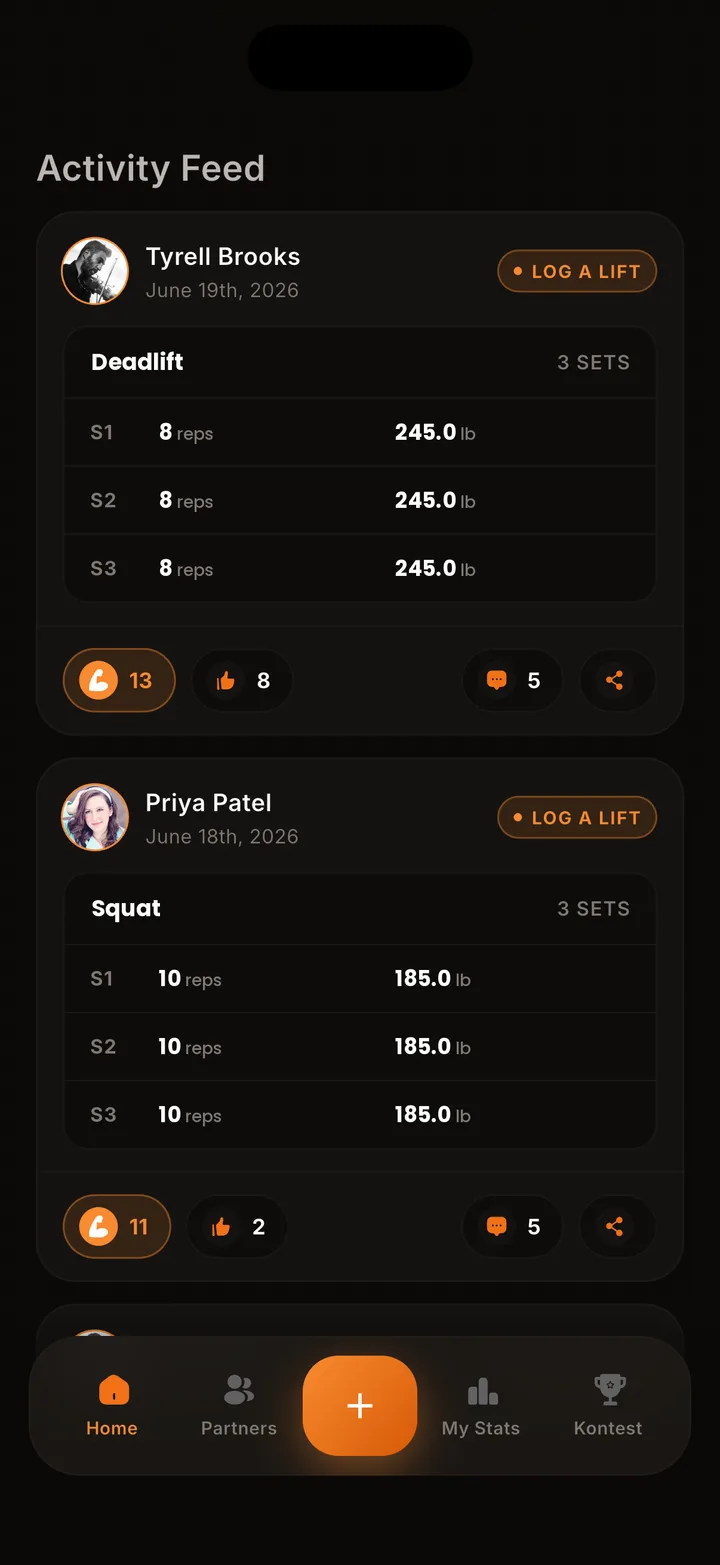
Logging every set, rep, and weight in Kontest takes seconds, and the app tracks your current PR against a goal for every lift automatically, so the "add weight or add reps" decision from the rule above is a glance at your numbers instead of a guess. Log your squat, bench, and deadlift sessions in Kontest, put your progression plan on paper (or in the app), and download Kontest to start tracking the numbers this plan actually depends on.
Plateaus: what to do at week 6
If you're not hitting the prescribed reps or weight by week 6 of any progressive overload plan, two things are usually true: you're either under-recovering or the jumps were too aggressive for where you actually are. Here's what to do about each.
If you're missing reps but not grinding (RPE feels fine, the number just isn't there): the weight jumps were too big. Cut them in half, 2.5 lb instead of 5 lb on upper body, 5 lb instead of 10 lb on lower body, and keep going. Smaller, consistent jumps beat bigger jumps you can't sustain.
If every set feels like a grind (RPE 9-10 on sets that used to be 7-8): you're under-recovered, not undertrained. Take a deload week at 60% of your working weights, sleep more if you can, and resume the plan at the last weight you handled cleanly, not the weight the program says you should be at.
If you genuinely can't tell which one it is: that's a logging gap. Without RPE and rep data from the last few weeks, you're diagnosing a plateau from memory, which is exactly the failure mode this entire plan is built to avoid.
A plateau at week 6 isn't proof the plan failed. It's proof you need to switch which overload method you're leaning on, from load to reps, or from reps to density, exactly like the ranking above lays out.
FAQ
What is progressive overload? Progressive overload is the practice of gradually increasing the demand on your muscles over time, through more weight, more reps, more sets, or less rest between sets, so your body has a reason to keep adapting instead of maintaining its current level.
How do I progressively overload if I can't add weight every week? Switch methods. Add reps at your current weight instead, then add a set once you've maxed out reps, then cut rest time once sets and reps are maxed. Weight is only one of four ways to overload, and it's the first one to stop working.
Is progressive overload necessary for building muscle, or just strength? Both. Muscle growth requires the same escalating demand as strength does, which is why lifters who add reps or sets over time build muscle even on weeks they don't add weight to the bar.
How often should I increase weight when progressively overloading? Once every 1-2 weeks on main compound lifts if you're hitting your rep target at RPE 8 or below, and only after a full rep-progression block if a lift has stalled. Trying to add weight every single session on the same lift is the most common reason overload plans break down early.
What if I hit a plateau at week 6 of my program? Look at your RPE first. Missing reps with an easy RPE means the jumps were too big, so cut them in half. Grinding every set to a 9 or 10 means you're under-recovered, so take a deload week instead. Then switch overload methods rather than pushing harder on the one that stopped working.
A progressive overload workout plan doesn't need to be complicated to work. Pick a method, apply the weight-vs-reps rule honestly, run the 12-week template above (or your own version of it), and log every session so week 6's plateau gets diagnosed instead of guessed at.