A gym buddy app has to solve one of two completely different problems, and most "best gym buddy apps" lists blur them together like they're the same search. Either you don't have anyone to train with yet and need to find someone, or you already have a friend group and need a way to actually compete with them instead of texting "did you go today?" back and forth for a month before you both quietly stop.
Below is the honest split: real apps for finding a workout partner if you're starting from zero, and real apps for competing with the friends you already train around, ranked by what actually works, not by who paid for placement.
Two jobs, one search term: finding a partner vs. competing with friends you have
If you're searching "gym buddy app" because you moved cities, work from home, or just don't know anyone who lifts, your job is discovery: find a real person nearby who trains at a similar level and actually shows up. That's a matching problem, closer to dating apps than fitness apps, and the tools that solve it look like it.
If you already have three friends in a group chat who all say they're "getting back into it," your job is different. You don't need to meet anyone. You need a reason for all four of you to actually open a workout app on the same day, and something better than a group chat to see who's pulling their weight. That's a competition problem, and it's the one most fitness apps ignore, treating your friends as a feed you scroll instead of something built into how you train.
Why training with someone works
The research on this is old and it's not close. A study that tracked adults who joined a fitness program either with a spouse or alone found that monthly attendance held at 54% for people who trained with a spouse, versus 40% for people who joined solo, over a full year. The dropout rate told the bigger story: 6% for the paired group versus 43% for people going it alone, a sevenfold difference. The researchers behind it pointed to spousal support driving the gap, not just personal motivation, since both groups presumably wanted to get fit when they signed up.
That's a spouse-specific study, not a friend-group study, so treat the exact numbers as directional rather than a promise about your specific gym buddy. But the mechanism (someone else expecting you to show up) doesn't require a marriage license to work. We go deeper on why accountability partners outperform willpower alone in our breakdown of workout accountability. The short version: a person who'll notice if you skip a week beats a push notification every time, because a notification is easy to swipe away and a person isn't.
Best apps for finding a gym partner
If you're starting from zero, these are the two real options worth your time.
Bumble For Friends (BFF). Bumble's friendship app leaned into fitness matching with an Adidas campaign that added a gym-buddy interest badge to profiles, and the core mechanics work the same way Bumble's dating app connects couples: build a profile, swipe on people near you, match, message. It's free to download, with the same kind of optional paid boosts (profile spotlights, extended search) as Bumble's other apps, but matching and messaging cost nothing. It's the closest thing to a dedicated gym-buddy-finder that's actually maintained and has real usage, rather than a one-person side project that hasn't been updated since 2019.
Meetup. Less a gym buddy app and more a directory of people who already organized the group you're looking for. Search "workout buddies," "fitness," or your city plus "run club" and you'll find real, active local groups: running crews, lifting meetups, hiking groups, some free and casual, others charging small organizer dues to cover space rental. Joining and RSVPing to events is free; any cost comes from the individual group's organizer, not from Meetup itself. It's slower than a swipe-to-match app, but a group of 15 people who show up to the same track every Saturday is a stronger accountability structure than one matched stranger who might flake.
Neither of these apps helps once you've actually found your person or group. That's a different job, and it's where most "gym buddy" content stops short.
Best apps for competing with friends you already have
This is the part of the search that's actually underserved, and it's the whole reason Kontest exists (that's our app, full disclosure, so weigh that accordingly).
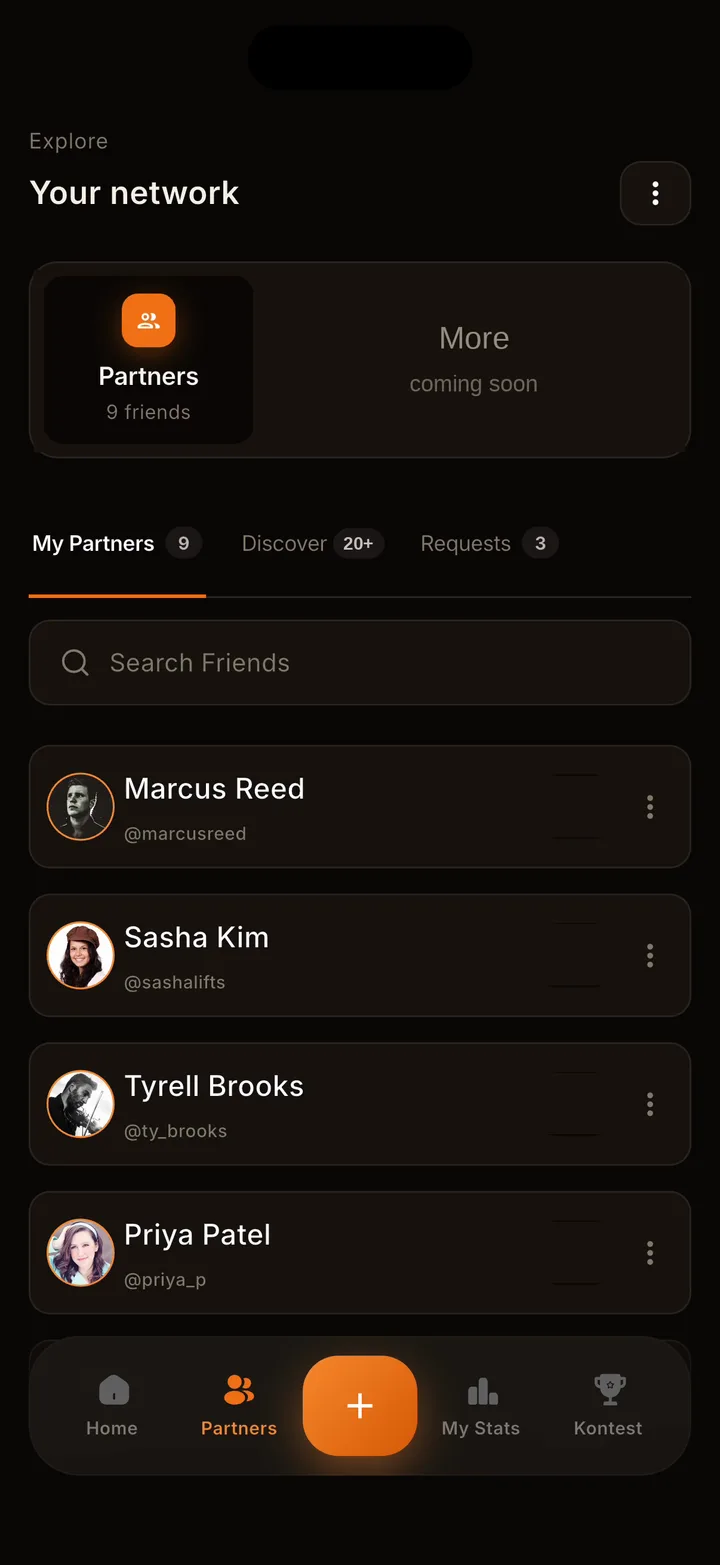
Kontest (that's us, full disclosure). You create or join a kontest, a head-to-head or group challenge with the friends you already have, across five categories: reps logged, weight lifted, distance covered, steps, or strength. Set how often everyone needs to log (twice a week, three times a week, whatever fits your group), invite people straight from your partner list or from a discover feed of other lifters, and everyone's progress updates on a live leaderboard the moment anyone logs a set. Underneath the competition layer you still get real training tools: workout logging, personal records, streaks, and XP that climbs with every session, so it's not a game bolted onto a weak tracker. It's free to start, no credit card required, with a Pro plan coming; current plans are on our pricing page.
Strava. If your friend group runs or rides more than it lifts, Strava's Group Challenges let you gather a big group (creators can invite as many as 199 people) around a shared goal with a real leaderboard. The catch: creating or joining a Group Challenge now requires a paid subscription, around $11.99 a month or $79.99 a year, after Strava moved the feature behind its paywall. Free accounts can still record activities and see the community feed, just not compete in a new group challenge.
WHOOP Teams. If your group already wears WHOOP, Teams lets you build a group and compare strain, recovery, and sleep on a shared leaderboard, with the option to control which metrics you show. The tradeoff is real: there's no software-only tier, since WHOOP requires buying into a membership that starts at $199 a year and includes the wearable itself, running up to $359 a year for the higher tiers. It's a serious cost just to unlock a friends leaderboard if you don't already own the hardware for other reasons.
Worth naming what's missing from this list: Fitbit, the most-owned fitness wearable on the planet, doesn't have a friends-competition feature anymore. Google shut down Fitbit's Challenges, Adventures, and Open Groups back in 2023 and never replaced them with anything comparable. Beyond a passive weekly step leaderboard, millions of people own a Fitbit and have no built-in way to run a challenge with a friend on it. That gap is exactly the space Kontest and Strava's paid tier are fighting over, and it's a big part of why we built this app in the first place.
Feature comparison table
| App | Cost to compete with friends | Best for |
|---|---|---|
| Bumble For Friends (BFF) | Free (optional paid boosts) | Finding a new gym partner near you |
| Meetup | Free to join (organizers may charge dues) | Finding a local run club or lifting group |
| Kontest | Free, no credit card; Pro coming soon | Competing with the friends you already have |
| Strava | ~$11.99/mo or $79.99/yr for Group Challenges | Runners and cyclists already on Strava |
| WHOOP | $199-$359/yr (includes the wearable) | Comparing strain, recovery, and sleep among owners |
Prices reflect what each app publicly lists as of this writing; subscription pricing changes often, so confirm on the app's own page before you commit.
How to start a fitness competition with friends in 5 minutes
You don't need to convince your whole group to commit to a new program. You need one kontest running today.
Open Kontest and tap into the Kontest tab, where "Challenge your circle" sits at the top with a New button. Pick one of the five categories (reps, weight, distance, steps, or strength) based on what your group actually trains. Set how often people need to log: twice a week is a reasonable starting cadence for most friend groups. Invite people straight from your partners list, or pull from the discover feed if you want to loop in someone you've trained with but haven't connected with yet. Once it's live, everyone logs their sessions like normal and the leaderboard updates itself. No spreadsheet, no group chat tally, no one manually keeping score.
Start your first kontest free and settle who the fittest friend actually is. If your current routine already has you experimenting with different splits, our guide to the best workout apps of 2026 covers where a competition layer like this fits next to whatever you're already using to log sets.
FAQ
What's the best free workout buddy app? For finding someone new, Bumble For Friends is the strongest free option built specifically for gym-buddy matching. For competing with friends you already have, Kontest is free with no credit card required, and it's the one built around the competition itself rather than treating friends as a bonus feature.
Is there an app to find a gym partner near me? Yes. Bumble For Friends matches you with people nearby based on fitness interests, and Meetup lists local running clubs and lifting groups you can join directly, no matching required, just show up.
How do I stay accountable working out with someone? Set a shared, trackable goal instead of a vague plan to "meet up more." A study on adults exercising with a spouse found paired training cut the dropout rate by more than sevenfold compared to training alone, and the mechanism was social support, not just willpower. A shared leaderboard or a standing group challenge gives you that same visible commitment without needing to coordinate schedules every week.
What's a good workout accountability app with friends? Kontest is built for exactly this: a shared kontest with a live leaderboard means everyone can see who's actually logging sessions, not just who said they would.
Can you compete with friends on Strava for free? Not anymore. Strava now requires a paid subscription, roughly $11.99 a month or $79.99 a year, to create or join a Group Challenge. Free accounts can still record and share activities, just not compete inside a new group challenge.