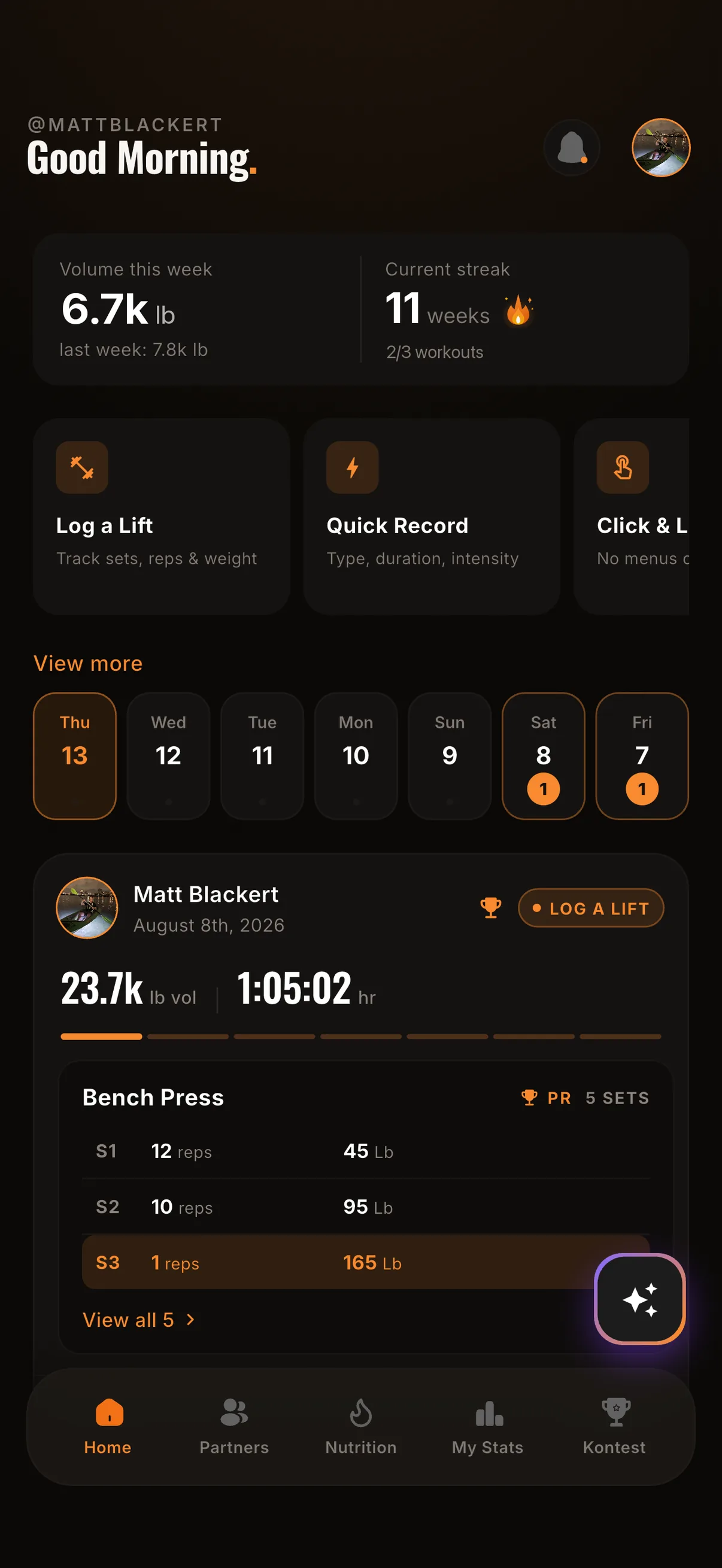
Gym motivation is not a feeling you wait for. It's evidence you manufacture, on purpose, by giving yourself proof that the last month of training actually worked. Wait for the feeling first and you'll wait through most of your year.
That's the whole argument here, so let's get it out early. The fitness industry sells motivation as a mood you catch, like a cold, from the right playlist or the right influencer screaming at 5 a.m. Mood is real. It is also not what keeps someone training in February, once the New Year's crowd has thinned back out. What keeps them going is a log they can point to and say: that worked, do it again.
We've already made the case that accountability beats motivation when the question is whether you show up on a bad day. This piece is the layer underneath that one. Accountability only works if there's something worth being accountable to, and that something is evidence: fresh starts, streaks, identity, and friction. Four real levers, not four pep talks.
Gym motivation is evidence, not hype
Watch enough fitness content and you'll notice the same trick on repeat: a jump cut, a personal record, a scream into the camera. It's entertaining. It's also a dead end as a strategy, because hype is built to spike and fade inside the same ten seconds it took you to watch it. You can't bank that feeling for Thursday.
Evidence works differently. A rising number in your training log, a squat that used to grind now moving clean, a streak that's survived six weeks of a genuinely hard month, all of it sits there and keeps paying out motivation on a delay. You don't have to re-feel the original spark. You just have to look at the log.
That's why "just get motivated" is such useless advice. It skips the part where motivation actually gets built. Nobody watches a highlight reel and becomes a different person for eight weeks. People become different because they logged forty sessions and can now point at forty data points that say the thing is working.
The fresh start effect: use it, don't worship it
Researchers Hengchen Dai, Katherine Milkman, and Jason Riis found something worth stealing: people are far more likely to chase a goal right after what they call a temporal landmark. A Monday. The first of the month. A birthday. New Year's Day. Searches for diet and exercise information reliably spike around these dates, and so does gym attendance. Your brain treats a fresh calendar page as a chance to reset the story it tells about you.
The mistake is worshiping the landmark instead of using it. If you're waiting for January 1 because this Tuesday doesn't feel special enough, you've turned a psychological trick into an excuse. The fix is cheap: manufacture your own landmark. Call it week one. Start your kontest on a Wednesday and mean it. The effect doesn't care whether the calendar agrees with you. It cares whether you treat the day as a beginning.
If you're starting from actual zero and want that fresh start to attach to something concrete instead of vibes, a structured 12-week beginner plan gives you the container. A fresh start with no plan behind it burns itself out by day four.
You get more landmarks than the calendar hands you, too. A new training block, a friend joining your gym, moving apartments, all of them work as a reset if you decide to treat them that way. The effect isn't magic. It's permission, and permission is available on any Tuesday you choose to take it.
Streaks: why not breaking the chain works
Jerry Seinfeld is credited with a productivity trick that has nothing to do with jokes: write every day, mark an X on a calendar, don't break the chain. The advice spread because it leans on a lever that has nothing to do with willpower: loss aversion. Losing something you already have hurts more than gaining the equivalent one feels good. A streak turns "should I train today" into "am I willing to lose eleven weeks," and that's a much harder sell to yourself than a vague goal ever was.
That's also why Kontest tracks a running streak instead of just a workout count. A number that only goes up is nice to look at. A number you can lose is a reason to show up on the exact day you'd otherwise skip.
Streaks have one failure mode worth naming: they punish the wrong thing if a single missed day, a flu, a flight, wipes out eleven weeks of real work. That's a design flaw, not a fact of nature, which is why positive-only XP matters as much as the streak itself. A system that only ever rewards and never punishes lets a streak survive a rest day instead of treating rest like a crime.
The practical version: don't build a streak around perfect days, build it around logged days. A short session still counts. A rest day you planned and logged still counts. The chain you're protecting is "I stayed in the system," not "I trained hard every single time," and conflating the two is exactly how a bad week turns into a bad month.
Identity: become a person who logs
James Clear's line from Atomic Habits gets quoted often enough to sound like a cliché, but it holds up: every action is a vote for the kind of person you believe yourself to be. Log a workout and you've cast a vote for "person who trains." Skip one and you've cast a vote the other way. Neither vote decides the election by itself. The pattern does.
This is the slowest of the four levers and the most durable. Fresh starts fade by week three. Streaks can be lost in one bad week. Identity survives both, because it isn't tied to a single date or a single number, it's tied to the accumulated evidence that this is just what you do now. Ask a serious lifter why they trained on a day they didn't feel like it and you'll rarely hear "I found my motivation." You'll hear some version of "because that's what I do."
Logging is the mechanism that makes the identity visible to you, not just true in the abstract. A PR page, an XP total, a streak counter: these are just a record of the votes you've cast, stacked up somewhere you can actually see them add up.
Lower the friction, not the standard
When a habit doesn't stick, the default advice is to raise the standard: try harder, want it more, get serious. That's backwards. The more reliable fix is to lower the friction between deciding to train and actually training, because most missed workouts aren't a motivation failure. They're four small obstacles stacked on top of each other.
Decide your sets and reps the night before instead of standing in the gym deciding cold. Lay out your gym clothes somewhere you'll trip over them. Log the workout on your phone before you've even left the floor, while the numbers are still fresh, instead of promising yourself you'll remember later. None of that requires more willpower. It requires removing the three seconds of friction where "I'll skip today" gets a foothold.
The gyms that fill up in January and empty out by March aren't full of people who lost their motivation. They're full of people who never lowered the friction, so the first inconvenient week became the last week.
None of the four levers above work in isolation as well as they work stacked. A fresh start gets you to day one. A streak keeps you honest through week three. Identity carries you past the point where either of those has faded. And low friction is what makes it possible to keep feeding all three without the whole thing turning into a chore you resent. Skip friction and even a strong streak eventually collapses under its own inconvenience.
When motivation is gone anyway: the accountability handoff
Do all four of these right, fresh starts, streaks, identity, low friction, and motivation will still go missing on some days. That's not a failure of the system. It's the day the system was built for.
This is exactly where the handoff happens. A training partner or a kontest leaderboard doesn't ask how motivated you feel. It asks whether you showed up, and it makes not showing up cost something real: a streak, a spot on the board, a friend who noticed. Gym motivation gets you the first six weeks. Evidence and the four levers above stretch that considerably further. But the actual bridge across the days when none of it is working is a system that doesn't need your feelings to cooperate.
Stop waiting to feel like it. Start a kontest and let the leaderboard feel it for you.
FAQ
How do I get motivated to workout when I genuinely don't want to go? Skip the pep talk and open your log instead. Look at what the last four weeks actually did, a heavier squat, a longer streak, a faster mile, and let that evidence do the convincing a mood never will. If the log is thin because you're just starting, borrow a fresh start: today, not next Monday, and pair it with an actual plan so the motivation has something to attach to.
Is workout motivation something you're born with, or can you build it? You build it. Motivation isn't a fixed trait some people have and others don't, it's a byproduct of seeing your own progress, and progress only becomes visible once you're tracking it. People who feel perpetually unmotivated are usually people with no record of what's already working.
What's the actual difference between motivation and discipline? Motivation is the feeling that makes something easy to do. Discipline is doing it anyway when the feeling doesn't show up. The system in this piece, fresh starts, streaks, identity, friction, is really a way of needing less discipline, because it stacks the deck so the easy path and the right path are the same path more often.
How long does fitness motivation usually last before it fades? Long enough to get you through the first few weeks and not much further on its own. Most people who quit a new program do it inside the first six weeks, right when the novelty wears off. That's exactly why the four levers above exist: to keep something running after the initial spike is gone.
What if I've tried everything and still can't find motivation to workout? You've probably tried motivation tricks (playlists, quotes, new gear) without the underlying evidence engine. Start smaller than you think you need to: one fresh start, one visible streak, one workout logged somewhere you can watch it grow. And on the weeks that still isn't enough, that's what accountability is for, not another attempt to feel differently.