The 2 Day Split Workout: The Minimum That Still Works
A 2 day split workout is not a downgrade from a real program, it's the real program for whoever only has two days to give this month. Two focused, full body sessions a week land squarely in the range where actual strength and muscle gains happen, and they beat a four or five day workout split you keep bailing on by week three.
This guide gives you the complete 2 day split: two full body sessions, A and B, the progression rules that make low frequency actually work, and the exact point where you should add a third day back instead of cramming more onto these two.
Who a 2 Day Split Is Actually For
This is for the season of life where the gym is not the problem, the calendar is. New parents. A work quarter that ate your evenings. A move, an injury you're training around, a semester that only leaves two open slots. None of that means you have to stop training. It means your program needs to shrink to fit the time you actually have, instead of sitting on a shelf because the "real" version needs four days you don't own right now.
If you've never run a structured program at all, spend a few weeks on our beginner workout plan first, so you're learning squat form and building a habit before you're also juggling a packed week. This page is for lifters who already know their way around a barbell and need a workout routine that fits two days without falling apart.
Two honest caveats up front. A 2 day full body workout will not build muscle as fast as a 4 or 5 day split, and it's not meant to. It's meant to keep the bar moving and the habit alive until you have more time. Both of those beat the alternative, which is stopping entirely because the perfect program didn't fit this month.
The Complete 2 Day Split Workout Program
Run these two sessions on non-consecutive days, Monday and Thursday or Tuesday and Friday both work. Each one trains your whole body, so spacing them out gives you real recovery between sessions instead of stacking fatigue back to back.
Full Body A
| Exercise | Sets | Reps | RPE |
|---|---|---|---|
| Back squat | 4 | 5 | 8 |
| Barbell bench press | 4 | 6-8 | 8 |
| Barbell row | 3 | 8-10 | 8 |
| Romanian deadlift | 3 | 8 | 8 |
| Overhead press | 3 | 8-10 | 8 |
| Lat pulldown | 3 | 10-12 | 8 |
| Plank | 3 | 30-45 sec | 8 |
Full Body B
| Exercise | Sets | Reps | RPE |
|---|---|---|---|
| Deadlift | 3 | 5 | 8 |
| Incline dumbbell press | 4 | 8-10 | 8 |
| Pull-up (or lat pulldown) | 4 | 6-8 | 8 |
| Leg press | 3 | 10-12 | 8 |
| Seated cable row | 3 | 10-12 | 8 |
| Lateral raise | 3 | 12-15 | 9 |
| Hanging knee raise | 3 | 12-15 | 8 |
Alternate A and B each session, so a two week block looks like A, B, A, B. Every set here is carrying more weight than it would on a higher frequency split, since there's no third or fourth session to pick up the slack. That's on purpose. A 2 day workout routine only works if the two days you run are dense enough to matter.
Plan on 60 to 75 minutes per session. If you're consistently running past that, the exercise list is too long for the time you have, not the sets and reps.
Why Full Body Beats Upper/Lower at 2 Days a Week
The instinct when you're down to two days is to split the body in half, upper on day one, lower on day two, the same logic that works fine at four or six days. At two days, it backfires. An upper/lower split run twice a week only trains your upper body once a week and your lower body once a week, and once a week per muscle group is the low end of what actually drives growth, not the target.
Run full body instead and both sessions hit your whole body, which means every muscle group gets trained twice a week even though you're only in the gym twice. That's the same frequency our upper/lower split guide needs four days to deliver, compressed into two, just with less total volume per muscle group per week. Less volume than a 4 day program is expected at 2 days. Less frequency than 2x a week per muscle group is the mistake worth avoiding, and full body is how you avoid it.
Progression Rules at Low Training Frequency
With only two sessions a week, neither one can be a throwaway. These rules matter more here than on any higher frequency split.
- Add reps before you add weight. If a lift calls for 3 sets of 8-10, start at 8 across all three sets and add a rep per session until you hit 10 across the board. Then add weight and reset to 8.
- Train your top sets close to the RPE listed. You don't get a second crack at this muscle group until three or four days from now. Leaving reps in reserve at 2 sessions a week just stalls the whole program.
- Add weight on your main lifts whenever the reps land clean. 2.5-5 lb on upper body lifts, 5-10 lb on lower body lifts, every time you hit the full rep range at an RPE of 8 or under.
- Track total weekly volume, not just how a single session felt. Sets multiplied by reps multiplied by weight, added up across both sessions, tells you whether two days is genuinely enough or whether fatigue is quietly building without the numbers to prove it.
- Deload every 5-6 weeks. Lower frequency programs push each session harder to make up for the missing days, and that catches up with your joints faster than the calendar suggests. Drop to about 60% of your working weights for a week before you're forced into one.
None of this works from memory. If you can't say exactly what you lifted last Thursday, you're not progressing on purpose, you're guessing and hoping the guess is right.
2 Day vs. 3 Day Split: When to Step Up
| Split | Frequency per muscle group | Weekly volume | Best for |
|---|---|---|---|
| 2 day full body | 2x/week | Lowest of the two | A genuinely packed schedule, or easing back in after time off |
| 3 day full body | Close to 3x/week | Meaningfully higher | Anyone who can free up one more day and wants faster progress |
The jump from two days to three is bigger than it looks on paper. A third session doesn't just add 50% more volume, it adds a full extra pass at every major lift in the same week, and that's usually the difference between a program that maintains you and one that actively builds new strength. Our 3 day workout split guide covers three complete versions once you're ready to make that jump.
Stay on two days as long as two days is genuinely what you have. Move to three the moment a third slot opens up on your calendar, not before, and not out of guilt for running the smaller version.
How to Add a Third Day Back When Life Calms Down
The good news: you don't have to relearn a program from scratch. The 2 day full body workout above and the full body version of our 3 day split guide share the same DNA, full body sessions built around the same main lifts, so stepping up is mostly arithmetic, not a redesign.
When a third day opens up, add it as a second full body session in the rotation so your week reads A, B, A instead of A, B repeating. That alone lifts your frequency from 2x to closer to 3x per muscle group without changing a single exercise. From there, follow the 3 day guide's full body option directly, or branch into its push/pull/legs or upper/lower/full versions once you want more volume per session instead of more frequency.
Whatever you do, make the change deliberately. Adding a day because you finally have the time is a upgrade. Adding random extra sets to your existing two days because you feel like you "should" be doing more is just a good way to turn a sustainable program into one you quit in a month.
Common Mistakes on a 2 Day Workout Split
- Turning it into a bro split. Two days is not enough sessions to justify a chest day and a back day. Full body, both days, every time.
- Cramming in extra exercises "since there's only two days anyway." More exercises per session means less quality per lift, and worse recovery from a session that's already carrying more weight than usual. Stick to the list, add sets to lifts that matter before adding new movements.
- Skipping the warmup to save time. A rushed 60 minute session under real load is exactly when a cold shoulder or a stiff lower back turns into a missed week, which defeats the entire point of a low frequency plan.
- Testing max effort every session. At two sessions a week, burning one of them on an all-out single instead of your working sets is a bigger tax on your weekly volume than it would be on a higher frequency split.
- Not tracking anything because "it's just two days." Low frequency training needs more precision, not less. If you don't know last Thursday's numbers, you can't apply the progression rules above at all.
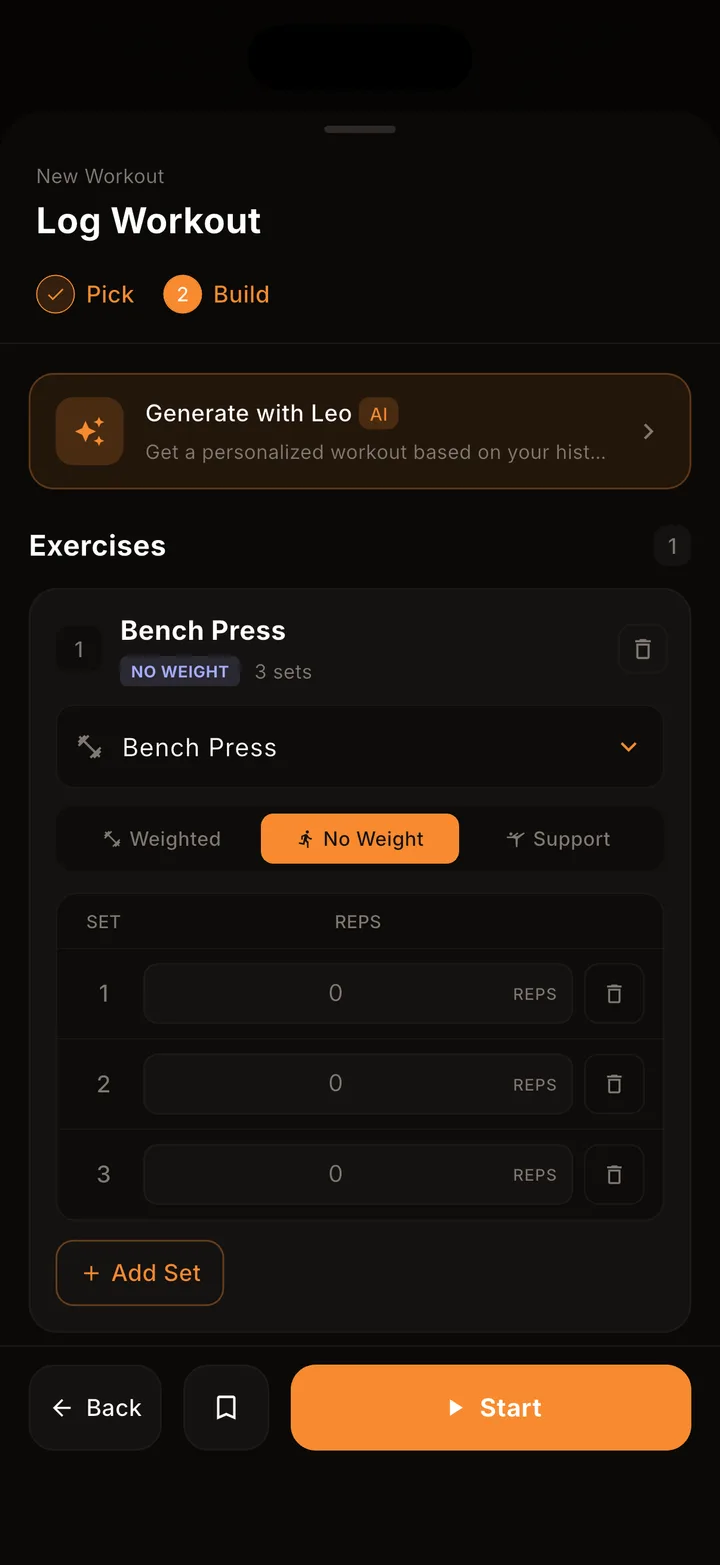
This is exactly where logging earns its keep. Kontest tracks your workouts, PRs, and estimated 1RM automatically, so a 2 day workout split doesn't quietly turn into "whatever I remember from last time." Start a kontest with a friend running the same two days a week and race for who logs both sessions first, since XP in Kontest is positive-only and a two-session week can still climb the leaderboard just fine. Two days a week still counts. Log both in Kontest and keep the streak alive. Join the Kontest beta and log your first session this week.
FAQ
Is a 2 day split enough to build muscle? Yes, as long as the two sessions are full body and dense enough to make up for the missing days. You won't progress as fast as a 4 or 5 day program, but two well-run full body sessions a week still hit every muscle group twice weekly, which is enough frequency for real gains.
What is the best 2 day full body workout? The best 2 day full body workout alternates two different sessions (an A and a B day) so you're not repeating the exact same lifts every time, while still hitting a squat pattern, a hinge pattern, a horizontal push and pull, and a vertical push or pull across the two days combined.
Is a 2 day workout split better than a 3 day split? Neither is "better" in general. A 3 day split delivers more weekly volume and usually faster progress, but a 2 day split is the better choice whenever three days genuinely isn't available, since a smaller program you complete beats a bigger one you skip.
Can beginners use a 2 day workout routine? Beginners can, though three days tends to work better early on since it gives you more practice reps on your main lifts while you're still learning form. If two days is truly all the time you have, our beginner workout plan can be trimmed to the two hardest-working days instead.
How long should a 2 day split workout session last? Most sessions run 60 to 75 minutes, longer than what you'd expect from a higher frequency split, since each session is covering your entire body in one sitting. If a session is regularly running past 75 minutes, cut an accessory exercise before you cut your main lifts.
A 2 day split workout is not a lesser program, it's the correct program for a season that only has two days in it. Run the full body sessions above, apply the progression rules every time, and add a third day the moment your schedule actually allows it, not a day before.