Progressive resistance training is the reason your first month of lifting felt like free progress and month six did not. It comes down to one rule: the resistance your muscles work against has to keep going up, on purpose, or your body stops bothering to adapt.
That's the entire principle, and it predates every app or program built on top of it. Below is what the term actually means, how it's different from (and identical to) progressive overload, why a barbell, a machine, and a resistance band all apply the same rule in different ways, and the weekly decision that turns this from a concept into five more pounds on your squat.
What progressive resistance training means
Progressive resistance training means increasing the resistance a muscle works against over time, on purpose, instead of repeating the same movement at the same difficulty indefinitely. Resistance can come from a barbell, a machine stack, a resistance band, or your own bodyweight. The "training" part is what makes it progressive: you track what you did last time and make this time slightly harder.
Exercise physiologists call the underlying idea SAID, specific adaptation to imposed demand. A muscle adapts to whatever demand you actually place on it, not more. Hold the demand steady and adaptation stops, because your body already met the bar you set. Raise the demand in small, trackable steps and the muscle has a reason to keep changing.
This is why a progressive resistance exercise and plain old lifting weights aren't the same thing on paper, even when they look identical in the gym. Two lifters can run the exact same bench press session, but only the one tracking last week's numbers and deliberately trying to beat them is doing progressive resistance training. The other one is just moving weight.
Progressive resistance vs. progressive overload (same idea, two labels)
Progressive resistance training and progressive overload describe the same rule from two different angles, and lifters use the terms almost interchangeably. If you're wondering what progressive overload actually is: progressive overload is the practice of gradually increasing the demand on your muscles over time, through more weight, more reps, more sets, or less rest, so your body keeps adapting instead of maintaining its current level.
"Progressive resistance" is the older, more clinical term. It shows up first in physical therapy and rehab settings, describing resistance that increases as a patient gets stronger. "Progressive overload" is the strength-training version of the same idea, popularized once the rehab principle crossed over into the weight room. Say either one to an experienced lifter and you'll get the same nod.
The practical difference, if there is one: "resistance" points at what changes (the load itself, whether that's a barbell plate or a heavier resistance band), while "overload" points at the effect you're going for (a demand your body hasn't fully adapted to yet). Same rule, same result, just described from the input side or the output side.
The resistance curve: free weights, machines, and bands compared
Not all resistance behaves the same way through a rep, and understanding why changes how you should progress each tool.
| Resistance Type | Resistance Curve | How to Add Resistance | Best For |
|---|---|---|---|
| Free weights (barbell, dumbbell) | Flat: gravity pulls the same regardless of joint angle | Add plates or a heavier dumbbell in fixed increments (2.5-10 lb) | Main compound lifts, testing real strength |
| Machines (plate-loaded or pin-stack) | Often variable: cams and levers shift resistance to match your leverage through the rep | Move the pin down a slot, or add a plate | Isolation work, safely pushing near failure |
| Resistance bands | Ascending: resistance increases the further the band stretches | Move up a band thickness, shorten the anchor point, or stack bands | Accessory work, joint-friendly overload, travel |
| Bodyweight | Fixed by your own mass, changes only with leverage or added load | Change the lever (a decline push-up vs. a standard one), add a weighted vest, slow the tempo | Beginners, home training, high-rep endurance work |
The takeaway: "add weight" is only the free-weight version of progressive resistance. A band gets more resistant by moving up a color or shortening the anchor. A bodyweight movement gets more resistant by changing the lever arm or slowing the tempo down. The principle doesn't care which tool you're holding, only that this week's demand is higher than last week's. Free weights also happen to be the easiest place to test your one-rep max periodically, since gravity doesn't shift the resistance curve no matter what day it is.
How to apply it week to week
The weekly decision is simple, whichever tool you're using. If you hit the top of your rep range on every set at an RPE of 8 or lower, increase resistance next session (more weight on a barbell, a thicker band, a lower pin setting). If you didn't hit the top of the range, or it took a 9 or 10 to get there, repeat the same resistance and add a rep instead.
Apply the rule per exercise, not per session. Your bench might be ready for more resistance while your rows aren't, in the same week. And when a lift genuinely stalls on load, the fix usually isn't pushing harder, it's switching to reps or sets for a few weeks before trying the heavier weight again.
We built out the full week-by-week version of this rule, plus a 12-week template and a real bench press case study, in the complete progressive overload plan. This section is the short version. That one is the whole system.
What research says about progression speed
Exercise science is fairly settled on the SAID principle itself. Progression speed is where things get more individual, but a few patterns hold up across coaching experience and the research behind it.
Beginners can add resistance faster than experienced lifters, often weekly on main compound lifts, because almost any structured demand is new to an untrained muscle. That window narrows within the first year of consistent training, which is why "just add 5 lb every week forever" stops working for everyone eventually, not because the lifter did something wrong.
Bigger, slower-recovering muscle groups (legs, back) generally tolerate faster load increases than smaller, more joint-stressed ones (shoulders, wrists). That's part of why upper-body accessory work usually progresses in reps or bands rather than raw plates.
And recovery, not motivation, is the real limiter on progression speed. A lifter sleeping five hours a night while adding weight every session isn't outrunning the principle, they're borrowing against a recovery deficit that eventually comes due as a stalled lift or an injury.
The principle is useless without a log
Every rule above depends on knowing what you actually did last time, not what you remember doing. Was last week's set a real RPE 8, or an 8 you're calling it because a 9 feels like failure? Did you actually add resistance three sessions in a row, or did one of those sessions quietly repeat the same weight?
Progressive resistance training only works as a comparison. This week's set has to be measured against last week's set, and memory is a bad measuring tool. Lifters who eyeball their progression are usually repeating the same resistance for months without noticing, because a plateau feels identical to a memory gap from the inside.
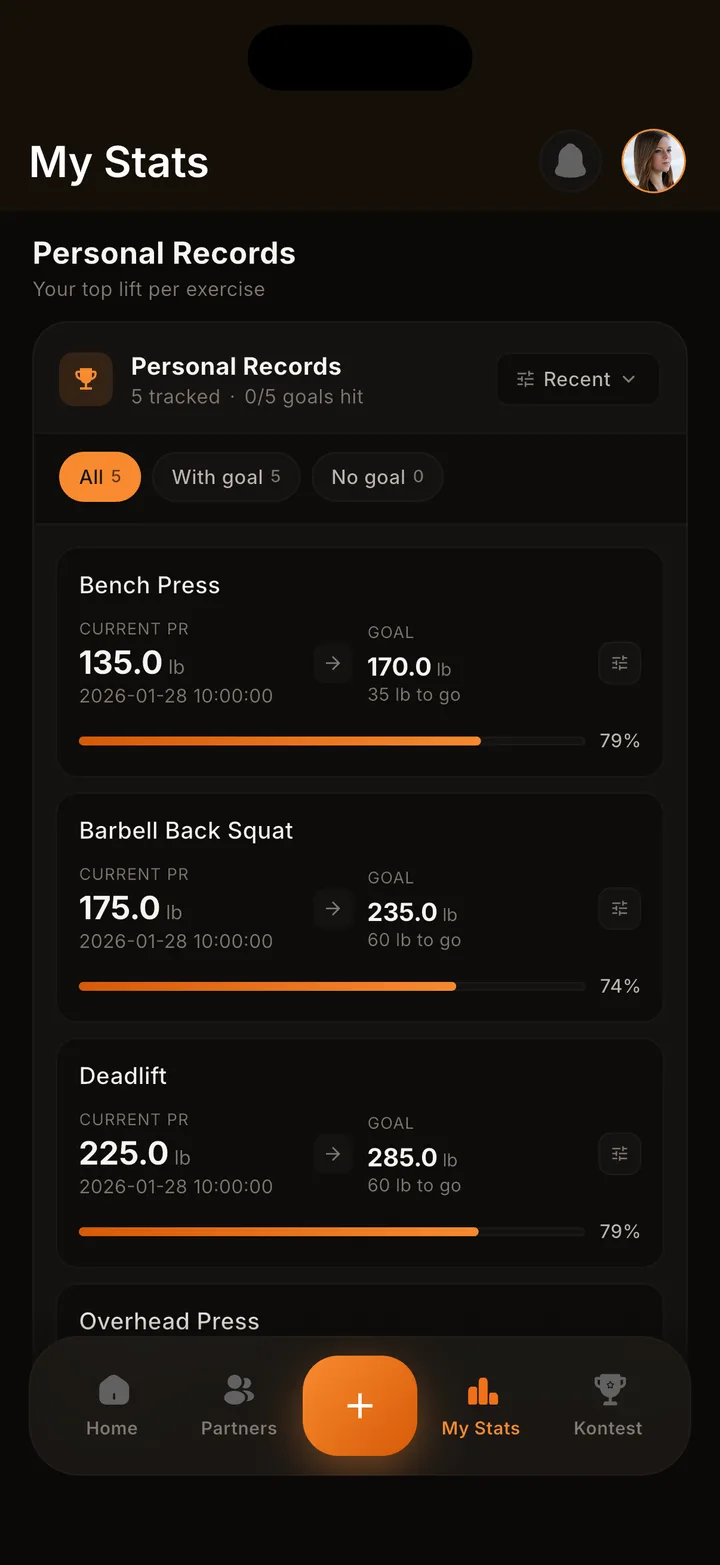
Kontest shows your load trend per lift, so the next 5 lb never sneaks past you (or fails to show up when it should have). Log a set and the app tracks your current PR against your last few sessions automatically, on a barbell, a band, or a machine stack, so the weight-vs-reps decision from the section above is a glance at your numbers instead of a guess. Join the Kontest beta and put a real log behind the principle instead of a mental estimate.
FAQ
What is progressive overload? Progressive overload is the practice of gradually increasing the demand on your muscles over time, through more weight, more reps, more sets, or less rest between sets, so your body keeps adapting instead of maintaining its current level. It's the same underlying rule as progressive resistance training, described from the effect instead of the tool.
What is a progressive resistance exercise? A progressive resistance exercise is any movement, a barbell lift, a machine exercise, a band movement, or a bodyweight exercise, done with resistance that increases on a schedule instead of staying flat. The exercise itself doesn't define it. Tracking and raising the demand over time does.
What are the basic principles of resistance training? The core resistance training principles are specificity (train the muscle and movement you actually want to improve), progressive overload (raise the demand over time), and recovery (adaptation happens between sessions, not during them). Skip any one of the three and the other two stop paying off, no matter how hard the session felt.
How much weight should I add each week? On main compound lifts, 2.5-5 lb on upper-body movements and 5-10 lb on lower-body movements roughly every one to two weeks is a reasonable pace for most lifters who are consistently hitting their rep target at an RPE of 8 or lower. Once weekly jumps stop landing cleanly, switch to adding reps instead of forcing the same weight increase.
Do I need a program to do progressive resistance training, or can I just add weight when it feels right? You need a rule, not necessarily a full program. "Add weight when it feels right" is how most lifters accidentally stall, because "feels right" drifts with mood and sleep. A simple rule (hit your rep target at RPE 8 or lower, add resistance) and a log to check it against is enough structure to make the principle actually work.
Progressive resistance training doesn't require a special program, a specific tool, or a gym full of equipment. It requires one honest comparison every session: is this harder than last time, in a specific and trackable way, and if not, what's the smallest change that makes it true again. Pick your tool, apply the weight-vs-reps rule, and keep a log good enough to trust.