The Arnold Split: The Classic 6 Day Program (Plus a 4 Day Version)
An Arnold split workout pairs opposite muscle groups in the same session, chest with back, shoulders with arms, then trains legs on their own, and runs that three-day cycle twice a week for six total training days. It carries Arnold Schwarzenegger's name because it's close to how he trained through his Mr. Olympia years: high frequency, high volume, and supersets that keep the bar moving instead of letting you rest between sets.
Six days a week is not a casual commitment. This guide gives you the honest version: the full classic program with real sets, reps, and RPE, a 4-day adaptation that keeps the structure without the second job's worth of gym time, and the recovery math that decides which one you can actually sustain.
What the Arnold Split Workout Is
The arnold split workout groups training into three session types, run twice through the week:
- Chest and back. Every set is a superset: one chest exercise immediately followed by one back exercise, no rest between them. Push and pull recruit opposite muscles, so one side gets to rest while the other works.
- Shoulders and arms. Delts, biceps, and triceps in one session, since none of them need much recovery time from the day before.
- Legs. Quads, hamstrings, glutes, and calves, trained on their own because a real leg session has nothing left over for anything else.
Run chest/back, shoulders/arms, legs, then repeat, and you land on six training days with one day off. This is the arnold schwarzenegger workout split as it's usually described in bodybuilding circles: not a single fixed routine handed down word for word, but a training pattern, chest and back paired as antagonist supersets and everything trained twice a week, that shows up across his era of competitive bodybuilding.
The chest and back workout is the signature piece. Pairing a push and a pull means you can move from a heavy bench press straight into a heavy row with almost no rest, which is how six-day training and a 90-minute gym session coexist without your CNS filing a complaint.
Who Should Run It (and Who Absolutely Should Not)
This split rewards people who have the time, the appetite, and the recovery capacity for high-frequency training. It's a poor fit for almost everyone else, and that's fine.
Run it if:
- You can train six days a week, most weeks, without your job or your family calendar torching the plan by week three.
- You've got at least a year of consistent lifting behind you. Supersetting heavy compounds only works if your form holds up when you're breathing hard.
- Your recovery inputs (sleep, food, stress) are dialed in enough to support daily training. Six days on borrowed sleep is how you get hurt, not how you get bigger.
Skip it, or scale it down, if:
- You're new to lifting. Learning bar path and bracing under fatigue, which is what supersets demand, is a bad place to start. Run a simpler split for your first year and come back to this one once the fundamentals are automatic.
- Six days a week isn't realistic for your schedule. A 3-day workout split trains every major muscle group in a third of the sessions and is far easier to actually finish every week.
- You're managing a joint issue or coming back from injury. High-frequency training punishes anything that isn't fully healthy, since there's no built-in rest day to hide behind.
If you're on the fence, the 4-day version below is built for exactly that hesitation.
The Complete 6-Day Program (Tables per Day)
This is a real 6-day split: chest/back, shoulders/arms, legs, twice through, one rest day. Superset pairs are marked 1a/1b, meaning you do one set of 1a, rest zero to fifteen seconds, then one set of 1b, then rest for real before the next pair.
Day 1: Chest & Back A
| Exercise | Sets | Reps | RPE |
|---|---|---|---|
| 1a. Barbell bench press | 4 | 6-8 | 8 |
| 1b. Wide-grip pull-up | 4 | 6-8 | 8 |
| 2a. Incline dumbbell press | 3 | 8-10 | 8 |
| 2b. Bent-over barbell row | 3 | 8-10 | 8 |
| 3a. Flat dumbbell fly | 3 | 12-15 | 8 |
| 3b. Lat pulldown | 3 | 12-15 | 8 |
| 4a. Cable crossover | 2 | 15 | 9 |
| 4b. Straight-arm pulldown | 2 | 15 | 9 |
Day 2: Shoulders & Arms A
| Exercise | Sets | Reps | RPE |
|---|---|---|---|
| Seated barbell overhead press | 4 | 6-8 | 8 |
| Lateral raise | 3 | 12-15 | 8 |
| Rear delt fly | 3 | 12-15 | 8 |
| Barbell curl | 3 | 8-10 | 8 |
| Close-grip bench press | 3 | 8-10 | 8 |
| Incline dumbbell curl | 2 | 10-12 | 9 |
| Overhead tricep extension | 2 | 10-12 | 9 |
Day 3: Legs A
| Exercise | Sets | Reps | RPE |
|---|---|---|---|
| Back squat | 4 | 6-8 | 8 |
| Romanian deadlift | 3 | 8-10 | 8 |
| Leg press | 3 | 10-12 | 8 |
| Leg curl | 3 | 12 | 8 |
| Standing calf raise | 4 | 12-15 | 9 |
| Hanging leg raise | 3 | 12-15 | 8 |
Day 4: Chest & Back B
| Exercise | Sets | Reps | RPE |
|---|---|---|---|
| 1a. Incline barbell press | 4 | 6-8 | 8 |
| 1b. Weighted pull-up | 4 | 6-8 | 8 |
| 2a. Flat dumbbell press | 3 | 8-10 | 8 |
| 2b. Seated cable row | 3 | 8-10 | 8 |
| 3a. Pec deck | 3 | 12-15 | 8 |
| 3b. Single-arm dumbbell row | 3 | 12/side | 8 |
| 4a. Feet-elevated push-up | 2 | AMRAP | 9 |
| 4b. Face pull | 2 | 15-20 | 9 |
Day 5: Shoulders & Arms B
| Exercise | Sets | Reps | RPE |
|---|---|---|---|
| Dumbbell shoulder press | 4 | 8-10 | 8 |
| Cable lateral raise | 3 | 15 | 8 |
| Reverse pec deck | 3 | 15 | 8 |
| EZ-bar curl | 3 | 8-10 | 8 |
| Skull crusher | 3 | 8-10 | 8 |
| Cable curl | 2 | 12-15 | 9 |
| Rope tricep pushdown | 2 | 12-15 | 9 |
Day 6: Legs B
| Exercise | Sets | Reps | RPE |
|---|---|---|---|
| Front squat | 4 | 6-8 | 8 |
| Walking lunge | 3 | 12/leg | 8 |
| Leg extension | 3 | 12-15 | 8 |
| Seated leg curl | 3 | 12-15 | 8 |
| Seated calf raise | 4 | 15 | 9 |
| Cable crunch | 3 | 12-15 | 8 |
Day 7 is off. Full stop, no exceptions, no "quick pump session." That's the one day your joints and your central nervous system get to actually recover from a 6 day split, and skipping it is how week 4 turns into a wall instead of a plateau.
The 4-Day Arnold Adaptation
Most people reading this do not have six training days. Here's the honest version that keeps the structure and the supersets without eating your whole week.
The trade-off: chest and back gets trained twice, shoulders/arms and legs once each. Chest/back can absorb the extra frequency because the antagonist supersets mean each muscle still gets real rest inside the session, while a second leg day or a second arm day on top of everything else usually just adds fatigue without adding results at four days a week.
Day 1: Chest & Back
| Exercise | Sets | Reps | RPE |
|---|---|---|---|
| 1a. Barbell bench press | 4 | 6-8 | 8 |
| 1b. Weighted pull-up | 4 | 6-8 | 8 |
| 2a. Incline dumbbell press | 3 | 8-10 | 8 |
| 2b. Seated cable row | 3 | 8-10 | 8 |
| 3a. Cable crossover | 3 | 12-15 | 9 |
| 3b. Lat pulldown | 3 | 12-15 | 9 |
Day 2: Legs
| Exercise | Sets | Reps | RPE |
|---|---|---|---|
| Back squat | 4 | 6-8 | 8 |
| Romanian deadlift | 3 | 8-10 | 8 |
| Leg press | 3 | 10-12 | 8 |
| Leg curl | 3 | 12 | 8 |
| Standing calf raise | 4 | 12-15 | 9 |
Day 3: Rest
Day 4: Shoulders & Arms
| Exercise | Sets | Reps | RPE |
|---|---|---|---|
| Seated dumbbell shoulder press | 4 | 8-10 | 8 |
| Lateral raise | 3 | 12-15 | 8 |
| Barbell curl | 3 | 8-10 | 8 |
| Close-grip bench press | 3 | 8-10 | 8 |
| Rope tricep pushdown | 2 | 12-15 | 9 |
| Hammer curl | 2 | 10-12 | 9 |
Day 5: Chest & Back (Emphasis B)
| Exercise | Sets | Reps | RPE |
|---|---|---|---|
| 1a. Incline barbell press | 4 | 6-8 | 8 |
| 1b. Wide-grip lat pulldown | 4 | 8-10 | 8 |
| 2a. Flat dumbbell fly | 3 | 12-15 | 8 |
| 2b. Bent-over barbell row | 3 | 8-10 | 8 |
| 3a. Feet-elevated push-up | 2 | AMRAP | 9 |
| 3b. Face pull | 3 | 15-20 | 9 |
Train Monday, Tuesday, Thursday, Friday, rest Wednesday and the weekend. If you'd rather rotate the bonus day between legs and shoulders/arms instead of always doubling up chest and back, that works too, just keep whichever muscle group you double up on the pattern that gives it the most recovery inside the session (chest/back, via the supersets), not the least.
Recovery and Progression at High Frequency
Six days a week only works if recovery is actually built into the plan, not treated as an afterthought.
Sleep and food come first. This isn't optional advice, it's the mechanism. High-frequency training without 7 to 9 hours of sleep and enough food to support it just accumulates fatigue until something (a lift, a joint, your motivation) breaks.
Progress the pair, not just one lift. On chest/back supersets, don't chase weight on the bench press while ignoring the row. Add reps first: once both exercises in a pair hit the top of their rep range for every set, add weight to both and drop back to the bottom of the range.
Deload every 4 weeks, not 6. The 6-day version accumulates fatigue faster than a standard 3 or 4-day split, so pull the deload trigger a couple weeks earlier than you would on lower-frequency programs. Drop to about 60% of your working weights for one week.
Watch your joints, specifically. Supersetting compounds like bench press and heavy rows six days a week puts real repeated load through your shoulders and elbows. Sore muscles are normal. Sharp or pinching joint pain is your cue to drop a day, not push through it.
Arnold Split vs PPL
Both splits train hard and both can build serious muscle. The difference is in structure and how forgiving each one is when your week gets messy.
| Split | Session structure | Frequency per muscle group | Best for | Biggest downside |
|---|---|---|---|---|
| Arnold split | Antagonist supersets (chest/back), straight sets elsewhere | 2x/week on the 6-day version | Experienced lifters with 6 real training days and dialed-in recovery | Falls apart fast if sleep, food, or schedule slip |
| Push pull legs | Straight sets, one movement pattern per session | 2x/week (6-day) or 1x/week (3-day) | Lifters who want the same frequency with more schedule flexibility | Missing a day scrambles the order more visibly at 6 days |
The practical difference shows up in the gym, not on paper: PPL sessions are longer and lower-density, since you're resting fully between every set. Arnold split sessions move faster because the chest/back supersets cut dead time, which is also why the classic version fits into roughly the same weekly hours as a 5-day PPL cycle despite having one more training day.
Common Mistakes
- Treating the superset rest period as optional to skip entirely. Zero to fifteen seconds between 1a and 1b is the point. Resting a full 90 seconds between them defeats the density that makes six days sustainable in the first place.
- Running the 6-day version with a beginner's recovery capacity. If you're new to lifting, this split will bury you before it builds you. Earn it first.
- Picking a chest exercise and a back exercise that compete for the same stabilizers. Bench press paired with a heavy deadlift variation, for example, both hammer your lower back and grip in ways that don't actually let either side rest. Stick to true push/pull pairs like the tables above.
- Ignoring the calendar math. Six days a week for four straight weeks without a deload is how good programs turn into injuries. Build the deload in before you need it.
- Not logging the superset pairs together. If you only track the bench press number and lose the row number, you lose half the information you need to know whether the day actually worked.
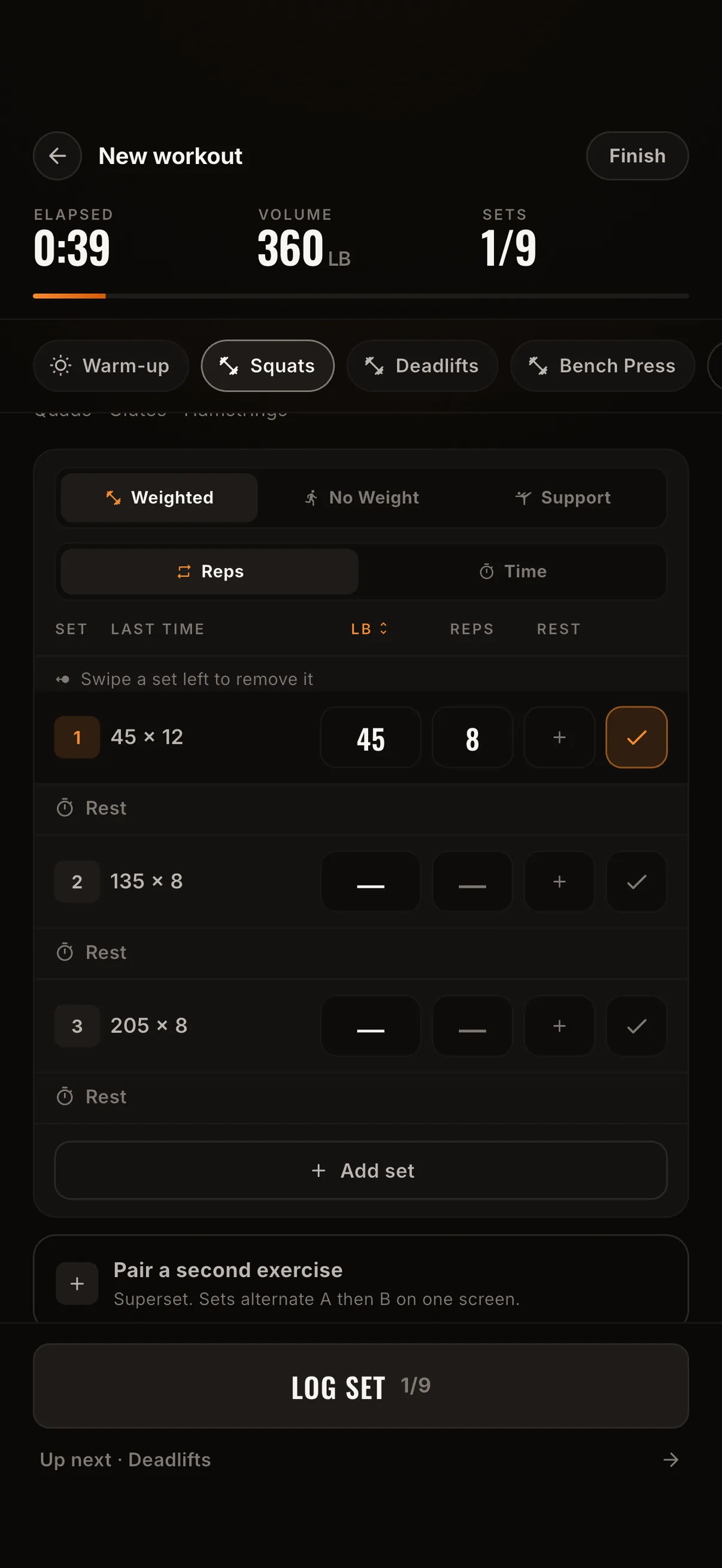
That last one is the easiest mistake to fix. Log every chest and back superset in Kontest and you get both sides of the pair on record automatically, then race a friend on weekly volume instead of just comparing bench numbers. If you're not tracking training this way yet, Kontest is free to join in beta.
FAQ
What is the Arnold split workout? It's a 6-day training split that pairs chest and back as antagonist supersets, trains shoulders and arms together, and trains legs on their own, running that three-session cycle twice a week. It's named for Arnold Schwarzenegger, whose training during his competitive bodybuilding years followed this general pattern.
Did Arnold Schwarzenegger actually train this way? The chest and back superset pairing, along with training each muscle group twice a week across a 6-day split, is well documented in bodybuilding literature from his era. The exact sets and reps in any modern "Arnold split" writeup, including this one, are a reconstruction built on that pattern, not a word-for-word transcript of a specific training log.
Is a 6 day split too much for most lifters? For most lifters, yes. A 6 day split demands recovery capacity (sleep, food, and time) that most schedules and bodies can't sustain for long. The 4-day adaptation above keeps the same chest/back superset structure at a frequency far more people can actually maintain.
What makes chest and back a good superset pairing? Chest and back are antagonist muscle groups: one pushes, one pulls, and they don't compete for the same recovery resources within a session. Pairing them lets you train with almost no rest between exercises while each muscle still gets a genuine break while its opposite is working.
Can beginners run the Arnold split? Not the 6-day version. Supersetting heavy compound lifts requires the kind of bar control and bracing that takes time to build. A beginner-friendly full body or 3-day split will teach those fundamentals faster and with far less injury risk.
An arnold split workout is one of the most demanding templates in strength training, and also one of the most rewarding when your schedule and recovery can actually back it up. Run the full 6-day version if six real training days fit your life, drop to the 4-day adaptation if they don't, and log every session either way so you know which version is actually working.