How to Find a Gym Partner Who Will Not Flake
Most people go looking for a gym partner the way they look for a parking spot: drive around, hope, take whatever shows up first. That's why so many partnerships die inside three weeks. Finding a gym partner who actually sticks works the same as finding any other reliable person in your life: you look in the right places, you check a few things before you commit, and you agree on the rules before the first missed Tuesday tests them.
This guide covers how to find a gym partner, how to vet one before you hand them your Tuesdays and Thursdays, and the ground rules that keep a partnership alive past the first month. Then the part most guides skip: your best gym partner might already be in your phone, three states away, and that's fine.
Why Training With a Partner Works
We already went deep on the research behind this in our piece on workout accountability: people working out with someone else show dramatically higher attendance and far lower dropout than people going it alone, and the mechanism isn't chemistry, it's structure. Someone else has to notice if you skip. Something has to feel like a loss when you do. A running streak makes skipping cost more than it would in isolation.
A gym partner is the original, low-tech version of that structure. No app required, no leaderboard, just a person who expects you at 6 p.m. and will ask where you were if you weren't. The rest of this guide is about getting the person part right, because the mechanism only works if the partner actually holds up their end.
Where to Find a Gym Partner
The honest ranking, roughly in order of how likely the partnership is to actually last:
Your own gym floor
The best candidate is usually already there. Look for people on your schedule and your rough level: the guy who's always on the squat rack at 6 a.m., the woman doing accessory work in the same corner you do every week. Shared time and shared space beat almost any deliberate search, because you're both already proving you show up before you've said a word to each other.
A class you already attend
Group cycling, a CrossFit box, a run club, anywhere with a fixed schedule doubles as a partner-finding machine, since everyone there has already cleared the hardest part: showing up regularly. Talk to the same three or four people for a month before you ask anyone to be your actual workout partner. Consistency is easy to fake for one class. It's hard to fake for four weeks straight.
Your group chat
Before you look for a stranger, check who you already know. The friend who "should really get back into it," the coworker who mentions the gym twice a week and never brings anyone, the sibling across town: these people are lower risk than a stranger, because you already have a read on whether they follow through on things. A group chat is also the easiest place to find a gym partner if you're starting from zero, since nobody there is judging your current fitness level. They already know you.
Apps built for exactly this
If none of that pans out, apps exist specifically to solve the matching problem: getting a stranger who trains at your level and near your schedule in front of you without waiting for a chance encounter. We compared the real options, split by whether you need to find someone from scratch or actually compete with the friends you already have, in our breakdown of the best gym buddy apps. Worth a look once your gym, your classes, and your group chat have all come up empty.
How to Vet a Potential Gym Partner
Finding a candidate is the easy part. Before you hand over real training time, check three things.
Schedule. Not "we're both free most evenings," the actual days and times. A workout partner whose real availability is Tuesday and Thursday at 6 p.m. only works if yours is too. Vague overlap turns into a partnership that meets twice a month and then quietly stops.
Goals. You don't need identical goals, but you need compatible ones. Two people chasing strength on a similar timeline train well together. Pair a powerlifter with someone doing casual cardio three days a week and one person ends up waiting around while the other feels rushed, and that mismatch kills more partnerships than personality clashes ever do.
Seriousness. Watch what someone does before you ask, not what they say. A person who's already cancelled on casual gym plans twice will cancel on you too. The best predictor of a reliable partner is a track record you can actually observe, not a promise about how committed they're about to become.
A few questions get at all three at once: What days can you actually commit to, not just prefer? What are you training toward right now? How many sessions have you missed on your current program this month? The last one feels blunt. Ask it anyway. It tells you more than anything else on this list.
Ground Rules That Keep a Partnership Alive
Set these before the first miss, not after.
| Rule | What it looks like |
|---|---|
| Fixed days and times | An actual slot on the calendar both of you protect, not "sometime this week" |
| Notice window | Text by a set time (say, 8 a.m.) if you can't make it, instead of a no-show |
| Matched effort | Whoever finishes first spots or waits; nobody trains at a pace that leaves the other behind |
| Injury protocol | Agreed up front: a hurt partner still shows up to spot or gives an honest heads-up, doesn't just vanish |
| Review point | Revisit the arrangement after a month. Adjust it or end it, don't let it quietly rot |
Two of these matter more than people expect. The notice window turns a flake into a heads-up, since the real problem is rarely that plans change, it's finding out at 5:58 for a 6:00 session. And the review point matters because most gym partnerships don't end in a blowup, they end by drifting until neither person brings it up again. Put an actual date on the calendar to check in, even if the check-in is two lines of text.
When Your Best Partner Lives in Another City
Your best gym partner does not have to share your gym, your city, or your time zone. If the person whose consistency you trust most moved away, or you've never lived near your most reliable friend, the setup above still works. You just swap the shared gym floor for a shared log.
The mechanism that makes a gym partner effective, someone seeing whether you actually showed up, doesn't require a shared address. It requires visibility: a place where your partner can see that you trained, not just take your word for it. A one-line "done" in a group chat gets you halfway there. An actual log, sets and weight and all, does it properly, because it's harder to fake and easy to notice when it goes quiet for a week.
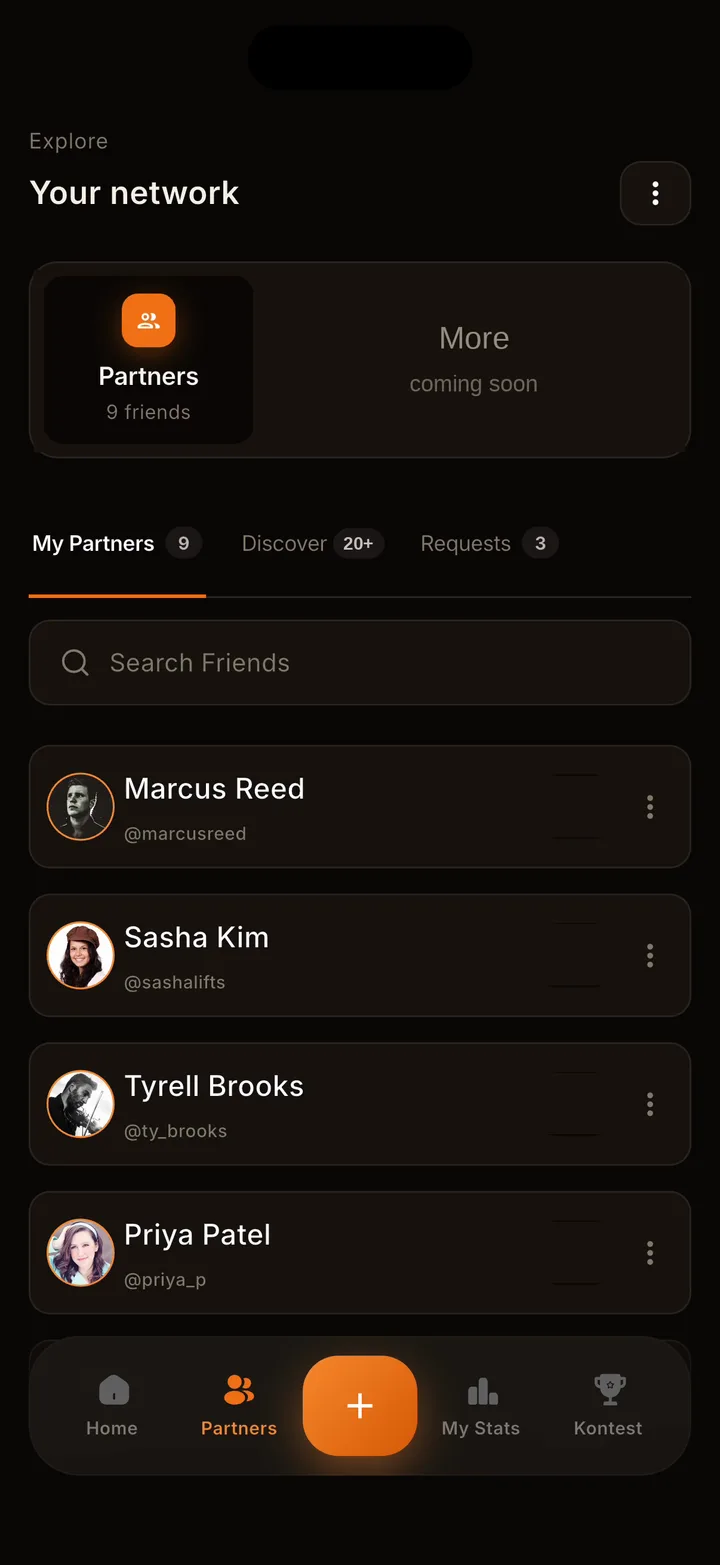
This is the piece software has only recently started solving well, and it's a big part of why Kontest exists. Your gym partner does not need to share your gym. Create a kontest with them, both of you log your sessions, and you're training in the same place even when that place is three states apart.
Turning a Partnership Into a Competition
Once the accountability piece is solid, most partnerships hit a ceiling: you're both showing up, which is the hard part solved, but nothing is pulling either of you to do more than the minimum. That's where a little competition earns its keep.
A kontest turns a partnership into something with a score. Every logged set counts toward XP, both of you can see the other's week on a shared leaderboard, and a streak gives you both something to protect instead of just a plan to follow. None of it punishes a missed day. Kontest's XP only ever adds, it never gets taken away for a skipped session, so the competition stays fun instead of becoming another way to feel bad about a rest day.
Your gym partner does not need to share your gym. Start a kontest and train together anyway. Maybe that's the person on the rack next to you. Maybe it's the friend three states over who's the only one who's ever actually shown up. Kontest is free to join in beta.
FAQ
What makes someone a good gym partner? Reliability first, personality second. A workout partner who shows up on time every week, even one you'd never grab coffee with otherwise, beats a friend you love hanging out with who cancels half the time. Check the track record before you check the chemistry.
How do I find a gym partner if I don't already know anyone who lifts? Start with your own gym floor or a class you attend regularly. The people who show up on your schedule at your level are already proving the one thing that matters most. If that comes up empty, a gym buddy app can supply candidates you'd never otherwise cross paths with.
Can a gym partner work if you're at different fitness levels? Yes, within reason. A large gap in strength or experience usually means one person waits around and the other feels rushed. A moderate gap is fine, and often useful, since the stronger lifter sets a pace the other one grows into.
Do you have to train together in person for it to count? No. The mechanism that makes a gym partner useful, someone who can see whether you trained, works over distance too. A shared log or app-based leaderboard restores that visibility even when you're not in the same city, which is exactly what a remote kontest is built to do.
How often should you check in on a gym partnership? About once a month. Most partnerships don't blow up, they quietly drift until nobody brings it up anymore. A short monthly check-in, still working, still the right days, catches that before it happens.