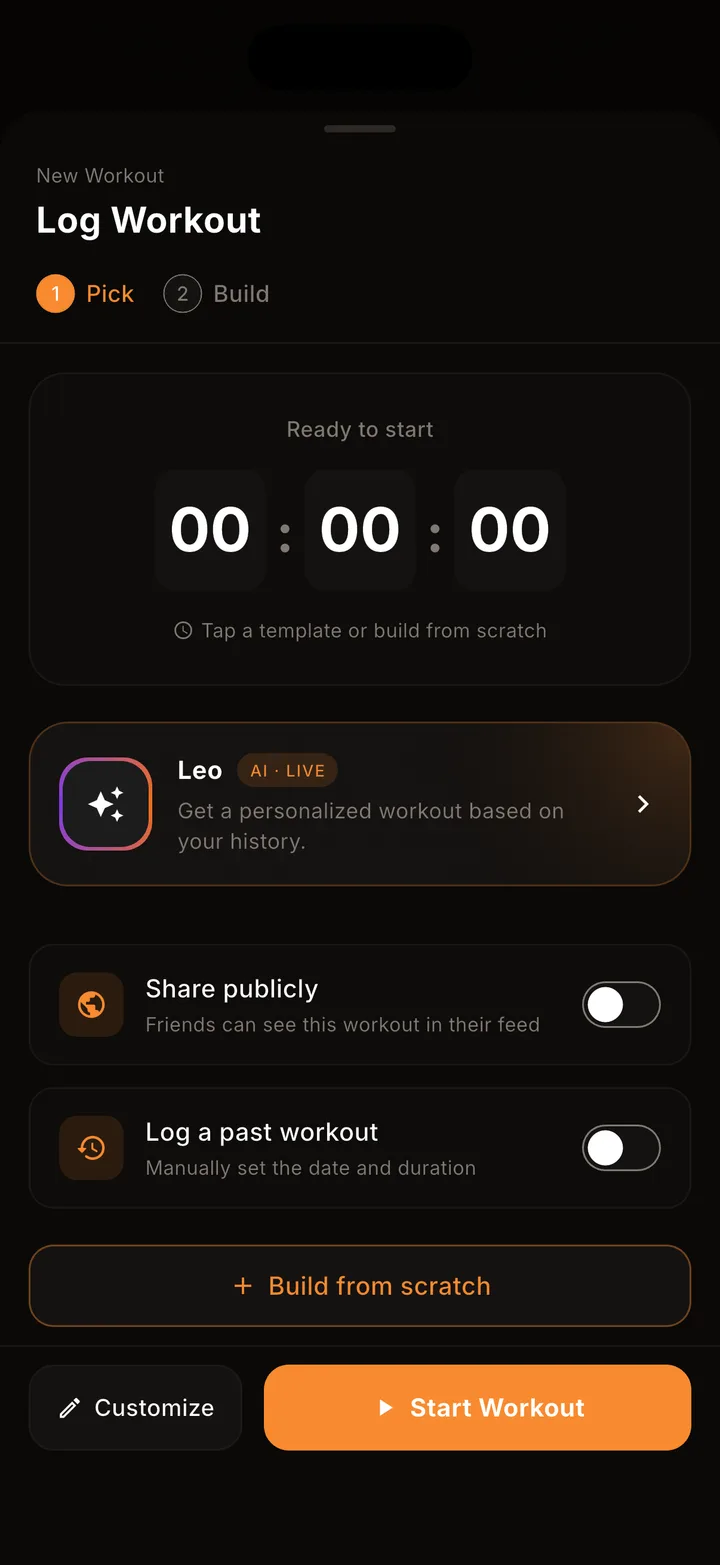
You don't need a coach, a $30 template, or three hours of YouTube research to build a workout plan that actually works. You need to make 5 decisions, in the right order, and write them down. That's it. Here's how to create a workout plan in about 20 minutes, the same framework a coach would use, minus the invoice.
Most people get stuck not because programming is hard, but because they try to decide everything at once: days, split, exercises, sets, reps, weights, progression, all in one overwhelmed scroll through Instagram. Split it into 5 separate calls, each one boring and obvious once you isolate it, and the whole thing takes less time than a lifting session.
How to Create a Workout Plan: The 5 Decisions
Every real workout program, whether it costs $200 or nothing, is built from the same 5 decisions stacked on top of each other:
- How many days can you actually train (not how many you wish you could)
- What split fits that number of days
- Which exercises fill each session
- How many sets, reps, and what weight to start with
- What rule tells you when to add weight
Answer those in order and a workout plan falls out the other end. Answer them out of order, picking exercises before you've settled on a split, say, and you end up rebuilding the whole thing twice. The sections below walk through each decision with the actual numbers, not vague ranges you have to go interpret yourself.
Decision 1: Pick Your Training Days, Honestly
Not your best week. Your normal week, the one with a late meeting on Tuesday and a kid's soccer game on Saturday. Count the days you'll realistically train for the next 8 to 12 weeks, not the days a perfect version of you would train.
This matters because the split you pick in Decision 2 depends entirely on this number, and picking based on wishful thinking is the single most common reason workout plans die in week 3. A honest 3 day plan you finish beats an ambitious 5 day plan you abandon by week 2.
A rough guide for where most people land:
| Days Available | Who This Usually Is |
|---|---|
| 2 | Genuinely busy season: new job, new kid, travel-heavy month |
| 3 | The realistic default for most lifters with a full schedule |
| 4 | Training is a real priority and the schedule allows it |
| 5-6 | Training is a top priority, or you're intermediate/advanced and chasing specific numbers |
Pick the row that matches your actual calendar for the next couple of months, not the one that sounds more serious. You can always add a day later once the lower number becomes automatic.
Decision 2: Choose Your Split (a Decision Tree)
Your split is just how you divide your training days across your body. More days doesn't mean a better split, it means a different one. Use the number from Decision 1 to go straight to the right answer instead of reading five programs and guessing.
| Days a Week | Recommended Split | Full Program |
|---|---|---|
| 2 | Full body, twice a week | 2 day split workout |
| 3 | Full body or Push/Pull/Legs | 3 day workout split |
| 4 | Upper/Lower | Upper lower split |
| 5-6 | Push/Pull/Legs (repeated) | Push pull legs split |
| 6 (advanced) | Arnold split (chest/back, shoulders/arms, legs) | Arnold split |
A few notes on the edges. At 3 days, full body is the safer default if you're newer to lifting, since every muscle gets hit three times a week instead of once. Push/Pull/Legs at 3 days works better once you have enough training history to recover from hitting each muscle group harder, less often. At 6 days, Push/Pull/Legs run twice through the week is the standard choice, and the Arnold split is the higher-frequency, higher-volume alternative for people who've already outgrown a basic PPL and want more chest and back work specifically.
Whatever the table points you to, go read that full program page before moving to Decision 3. Each one already has the exercises, sets, and reps worked out. You're about to build a lighter version of the same logic yourself, so seeing a finished one first makes the next three decisions faster.
Decision 3: Pick Your Exercises (the Boring Reliable List)
This is where people waste the most time, scrolling for the "best" exercise for each muscle when the honest answer is that five or six movement patterns cover almost everything, and the exercises inside each pattern are interchangeable. Pick one per pattern per session and move on.
| Movement Pattern | Primary Pick | No-Barbell Alternative |
|---|---|---|
| Squat | Barbell back squat | Goblet squat or leg press |
| Hinge | Barbell deadlift or Romanian deadlift | Dumbbell Romanian deadlift |
| Horizontal push | Barbell bench press | Dumbbell bench press or push-up |
| Horizontal pull | Barbell row | Dumbbell row or seated cable row |
| Vertical push | Overhead press | Dumbbell shoulder press |
| Vertical pull | Pull-up or lat pulldown | Assisted pull-up or band pulldown |
| Core | Hanging leg raise or plank | Dead bug |
A full body or 2 day plan pulls one exercise from most rows every session. A split like Upper/Lower or PPL spreads them across the week instead, so a push day gets horizontal push, vertical push, and a couple of accessory lifts (triceps, side delts), while a pull day gets the pulling equivalents. Add one or two isolation exercises per session for whatever you personally care about (arms, calves, whatever), but the six rows above are what actually build the plan. Everything else is seasoning.
Don't chase novelty here. The exercise that builds the most strength and size is the one you can load consistently and track over months, not the one an ad convinced you was secretly better.
If you're deciding between two options in the same row, let equipment and joint comfort make the call, not preference. Someone with cranky shoulders often does better on a neutral-grip dumbbell press than a barbell bench. Someone without a rack does more useful work with a goblet squat than skipping the pattern entirely. The pattern matters more than the specific tool you use to load it, which is exactly why the table has a fallback column instead of one rigid answer per row.
Decision 4: Sets, Reps, and Starting Weights
This is the part people either overcomplicate with a spreadsheet or skip entirely by grabbing whatever weight looks reasonable. Neither works. Here's the version that does.
| Experience | Sets per Exercise | Rep Range (Compound) | Rep Range (Accessory) | How to Find Starting Weight |
|---|---|---|---|---|
| New (0-6 months) | 3 | 8-10 | 10-15 | A weight you could do 12-14 reps with, then load it for 8-10 |
| Intermediate (6 months-2 years) | 3-4 | 5-8 | 8-12 | Your last known working weight for that rep range, or 60-70% of a recent 1RM estimate |
| Advanced (2+ years) | 4-5 | 4-6 | 8-12 | Based on current training max, adjusted weekly |
If you have no idea what weight to start with, the safest rule is to underestimate on purpose. Do your first working set at a weight you're confident you could do for a couple more reps than prescribed. If it moves easily, add weight next set. That first session is a calibration session, not a test of how strong you are, and treating it that way prevents the two most common day-1 mistakes: a tweaked lower back from an ego squat, or a program that starts you so light the first four weeks feel pointless.
Decision 5: Set Your Progression Rules
A plan without a progression rule isn't a program, it's a workout you'll repeat identically until you get bored. The rule doesn't need to be complicated. It needs to exist and you need to follow it.
| Exercise Type | Progression Rule |
|---|---|
| Main compounds (squat, bench, deadlift, OHP) | Add weight once you hit the top of your rep range for all working sets, two sessions in a row |
| Accessory lifts | Double progression: add reps each session until you hit the top of the range for all sets, then add weight and drop back to the bottom of the range |
| Anything stalling 3 sessions in a row | Cut the weight 10%, rebuild for 2 weeks, then resume |
A realistic pace for main lifts once you're past the first couple of months: roughly 5 lb a week on upper body compounds, 5 to 10 lb a week on lower body compounds, slowing down naturally as the weights get heavier. That's not a guarantee, it's a starting expectation so you know the difference between normal progress and an actual stall.
Notice what's missing from that table: a rule for when to change the whole plan. That's on purpose. Most people quit a working program too early because a single stalled lift felt like proof the plan failed, when it was really just a signal to apply the third row and move on. Give a program 8 to 12 weeks before you judge it, and let individual exercises stall and get fixed inside that window instead of scrapping the whole thing every time one number stops climbing.
Write It Down, Then Log It
Five decisions made, you now have an actual workout plan: X days a week, this split, these exercises, these sets and reps, this progression rule. Write it down somewhere you'll actually look at it again. A note on your phone works. A spreadsheet works. The specific format matters far less than the fact that it exists outside your memory.
Here's the part almost every DIY plan skips: a plan on paper only tells you what you intended to do. It doesn't tell you what actually happened, and what actually happened is the only thing progression rules in Decision 5 can act on. If you don't know that your bench press has been stuck at 185 for three weeks, you can't apply the "cut 10% and rebuild" rule, because you don't know it applies. Logging every session, weight, and rep is what turns a plan into a program that adjusts itself.
Let AI Check Your Work (the MCP Walkthrough)
Once you're logging, there's a step past the plan itself: having something check whether it's still the right plan. This is where Kontest MCP comes in, and to be upfront, this is our own tool.
The idea: connect Kontest to Claude, ChatGPT, or Gemini once, and the AI can read your actual logged workouts, personal records, and volume by muscle group, not a description of your training you typed from memory. The conversation happens in your AI client, the same one you already use for everything else, not inside a separate app screen.
A real example of what that looks like once it's connected:
You: "I built a 4 day upper/lower plan 6 weeks ago. Is it still working?"
Claude: (pulls your last 6 weeks of logged sessions and PRs) "Your squat and bench have both moved up over the period, squat from 185x5 to 205x5, bench from 135x8 to 145x8. Your overhead press hasn't moved in 3 sessions though, still 85x8 across all three. That matches the stall pattern where a 10% deload and 2 week rebuild usually gets things moving again. Want a modified upper day with that adjustment?"
That's the honest end state of a good DIY workout plan: build it in 20 minutes using the 5 decisions above, log every session, and let an AI that can actually see your numbers flag the one lift that's quietly stopped moving, instead of you noticing three months later. Connecting takes about a minute, covered step by step on the MCP page, and it doesn't change anything about how you log your training day to day.
Knowing how to create a workout plan gets you a starting point. Logging it is what makes that starting point worth anything six weeks later. Start logging your plan in Kontest, free, and find out which of your 5 decisions was right and which one needs a rewrite.
FAQ
How do I make a workout plan for beginners? Use the same 5 decisions, weighted toward the safer end of each one: 3 full body days a week, the six movement patterns in Decision 3, 3 sets of 8-10 reps starting light enough to have a couple of reps in reserve, and a simple rule of adding weight once every set hits 10 reps.
How long should a workout plan last before I change it? Run it for 8 to 12 weeks before a real overhaul. Small adjustments, like swapping a stalled exercise or shifting a rep range, can happen anytime your log shows a reason to. A full rebuild before 8 weeks is usually chasing novelty, not fixing an actual problem.
Can I build my own workout plan without an app or trainer? Yes. The 5 decisions above are the entire framework a trainer would use, just without the parts specific to watching your form in person. The exercises, rep ranges, and progression rules are standard strength training practice, not something proprietary you need to pay someone to hand you.
What's the difference between a workout plan and a workout split? A split is just Decision 2, how your training days are divided across muscle groups (full body, upper/lower, push/pull/legs). A full workout plan includes the split plus the other four decisions: which days, which exercises, what sets and reps, and how you progress. A split alone isn't enough to train from.
How many exercises should be in a workout plan per session? Most sessions land between 4 and 7 exercises: one or two per major movement pattern relevant to that day, plus a couple of accessory or isolation movements. Fewer than 4 usually means you're not covering enough patterns; more than 7 or 8 in a single session tends to hurt quality on the lifts that matter most as fatigue builds.